 |
Brazilian Bullmastiff |
|
He is not recognized by the F.C.I. |
Origin |
Brazil | |
Translation |
Francis Vandersteen | |
En français, cette race se dit |
 |
Bullmastiff brésilien |
Diese Norm ist in deutscher Sprache sichtbar |
 |
Brasilianischer Bullmastiff |
En español, esta raza se dice |
 |
Bullmastiff Brasileño |
In het Nederlands, wordt dit ras gezegd |
 |
Braziliaanse Bullmastiff |
Usage |
| Herding, hunting, and guard dog. |
Preambule |
| The Brazilian Bullmastiff is a reliable guard dog, effective during the day and extremely vigilant at night. It must be able to distinguish friend from foe. Its temperament combines power, agility, balance, vigor, and liveliness. |
Brief historical summary |
| Traditional breeding, combined with strong selective pressure on dairy and beef cattle farms in Minas Gerais, led to the establishment of the current Brazilian Bullmastiff bloodlines. The selected individuals came from the following breeds: Dogue de Bordeaux, English Bullmastiff, Rottweiler, and American Pit Bull Terrier. These crosses were made with traditional Brazilian Mastiffs found on farms in Minas Gerais during the breed's development period, between 1988 and 2005. The individuals selected after these crosses provided the genetic material necessary for restoring the typical specimens known as Bull & Mastiffs, which existed in various regions of Europe and Brazil between the 19th and late 20th centuries. The breed was developed for farm work, with a flexible conformation allowing for selection based on temperament. Temperament, elegance, gentleness, and loyalty are the most sought-after characteristics in this breed. |
General appearance |
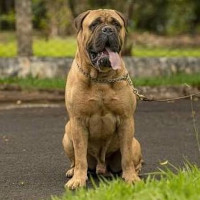
| Compact in build for its size, with great physical strength, robust, active, elegant, medium-sized, and well-proportioned, it exudes an impression of power. The breed should exhibit variations between the "Bulldog" and "Mastiff" styles, preferably with lighter dams and heavier sires. |
Behaviour / temperament |
| A born guardian. An intelligent and docile dog with family members. It must demonstrate extreme courage and submit to its owner's authority. It should be friendly with other animals and dogs, but fearless when provoked or on command. This breed enjoys the company of the whole family, especially children, but is rather solitary, particularly when its owner is away. As a guard dog, its role is to protect the family; as a herding dog, it performs various functions on farms, notably gathering cattle in the corral without biting or knocking them over. It must be extremely agile and intelligent to defend the flock against potential predators. |
Head |
||
Cranial region |
||
Head |
The head should be heavy, broad, and robust. This is the most striking morphological characteristic of the breed. The length of the muzzle should not be equal to that of the skull; it should be slightly shorter, without exaggeration. The ideal head is between the "bulldog" and "mastiff" types. | |
Facial region |
||
Nose |
Black, or preferably red, the same color as the coat. | |
Jaws and teeth |
A strong, powerful jaw is desirable. Strong teeth are typical of the breed and should be a primary criterion in the selection of breeding stock. | |
Eyes |
Oval or almond-shaped, possibly slightly round, a color close to that of the coat. | |
Ears |
Medium-sized, drooping, with thick skin. Viewed from the front, the dog presents a closed "V" shape when alert, broad at the base and forming a triangle in the middle. The ears should be aligned with the eyes, without being excessively pointed upwards or downwards. | |
Neck |
| Thick, strong, with dewlaps. |
Body |
Tail |
| The tail should be set low to mid-height. When the dog is alert, the tail tends to rise. Medium set. |
Limbs |
Forequarters |
||
Generality |
The shoulders and forelegs should be visibly muscular and powerful, as should the chest. The legs should be large and proportionate to the size of the dog. Legs with splayed or misaligned toes are a serious fault. | |
Hindquarters |
||
Generality |
The hindquarters, particularly the loin, should be well-muscled; the legs are well-formed and sturdy. Correct angulation of the hips and hocks. Strong, rounded croup. | |
Gait and movement |
| The gallop is fast and smooth, allowing the dog to work with livestock or hunt rodents. The trot should be fluid, elegant, and charming. |
Skin |
| The dog may have excess skin, but not excessively, with wrinkles on the face and dewlaps. |
Coat |
||
Hair |
Short hair. | |
Colour |
All variations of brindle, black, red, fawn, and white are accepted. | |
Size and weight |
||
Height at withers |
Ideally 60 cm, but this can vary: taller in males and shorter in females. | |
Weight |
Ideally 50 kg, but this can vary: heavier in males and lighter in females. | |
Faults |
| • Any departure from the foregoing points should be considered a fault and the seriousness with which the fault should be regarded should be in exact proportion to its degree and its effect upon the health and welfare of the dog and its ability to perform its traditional work. • Faults listed should be in degree of seriousness. |
NB : |
| • Any dog clearly showing physical or behavioural abnormalities shall be disqualified. • The above mentioned faults when occurring to a highly marked degree or frequently are disqualifying. • Male animals should have two apparently normal testicles fully descended into the scrotum. • Only functionally and clinically healthy dogs, with breed typical conformation should be used for breeding. |



 English (United Kingdom)

Comments