
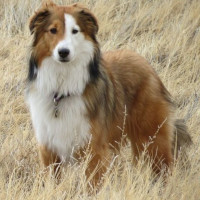
 |
Shel-Aussie |
|
He is not recognized by the F.C.I. |
Origin |
Great Britain <> U.S.A. -> U.S.A. | |
Translation |
Francis Vandersteen |
A brief presentation of the Shel-Aussie |
| The Shel-Aussie is a magnificent mixed-breed dog resulting from the mating of an Australian Shepherd with a Shetland Sheepdog. Both parent breeds are colorful, with thick coats that need weekly brushing. They also need to exercise for 30 to 60 minutes a day. They adapt fairly well to all climates, although they don't like extreme heat. They can live in apartments, provided they get enough exercise. This breed gets on well with people of all ages and all other types of pets, although you should bear in mind that these dogs are descended from sheepdogs and may try to herd smaller animals. |
History of the Shel-Aussie |
| The Shel-Aussie is a hybrid dog resulting from the mating of an Australian Shepherd with a Shetland Sheepdog. Consequently, the breed's history begins with these related breeds. |
A little of the Shetland Sheepdog |
||
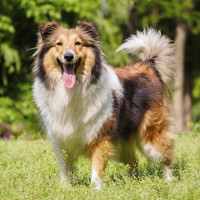
| Shetland Sheepdogs were developed on the Shetland Islands, which lie off the Scottish mainland. When fishing boats began to visit regularly in the 1700s, new breeds of dog were introduced to the islands. These included the black and tan King Charles Spaniel, Spitz-type dogs from Scandinavia, Yakki dogs from Greenland and other sheepdogs from Scotland. These dogs were then crossed with island dogs to create the Shetland Sheepdog. These little dogs began to gain popularity as pets in the 19th century, after British sailors visiting the islands bought them to take home. | ||
 |
||
| Standard of the Shetland Sheepdog |
A little of the Australian Sheepdog |
| The Australian Sheepdog most probably originated in the Basque region of the Pyrenees, between France and Spain. Although not native to Australia, the breed got its name from its association with American shepherds who came to North America from Australia in the 1800s. Pyrenean Mountain Dogs are thought to have been crossed with various types of Collies while in Australia, and then brought to the USA with flocks of sheep in the mid-to-late 19th century. This breed was often used to herd large groups of sheep and cattle, which it excelled at, especially in confined spaces. The breed's popularity grew in tandem with Western equitation after the Second World War. They were often seen in rodeos, horse shows, films and television programs. |
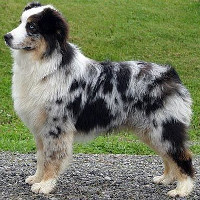 |
| Standard of the Australian Sheepdog |
Appearance of the Shel-Aussie |
| The Shel-Aussie's appearance is a cross between the Shetland Sheepdog and the Australian Sheepdog. Shetland Sheepdogs have extremely thick, beautiful coats. Their head is long and wedge-shaped, with a narrow, rounded muzzle. Its teeth meet in a scissor shape and its nose is black. Its eyes are dark, almond-shaped, and its little ears are generally upright and set high on the head. The tail is fairly long, reaching to the hock. Shetland Sheepdogs have light but muscular bodies. The Australian Shepherd Dog is an agile breed whose body is slightly longer than it is tall. They have hanging ears and, unlike the Shetland Sheepdog, a very short tail. These dogs stand well with a deep chest. Their head is about as long as their muzzle, which tapers slightly. Their eyes are medium-sized and oval-shaped, and can sometimes be different colors. Its ears are also set high, triangular and erect. The Shel-Aussie hybrid generally adopts the harsh, coarse coat of the Shetland Sheepdog, and is usually straight. The coat colors of both parents are similar. In addition, your Shel-Aussie may or may not have a tail, and may have different eye colors. |
Temperament of the Shel-Aussie |
| The intelligent Shel-Aussie is a breed that takes its fun-loving personality from both the Australian Shepherd and the Shetland Sheepdog. They are eager to please their owners and should be easy to train. Because they are alert, they make good watchdogs. The Shel-Aussie is also an excellent pet, as it is very loyal. Although they get on well with people and are also friendly with pets, they may not be the best choice for homes with small animals, as they have a strong herding instinct. This breed is lively and playful, making it a good choice for owners who are also active and would like a jogging or hiking companion. It is not always pleasant with children. This breed, like all others, needs to be well socialized and obedience-trained as a puppy. Introduce him to new people, places and animals while he's still young, to teach him how to behave around unfamiliar things. |
Needs and activities of the Shel-Aussie |
| This designer dog is quite active and loves to take part in all kinds of activities, including playing ball and going to the pool. It needs to be walked every day and given time to play and run freely in an enclosed space. This breed doesn't do so well in hot climates and shouldn't be overworked in hot weather. As the Shel-Aussie has a very high level of intelligence, it needs to be stimulated mentally and physically and will appreciate activities such as agility training and field trials. The recommended amount of exercise for the Shetland Sheepdog and Australian Sheepdog is 30 to 60 minutes a day. |
Maintenance of the Shel-Aussie |
| As the Shel-Aussie generally has a coat similar to that of its Shetland Sheepdog parent, it's likely to have the same grooming needs. This means you'll need to brush your dog at least once a week with a bristle brush. During the moulting period, he should be brushed daily. Brushing can be a little tricky, as you need to use a spray bottle to wet the fur before brushing, and you need to get right down to the skin. Water is important, as brushing these dry-coated dogs can damage their fur. You need to pay particular attention to the fur behind the ears and on the armpits, as these areas are prone to knots. They don't need frequent baths, as their coat is resistant to water and dirt. They don't need regular baths, as they're generally quite clean. Like all dogs, Shel-Aussies need their teeth brushed at least three times a week, their nails trimmed once or twice a month and the inside of their ears cleaned once a week. |



 English (United Kingdom)

Comments