 |
Scotchon |
|
He is not recognized by the F.C.I. |
Origin |
Scotland <> France / Belgium -> U.S.A. | |
Translation |
Francis Vandersteen |
A brief presentation of the Scotchon |
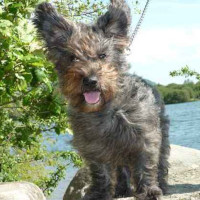
| The Scotchon is a cross between a Scottish Terrier and a Bichon frise. It's a small dog with floppy ears and lots of fur, usually curly. The coat can be black, gray, light brown or a combination of these colors. The Scotchon is a very playful, energetic dog; it's affectionate, friendly and intelligent, making it an excellent companion. He needs a good dose of activity for good health and to soothe his high energy levels. |
History of the Scotchon |
| The Scotchon originated in the United States. The breed is the result of crossing a Scottish Terrier with a Bichon frise. |
A little of the Scottish Terrier |
||
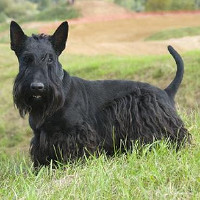
| The history of the Scottish Terrier dates back to 55 BC, when the Romans discovered the “terrarii” or ancient Scottish Terrier, a small hunting dog found in Britain. It was black or sandy in color, small, strong and long-haired, and it is thought that all Terriers originated from this breed. In the 17th century, the ancestor of the Scottish Terrier became a very popular breed, thanks to the love of the king. By 1800, there were two different breeds, the rough-coated Scottish Terrier and the smoother-coated English Terrier. The Scottish Terrier, formerly classified as the Skye Terrier, was recognized by the American Kennel Club in 1885, although it wasn't shown until the 1860s. | ||
 |
||
| Standard of the Scottish Terrier |
A little of the Bichon frise |
| The origins of the Bichon frise are uncertain. It is thought to be descended from the Barbet. The breed originated in Tenerife and was introduced to Europe by the French or Italians. The Bichon frise became very popular in the 16th century in the French and English monarchies. Spanish royalty came to appreciate the breed, as did painters such as Goya, who depicted the Bichon frise in several of his paintings. The breed went on to become a common dog, but after the First World War, the Bichon frise attracted the attention of French breeders because of its intelligence and appearance, and they continued to breed the Bichon frise. The breed was recognized by the American Kennel Club in 1972. |
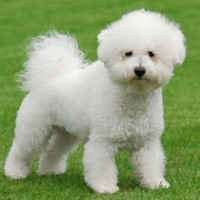 |
| Standard of the Bichon frise |
Appearance of the Scotchon |
| Since both parent breeds have a dense, double-coated coat, the Scotchon will inherit these characteristics. This breed has a thick, abundant coat, usually curly, and is also hypoallergenic. Like the Scottish Terrier, the Scotchon is sometimes wire-haired. Its coat can be black, gray, brown, gold or a combination of these colors, such as black and white. The Scotchon is a small but strong dog with floppy ears, a black nose and dark eyes. In general, these dogs have longer hind legs, shorter front legs, broad shoulders and a tail curled over their back, especially when they're happy. They have a sturdy, medium-sized head and a narrow muzzle. |
Temperament of the Scotchon |
| The Scotchon's personality lies somewhere between that of the Scottish Terrier and the Bichon frise. They are family dogs; they like to be with their families in an indoor environment, playing and going for walks. They are highly intelligent, energetic, friendly and generally easy to train. They tend to be friendly with other dogs, but early socialization is recommended as their parent breed, the Scottish Terrier, can have a bit of a temper. The Scotchon is affectionate but not overly so, and is also somewhat independent. These dogs can bark at anything, and their bark is generally powerful. This hybrid may inherit the hunting instinct of the Scottish Terrier or the shy personality of the Bichon frise. |
Needs and activities of the Scotchon |
| The two related breeds, the Scottish Terrier and the Bichon frise, are active dogs that like to go for walks and play every day. A 20-minute walk twice a day is just the thing for your Scotchon to get some fresh air and expend some energy. These dogs can become destructive when they're bored and have a lot of energy built up. Running isn't easy for them as they have short legs, but they'll enjoy interacting with other dogs at the park - it'll also give them a chance to practice their social skills. They are well suited to apartment living and, because of their dense coat, moderate to cool temperatures suit them best. The Scotchon is a companion dog, so it needs to live indoors with its family. |
Maintenance of the Scotchon |
| Like its two parent breeds, the Scotchon has a dense, double-layered coat. It doesn't shed much, but needs to be combed and groomed frequently. Weekly brushing is recommended to remove any tangles or matting, and to help maintain healthy skin. Their skin can be delicate, so bathing them too often is not recommended, as it can cause irritation. It's very important to remove tangles before bathing, otherwise it could be too difficult to remove them afterwards. We recommend clipping every two months to keep the coat short and elegant. If long hair is desired, it's best to trim several times a year. These dogs can have a bad reaction to fleas, so prevention is very important. What's more, like the Bichon frise, the Scotchon can suffer from allergies, so you need to be careful about the products you use on its skin. |



 English (United Kingdom)

Comments