Schnekingese

He is not recognized by the F.C.I.

Origin
Germany <> China -> U.S.A.
Translation
Francis Vandersteen

A brief presentation of the Schnekingese

The Schnekingese is a hybrid of the Miniature Schnauzer and the Pekingese. Although the place and date of origin of the hybrid are unknown, the history of the parent breeds is quite interesting, being rooted in elders, legends and wars. By choosing to educate yourself on these stories, you'll get an interesting read, to say the least, and a sincere appreciation of the race's parents and the hybrid. The two parent breeds have been combined, resulting in a feisty, courageous and loyal pet that longs to be with its human family members at all times.

History of the Schnekingese

The Schnekingese is a hybrid of the Miniature Schnauzer and the Pekingese. There is very little historical information available on the hybrid, including no place or approximate date of origin. On the other hand, there is a wealth of information on related breeds, whose history is very interesting, involving elders, legends and wars. The Schnekingese hybrid itself is recognized by these organizations: American Canine Hybrid Club, Designer Breed Registry, Designer Dogs Kennel Club, Dog Registry of America and International Designer Canine Registry.


A little of the Miniature Schnauzer

        
The Miniature Schnauzer is a breed that, as its name suggests, originated in Germany, with the origins of the Schnauzer-type dog dating back to at least the 1400s, when the breed was used to hunt and kill rats and other vermin found on German farms for many centuries. This size of Schnauzer is the most popular of the three sizes - Giant, Standard and Miniature - and shares the anti-dandruff and hypoallergenic characteristics of the larger versions of the breed. The Miniature Schnauzer is thought to be descended from the Affenpinscher, Poodle, Miniature Pinscher, Wire Fox Terrier and Zwergspitz. Although Miniature Schnauzers are depicted in photos dating back to the 1400s, the breed itself was not recognized until the late 1800s. The Miniature Schnauzer arrived in North America around 1924 and, after surviving two world wars, was officially recognized by the American Kennel Club in 1926. The breed continues to grow in popularity, becoming one of the most popular breeds in the United States.
Standard of the Miniature Schnauzer


A little of the Pekingese

The Pekinese parent breed originated in China, the earliest known record of a Pekinese-like canine having been found as early as the 8th century. The story of the Pekingese breed is even more interesting, as it is rooted in an ancient legend. Legend has it that a lion fell in love with a marmoset? a species of monkey? and asked a god to shrink him so that they could be together, while wishing to retain his big lion's heart and courageous character. The god granted his request and is said to have created the dogs known as "lion-dogs". So much for the legend, and here are the real facts: the origins of this little breed have been traced back to the Tang dynasty in China, in the 8th century. The Pekingese seems to have been cherished and appreciated as a companion only, with no real working activity. Considered sacred by the Chinese, they allowed only royalty to own this breed, making it illegal to own one - stealing a Pekingese, named after Beijing, the capital of China at the time, was a death sentence. Imperial families pampered these cuddly lovebirds and kept the bloodlines pure, favoring a breed that has changed little over the centuries. The Pekingese remains a regal, feisty and independent dog breed that was recognized by the American Kennel Club in 1906.
Standard of the Pekingese

Appearance of the Schnekingese

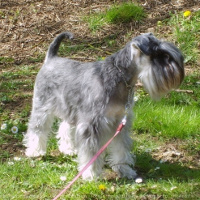
The Schnekingese hybrid can take on the appearance of one or both of the breed's parents. It is considered a small dog, measuring 25.5 to 35.5 centimeters and weighing 4.5 to 9 kilos. Depending on which parent breed has the most influence in the biological mix, its coat may be short or long, or rough with a dense undercoat, the most common colors being black, brown, tan and white. Its eyes are dark, small or large, its nose is black and its ears are floppy. They are solidly built, with great vitality and energy. Its tail can vary in length, again depending on the dominant breed in the biological mix. As only the Miniature Schnauzer is considered hypoallergenic, it may or may not inherit this characteristic.

Temperament of the Schnekingese

Your Schnekingese hybrid is a mix of Miniature Schnauzer and Pekinese and, as such, may inherit temperament qualities from one or both parent breeds. It is described as affectionate, lively, loving and energetic. It's important to note that your Schnekingese hybrid, like almost all other dog breeds, needs to be properly socialized from an early age to ensure it gets on well with children and other animals. He will naturally get along with adults, but proper socialization is necessary with children as they tend to play with them in a less respectful manner. It's also very important that you teach your children the proper ways to touch and play with your pets. As he has a strong prey drive, you should expect him to be only moderately tolerant of other animals, supervision being recommended in this case. Although your hybrid is a barker, don't expect him to be alert enough to be an effective guard dog. Your Schnekingese is a smarter-than-average dog, but he can be easily distracted from the task at hand, making him moderately easy to train. Try to make your training sessions interesting to hold his attention, using treats as rewards, remaining positive and firm but encouraging. Progress is likely to be gradual, but not as slow as with other breeds. He is considered a lively, moderately active dog.

Needs and activities of the Schnekingese

Your Schnekingese hybrid is a lively, moderately active little dog. He'll love taking a few long walks with you each day as part of his daily regimen. Playtime in the dog park or fenced-in yard fits perfectly into his exercise routine. He'll also enjoy playing interactive games such as fetch, frisbee, fly ball and obedience exercises. As he has a strong propensity for hunting, it's imperative that you keep him on a leash when he's outside the house or other enclosed space, unless you like to chase him through the neighborhood brambles in search of a small animal or an interesting scent. As a small dog, he will adapt very well to an apartment or condo, provided his exercise needs are met on a daily basis. He's also at home in a family home with or without a fenced yard, in an urban or rural setting. A moderate climate will suit him best. Depending on the parent breed that influences its coat, it may need extra protection in warmer or colder temperatures.

Maintenance of the Schnekingese

Your Schnekingese hybrid falls into the low-to-moderate maintenance category. Its coat may or may not be hypoallergenic, as only the Miniature Schnauzer brings this characteristic to the organic mix, and it falls into the low to moderate shedding categories. Depending on the length and thickness of its coat, whether the Pekingese's long coat or the Schnauzer's short, hard coat, it should be brushed once or twice a week for short coats and daily for long coats. Brushing removes loose hairs, debris, knots and tangles, and distributes the oils throughout the coat. Bathing should only be done when necessary, not on schedule, as frequent shampooing can dry out the skin and coat. Check his ears once a week and clean them if necessary, using a cotton ball and an approved canine earwash solution. While you're checking his ears, it's a good time to take a look at his toenails, trimming them if necessary, unless they've been worn down by physical activity. Like all canine breeds, we recommend brushing your Schnekingese hybrid's teeth at least two to three times a week, but daily brushing is optimal. What's more, your Schnekingese hybrid falls into the low-slobber, low-smell category.

Comments

Latest page updates

  • Telomian

    Telomian He is not recognized by the F.C.I. Origin Malaysia Translation Francis Vandersteen A brief presentation of the Telomian The Telomian is a very rare breed of dog, and the only one native to Malaysia to have been bred outside the country. They were originally bred by the indigenous people of Malaysia to combat parasites such as snakes, rats,...
  • King Wheaten -- Cavalier King Charles Spaniel X Irish Soft Coated Wheaten Terrier

    King Wheaten He is not recognized by the F.C.I. Origin Great Britain <> Ireland -> U.S.A. Translation Francis Vandersteen A brief presentation of the King Wheaten The King Wheaten is a small dog with a heart this big and a playful disposition. Borrowing the energy and soft-coated waves of the Irish Soft Coated Wheaten Terrier and the size and...
  • Spanierd -- English Springer Spaniel X German Shepherd

    Spanierd He is not recognized by the F.C.I. Origin Great Britain <> Germany -> U.S.A. Translation Francis Vandersteen A brief presentation of the Spanierd The Spanierd is a hybrid dog. Its parent breeds are the English Springer Spaniel and the German Shepherd. They have an affable personality. He's known for entertaining family and friends with his...
  • Alaskan Goldenmute -- Alaskan Malamute X Golden Retriever

    Alaskan Goldenmute He is not recognized by the F.C.I. Origin U.S.A. <> Great Britain -> U.S.A. Translation Francis Vandersteen This breed is also known as Alaskan GoldenGoldenmuteAlaskan Gold Retriever     A brief presentation of the Alaskan Goldenmute The Alaskan Goldenmute is a descendant of two great dog breeds: the Alaskan Malamute and the Golden...
  • French pointing dog Pyrenean type

    French pointing dog Pyrenean type FCI standard Nº 134 Origin France Translation Mrs. Peggy Davis Group Group 7 Pointing Dogs Section Section 1.1 Continental Pointing Dogs « Braque » Type Working With working trial Acceptance on a definitive basis by the FCI Tuesday 18 January 1955 Publication of the official valid standard Tuesday 01 August 2023 Last...
  • French pointing dog Gascogne type

    French pointing dog Gascogne type FCI standard Nº 133 Origin France Translation Mrs. Peggy Davis Group Group 7 Pointing Dogs Section Section 1.1 Continental Pointing Dogs « Braque » Type Working With working trial Acceptance on a definitive basis by the FCI Monday 17 January 1955 Publication of the official valid standard Tuesday 01 August 2023 Last...
  • Vucciriscu

    Vucciriscu He is not recognized by the F.C.I. Origin Sicily Translation Francis Vandersteen En français, cette race se dit Vucciriscu Diese Norm ist in deutscher Sprache sichtbar Vucciriscu En español, esta raza se dice Vucciriscu In het Nederlands, wordt dit ras gezegd Vucciriscu This breed is also known as Sicilian Vucciriscu Sicilian Butcher...

© 2026 Groupe Milouchouchou ASBL. Tous droits réservés. En savoir plus

Protected by Copyright01
We use cookies

We use cookies on our website. Some of them are essential for the operation of the site, while others help us to improve this site and the user experience (tracking cookies). You can decide for yourself whether you want to allow cookies or not. Please note that if you reject them, you may not be able to use all the functionalities of the site.

Ok