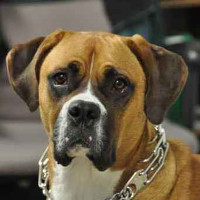
 |
Saint Berxer |
|
He is not recognized by the F.C.I. |
Origin |
Switzerland <> Germany -> U.S.A. | |
Translation |
Francis Vandersteen |
A brief presentation of the Saint Berxer |
| The Saint Berxer snores and drools, but is a gentle, affectionate dog that makes an excellent pet. They are designer dogs and are a cross between a pure-bred St. Bernard and a pure-bred Boxer. They are good with children and protect their family without being aggressive. They are intelligent, responsive dogs that are ideal for new dog owners. Early training and socialization will ensure that they are comfortable with other dogs. Common colors are brown or fawn with white markings, and they often have a black outline around the eyes. They have a short, thick coat and are known to shed moderately, but don't require much maintenance. |
History of the Saint Berxer |
| The Saint Berxer is a combination of a pure-bred St. Bernard and a pure-bred Boxer, both belonging to the Molosser group of dogs. |
A little of the St. Bernardshund |
||
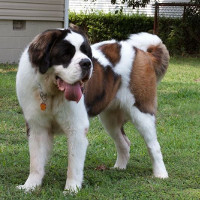
| The St. Bernard - also known as the Alpine Mastiff, Bernhardiner and St. Bernhard - is best known for its work in alpine rescue and for its imposing size. As far back as the early 18th century, monks living on the St. Bernard Pass - a route across the Alps between Italy and Switzerland - bred these dogs to help rescue travelers trapped in the snow. Their excellent sense of smell enabled them to locate people trapped under the snow, and the dogs would lie on top of them to keep them warm. They would travel in pairs, and the other dog would seek out one of the monks to help him after locating the victim. They are often depicted with a barrel of brandy around their necks to revive these travelers, but this is not true. The barrel was incorporated into a painting of the dogs by Edwin Landseer and the image has stuck. One of the most famous search and rescue dogs, owned by the monks of the St. Bernard Hospice, was called Barry and is thought to have saved between 40 and 100 people. At one point, the monks crossed St. Bernard Dogs with Newfoundland Dogs, thinking the longer hair would be beneficial. But it turned out that the opposite was true, and that the long hair froze in the snow, so the breed was abandoned. In 1880, they were officially named Chien du St. Bernard by the Swiss Kennel Club, and the Saint Bernard Club of America was founded in 1888. | ||
 |
||
| Standard of the St. Bernardshund |
A little of the Boxer |
| The Boxer was developed in Germany in the 19th century. Its ancestors included the Bullenbeisser (now extinct), which hunted wild boar and deer, and the Bulldog. In 1895, the first Boxer club was founded in Germany, the Deutscher Boxer Club. It drew up the breed standard in 1904. During the First World War, Boxers were used as messengers and guard dogs, helping to locate wounded soldiers. They were noticed by American soldiers and many ended up in the United States. They were recognized by the American Kennel Club in 1935. Boxers take around three years to reach maturity, and remain puppy-like and playful for a good three years before reaching adulthood. |
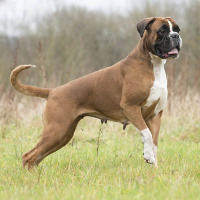 |
| Standard of the Boxer |
Appearance of the Saint Berxer |
| The Saint Berxer is a large but gentle dog weighing up to 55 kilos and measuring up to 66 centimeters. Common colors are brown or fawn with white markings, and they often have black markings around the eyes. Their coats are short and thick, and they have big heads and noses. The Saint Berxer has soft brown or hazel eyes and small ears set high on its head. They are generally slender like Boxers, but have broad chests and thick necks. It is known for its large legs and thick, fluffy tail. With a black nose and brown or black lips, its teeth may meet in a scissor bite or have the characteristic Boxer underbite. |
Temperament of the Saint Berxer |
| Although a large dog, the Saint Berxer is gentle and kind, making it an asset to any family. These dogs are playful and energetic, and get on well with children. Because of their size, however, they need to be supervised to avoid injury. Young children should be taught from an early age to respect and interact with animals. The Saint Berxer is intelligent and will be easy to train, even for novice dog owners. Early socialization is a good idea to ensure that he gets on well with other dogs. He's likely to be wary of strangers, but he's not an aggressive dog and will warm up to people once introduced. They are alert and make good watchdogs. These dogs don't like to be left alone for long periods, so are suitable for people who work from home or have at least one member at home during the day. They are energetic dogs that need daily exercise. |
Needs and activities of the Saint Berxer |
| Saint Berxers are active, energetic dogs that need daily exercise to burn off excess energy. They are very playful and can spend hours romping with children. As adults, they can go for long walks and hikes, and will enjoy trips to the beach or the dog park. Because of its size, the Saint-Berxer is not suitable for apartment dwellers. He needs space to run around, and is best suited to those with a fenced-in yard. It is sensitive to heat and cold. So make sure that exercise or play sessions don't take place in the middle of the day in summer, and don't leave it outside for too long in winter. |
Maintenance of the Saint Berxer |
| The Saint Berxer sheds quite a lot, so it needs regular brushing to remove loose hair and keep a beautiful coat. These dogs are notorious for drooling a lot and bringing in mud and dirt. Weekly brushing should be enough to keep this phenomenon under control. Although they do get dirty, don't bathe your dog too often, as this can strip the coat of its natural oils and dry it out. Try to get your dog into the habit of brushing his teeth every day, starting when he's a puppy. Check the ears regularly and, if necessary, remove any dirt and gently wipe the ear with absorbent cotton. Nails are likely to wear naturally, but if necessary, trim them. |



 English (United Kingdom)

Comments