
 |
Saint Bermastiff |
|
He is not recognized by the F.C.I. |
Origin |
Switzerland <> Great Britain -> U.S.A. | |
Translation |
Francis Vandersteen |
A brief presentation of the Saint Bermastiff |
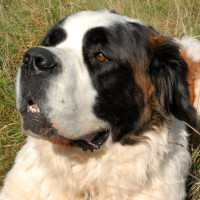
| A large dog, the Saint Bermastiff is a cross between the adorable St. Bernard and the majestic Mastiff, and is also known as the Saint Mastiff. A dog of this hybrid will be easy-going and affectionate towards its humans, with a desire to please them. You'll find the Saint-Bermastiff curious and sometimes lazy, appreciating an opportunity to rest and relax. This hybrid is generally intelligent and will easily understand commands. The Saint Bermastiff is generally kind to children and will enjoy playing with them and loving them. Daily exercise will be important for your Saint Bermastiff to maintain its physical and emotional health. |
History of the Saint Bermastiff |
| The Saint Bermastiff is a relatively recent hybrid, although the two breeds that make it up have a long history. |
A little of the St. Bernard |
||
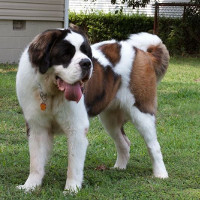
| The St. Bernard is thought to be the result of crossing dogs from the Alps with Mastiffs brought over by the Roman army during the reign of Emperor Augustus. Bernard de Menthon and a few monks created the breed; the dogs were then used by a Swiss hospice to help people crossing the Alpine pass between the countries of Switzerland and Italy. The breed became a popular choice for rescue work in the 17th century because they had the ability to sense a person who was buried under a lot of snow in an avalanche. Because of their ability to hear low-frequency sounds, the dogs were found to be able to predict storms and avalanches. | ||
 |
||
| Standard of the St. Bernard |
A little of the Mastiff |
| The Mastiff is a descendant of the Molossus family and is thought to have been brought to the British Isles on Phoenician trading ships somewhere between 2000 and 1500 B.C. These dogs were isolated on an island and bred to protect the tribes who lived on the islands for hundreds of years. During the Roman invasion in 55 BC, Mastiffs took part in the resistance against Rome. Julius Caesar was impressed by the breed's size and courage, and brought them to Rome to fight lions and gladiators. Over the centuries, the Mastiff continued to play its role as protector and guardian, but also participated in bull and bear baiting and pit fighting. The modern Mastiff is a descendant of these dogs as well as of the Lyme Hall Mastiffs. The foundation of Lyme Hall Mastiffs and future English Mastiffs was the dog of Sir Peers Legh, who was mortally wounded in battle on October 23, 1415 in northern France. His Mastiff defended him for hours during the battle and returned home with a litter of puppies. The Mastiff was eventually bred selectively to minimize problematic qualities, creating a large, docile dog that was recognized by the American Kennel Club in 1885. |
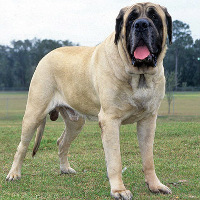 |
| Standard of the Mastiff |
Appearance of the Saint Bermastiff |
| The Saint Bermastiff inherits traits from both its parent breeds. As with all mixed breeds, you can expect him to inherit more physical characteristics from either parent breed, or a relatively equal combination of traits from each. Typically, the Saint Bermastiff is large in size, with a short to moderately long, soft, downy coat, and often feathers on the legs. The Saint Bermastiff's head will be broad, with a square face, large ears and a short muzzle. Its lips and nose are black. The hybrid's tail will frequently be thick and broad close to the body, tapering to its full length. The Saint Bermastiff's body will appear short and thick with a broad, deep chest. His eyes are dark and round, with an expression of kindness and understanding. |
Temperament of the Saint Bermastiff |
| The Saint Bermastiff inherits behavioral traits from its parents, the St. Bernard and Mastiff. The hybrid will be easy-going and affectionate, with a desire to please its humans. The Saint Bermastiff is unlikely to bark much, and sometimes prefers to be lazy. Both parent breeds are loyal to their humans, and this can be expected of the hybrid too. The St. Bernard and Mastiff are gentle dogs despite their large size, and both are protective of their humans; this will probably be the case in their offspring. As both breeds are patient and good with children, the hybrid should be too. Because of their size, interactions with small children should be monitored. Neither breed is aggressive, but because of their size, they could inadvertently hurt someone small. Although the hybrid is affectionate with its family, it will be wary of strangers and will probably need to be socialized from an early age in order to interact well with other animals. |
Needs and activities of the Saint Bermastiff |
| The Saint Bermastiff's activity requirements vary according to the dog and the characteristics it has inherited from its parents. The Saint Bermastiff is often active, requiring regular exercise. A hybrid dog can live in an apartment, provided it takes short daily walks or has access to a small yard where it can be active. The Saint Bermastiff will cope well with cold temperatures, but will probably struggle in particularly hot weather. When it's hot, it's important to give your Saint Bermastiff plenty of water and make sure it has access to shade. |
Maintenance of the Saint Bermastiff |
| Your Saint Bermastiff care will depend on the coat it inherits. If he inherits the smooth or rough coat of the St. Bernard, grooming will be relatively easy. Brush his coat with a stiff bristle brush every week to prevent shedding, and give him a bath if necessary with a mild soap designed for dogs. If the hybrid inherits the Mastiff's short coat, you'll need to brush it weekly and remove dead and loose hairs, especially during its two moulting seasons. The hybrid can inherit the Mastiff's increased oil production, which can lead to odor and the need for regular bathing, but you'll need to be careful not to remove the necessary oils. Regular brushing will help distribute the oils evenly. Regular ear cleaning is helpful to avoid infection and, as with all dogs, his teeth should be brushed every one to two weeks to ensure long-term dental health. Hybrids can be prone to bloat, so it's best to feed them two or three times a day rather than just one large meal. |



 English (United Kingdom)

Comments