 |
Rhodesian Bernard |
|
He is not recognized by the F.C.I. |
Origin |
Southern Africa <> Switzerland -> U.S.A. | |
Translation |
Francis Vandersteen |
A brief presentation of the Rhodesian Bernard |
| A large dog with an average weight of 41 to 59 kilos, the Rhodesian Bernard is a cross between a Rhodesian Ridgeback and a St. Bernard. Both parent breeds are intelligent, loyal, gentle and kind, but as both can sometimes be stubborn, training should start very early. Fortunately, both breeds want to please their humans, which will come in handy during training. Whichever coat the Rhodesian Bernard inherits, maintenance will not be difficult. As both parent breeds do well with children, the hybrid probably will too, although due to the dog's likely size, supervision in the presence of young children is important. |
History of the Rhodesian Bernard |
| The Rhodesian Bernard is a relatively new hybrid, although the two breeds that make up the hybrid have a long history. |
A little of the Rhodesian Ridgeback |
||
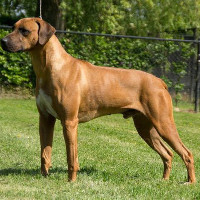
| European dogs such as Great Danes, Mastiffs, Bloodhounds, Pointers, Greyhounds, Terriers and many others were brought with the Dutch Boers when they settled in South Africa from the 16th to the 18th century. In the 18th century, the Boers realized that the dogs they used for hunting and guarding were not well adapted to the extreme temperatures that were occurring. Looking for a dog that would do well in such conditions, they bred European dogs and brought them along with a dog that was common among the nearby Hottentot or Khoikhoi tribes and had a distinctive ridge of fur along its spine. The dogs that were developed had the short coat and crest of the tribal dog. These dogs were good at hunting by sign and scent, and worked as protectors and hunters. These dogs were brought with the Dutch in the 1800s when they moved north to escape British rule, settling in Zimbabwe, which they called Rhodesia. There, the dogs were used to hunt lions. The breed was brought to London in the 1930s, then to America, where it was admitted to the American Kennel Club in 1955. | ||
 |
||
| Standard of the Rhodesian Ridgeback |
A little of the St. Bernard Dog |
| The St. Bernard Dog is thought to be the result of dogs from the Alps crossed with Mastiffs like dogs that were brought over by the Roman army during the reign of Emperor Augustus. The name "St. Bernard" comes from the breed's founder, Saint Bernard de Menthon, and the monks who were part of his establishment. Dogs of the breed were used by the Swiss Hospice St. Bernard to help travelers crossing the dangerous Alpine pass between Switzerland and Italy. Early St. Bernard dogs were short-haired and by the mid-1600s, the breed was the first choice for rescue work, as they could smell a person who had been buried by snow from an avalanche. It has been said that the St. Bernard can predict storms and avalanches thanks to its ability to hear very low-frequency sounds. |
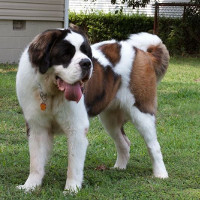 |
| Standard of the St. Bernard Dog |
Appearance of the Rhodesian Bernard |
| The Rhodesian Bernard will inherit traits from both its parent breeds. As with all mixed breeds, you can anticipate that it may inherit more physical characteristics from either parent breed, or a relatively equal combination of traits from each. Based on the size of its parent breeds, the Rhodesian Bernard will be a large dog with strong legs. The Rhodesian Ridgeback has a ridge of hair along the spine in the opposite direction to the rest of the coat, which may be inherited by the hybrid. The Rhodesian Ridgeback's coat is short and dense, while the St. Bernard can have a rough or smooth coat, either of which is dense, traits that can be passed on to the hybrid. If the rough coat is passed on, the hair will be longer than in the case of the smooth coat. The Rhodesian Ridgeback has a medium-length head, flat skull and long muzzle. The St. Bernard has a very large head and short muzzle, and the Rhodesian Bernard may inherit one or a combination of these traits from its parent breeds. |
Temperament of the Rhodesian Bernard |
| The Rhodesian Bernard will inherit its behavioral traits from its parent breeds, the Rhodesian Ridgeback and the St. Bernard. Both breeds are intelligent, loyal, gentle and kind, despite their large size. Each of the parent breeds can be stubborn, so hybrid training needs to start when it's young, otherwise some Dorsal Crested Rhodesian Dogs could cause problems and the size of the St. Bernard Dog means it could unintentionally cause damage without training. The Rhodesian Ridgeback is described as even-tempered and although wary of strangers, it will be affectionate with its humans. The Rhodesian Bernard is likely to do well with children, although small children should be supervised due to the breed's size. As both parent breeds seek to please their humans, the hybrid probably will too. |
Needs and activities of the Rhodesian Bernard |
| The Rhodesian Bernard's activity requirements vary from dog to dog. The Rhodesian Ridgeback is a strong, athletic breed that will require a great deal of exercise. It will benefit from daily walks or runs and will enjoy playing games with its humans. A dog of this breed can be a hunter, a show dog and a successful competitor in dog sports and trials. The St. Bernard doesn't require much activity, and if your dog inherits the coat of his St. Bernard parent, he could easily overheat, so it's important that he doesn't exert much energy in particularly hot weather. He will, however, enjoy spending time in the snow. |
Maintenance of the Rhodesian Bernard |
| Your Rhodesian Bernard's care will depend on the coat it inherits. Little grooming will be needed if your dog inherits a coat similar to that of the Rhodesian Ridgeback, brushing his coat once or twice a week will be sufficient. A shedding tool will be useful, especially during periods of excessive shedding. If your dog inherits the smooth or rough coat of the St. Bernard, grooming will also be easy, requiring regular brushing with a firm bristle brush. Whatever coat your dog inherits, bathing should take place occasionally. Your Rhodesian Bernard's ears should be cleaned and dried regularly to prevent infection and catch it early if it does occur. Your dog's nails should be trimmed as needed and his teeth brushed two or three times a week to maintain healthy teeth and gums. |



 English (United Kingdom)

Comments