
 |
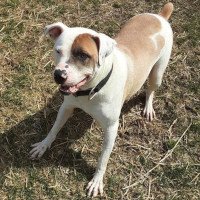
Pyrenees Pit |
|
He is not recognized by the F.C.I. |
Origin |
France <> U.S.A. -> U.S.A. | |
Translation |
Francis Vandersteen |
A brief presentation of the Pyrenees Pit |
| The Pyrenees Pit is a great designer dog, a deliberate cross between two loyal and powerful dogs with strong natural guarding instincts, the American Pit Bull Terrier and the Pyrenean Mountain Dog. Although the resulting hybrid is an extremely loyal and protective animal, it is also likely to be rather independent and strong-willed, and training can be difficult. Although an athletic dog, an hour a day of moderate to vigorous exercise is usually enough to keep this animal fit and happy, and even those that develop the Pyrenean Mountain Dog's characteristic thick, double-layered coat should only require grooming a few times a week. |
History of the Pyrenees Pit |
| The Pyrenees Pit, also known as the Pitenees, is a more recent designer dog, an intentional hybrid of the American Pit Bull Terrier, a loyal, powerfully built dog with a strong protective instinct, and the Pyrenean Mountain Dog, an attentive guardian with the ability to think independently. This particular crossbreed is still either new or rare enough not to feature in the majority of hybrid or designer dog clubs in the USA, and can only be registered with the Dog Registry of America. |
A little of the Pyrenean Mountain Dog |
||
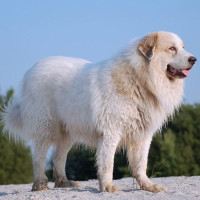
| The Pyrenean Mountain Dog is an extremely ancient breed with a mysterious past. Although no one really knows where these big white dogs came from, we do know that they have worked alongside Pyrenean shepherds for thousands of years to protect sheep from the bears, wolves and lynx that were once common in the region. As large predators became less common in the region, the dogs became more frequently used as property guards or gaol dogs, and were so highly regarded that they were dubbed the royal dog of France by the dauphin Louis XIV in the 1600s. While modern Pyrenean Mountain Dogs can live happily as pets, just as many are employed as guardians of people or property, and as the biggest predators return to the Pyrenean mountains, these faithful guardians are seeing a resurgence in popularity in their native territory. | ||
 |
||
| Standard of the Pyrenean Mountain Dog |
A little of the American Pit Bull Terrier |
| The American Pit Bull Terrier is, ironically, a breed that is not recognized as a breed by the American Kennel Club, although it is recognized by the United Kennel Club in England. The American Staffordshire Terrier, as recognized by the AKC, is so closely related to the American Pit Bull Terrier that some individuals can be recognized as American Pit Bull Terriers in England and also as American Staffordshires in the USA, although the breed standard for the Pit Bull allows a wider range of sizes and colors than the Staffordshire. |
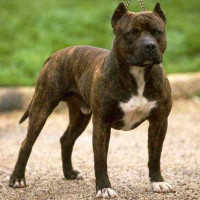 |
| Presentation of the American Pit Bull Terrier |
Appearance of the Pyrenees Pit |
| This crossbreed is generally a large animal that is very slightly longer than it is tall, although Pyrenees Pits are generally a little smaller than their parent breed, the Pyrenean Mountain Dog. They are well muscled and broad, with broad, robust heads and wide, deep muzzles. Those who lean towards the Pit Bull will generally have a stockier build, shorter muzzles and broader heads than those who more closely resemble the Pyrenean Mountain Dog. Their eyes generally come in shades of dark brown and can be round or almond-shaped, and they have short, somewhat triangular ears that can be carried low and close to the skull like the Pyrenean Mountain Dog or carried high in a rose or half, prick configuration like the American Pit Bull. The coat of the Pyrenees Pit can vary considerably from dog to dog, as the coats of the parent breeds are very different from one another. Some dogs may prefer the American Pit Bull Terrier heritage, with a short, single-layered coat, while others may inherit the winter-ready double-layered coat of the Pyrenees Mountain Dog, made up of a soft, thick undercoat covered by a layer of long, thick hair - a coarser texture. |
Temperament of the Pyrenees Pit |
| Although this hybrid is generally affectionate and extremely loyal to its family or charges, it can be more aloof or wary of others and require more socialization than average to be comfortable in a variety of situations. Although these dogs are generally good with the children of their own family, they may inherit a tendency to be overzealous in protecting them from perceived threats. All interactions between these powerful animals and children or other pets should be closely supervised, especially if the animal or child is not well known to the dog. Both parent breeds of the Pyrenees Pit have been bred to be strong-willed, with the ability to think independently when needed. While these are useful traits for protecting sheep from large predators as Pyrenees Mountain Dogs are built to do, or for driving bulls to market like the Pit Bull's ancestors, they can make obedience training much more difficult. The best results can be achieved with early training focused on consistency and positive reinforcement. |
Needs and activities of the Pyrenees Pit |
| Although these dogs are quite large and often have copious muscles, they don't require as much exercise as many other breeds with similar athleticism. An hour or two a day of moderate to vigorous exercise is usually enough to keep this hybrid healthy and fit. It may be advisable not to exercise your dog during the hottest part of the day in hot weather, as dogs with short, light-colored coats may be more prone to sunburn and skin cancer, while dogs with thicker, double-layered coats may be more susceptible to overheating. The Pyrenees Pit requires more space than most apartments can provide, and is happiest when given a larger home to spread out in. |
Maintenance of the Pyrenees Pit |
| The Pyrenees Pit needs only occasional baths, as the coats of the Pit Bull and Pyrenean Mountain Dog tend to shed dirt naturally. The brushing requirements of this dog vary somewhat according to the coat it inherits. Those who inherit the double coat of the Pyrenean Mountain Dog, whatever its length, do not need to be brushed daily as this often leads to breaking of the hair tips, but they do require combing and brushing every two or three days. to avoid the formation of tangles or knots and to remove dead hairs from the coat. Those who inherit the Pit Bull's short, single-layered coat will often be able to keep it healthy and shiny with weekly grooming sessions using either a smoother brush or a grooming glove. |



 English (United Kingdom)

Comments