Pomeagle

He is not recognized by the F.C.I.

Origin
Germany <> Great Britain -> U.S.A.
Translation
Francis Vandersteen

A brief presentation of the Pomeagle

The Pomeagle is a hybrid of a German Toy Spitz / Pomeranian and a Beagle. Although they can vary in size, they are generally intelligent, affectionate little dogs and a true companion. They'll happily follow you wherever you go, unless they're sidetracked by something else that catches their attention. Like a young child, they can be incredibly curious and want to investigate anything new. They adapt well to apartment living or a house with an enclosed yard, just make sure the fence is solid so they can't get out and disappear down the road after an interesting scent. The Pomeagle needs firm patient training, and it has to be fun or they'll switch off and find other things to do. They may inherit a stubborn sequence from their Beagle parent and prefer to do things their own way. Patience and kindness will eventually win them over. The Pomeagle can make a good family dog, just make sure he's well socialized when he's young.

History of the Pomeagle

The Pomeagle is a mixed-breed dog, a cross between the German Toy Spitz / Pomeranian and Beagle breeds. Small, affectionate and curious by nature, these puppies have inherited some of the best qualities of both their parents. Pomeagles are also known as Beagle Pom or Pomeranian Beagle mix. Despite their unfortunate status as a designer breed, you can find these mixed-breed dogs in shelters and associations, so remember to adopt, don't buy.


A little of the German Toy Spitz / Pomeranian

        
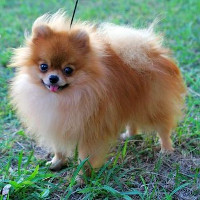
The German Toy Spitz / Pomeranian originates from the province of Pomerania, having been developed from ancient Spitz breeds. These dogs were characterized by their wedge-shaped heads, pointed ears and dense fur coats. They have always enjoyed great popularity, and the likes of Isaac Newton and Mozart were devoted owners. When Princess Charlotte of Pomerania married an English prince, soon to become King George III, she brought two white Poms with her, and the breed became popular in royal circles. But it was Queen Victoria, a passionate dog lover, who promoted the German Toy Spitz / Pomeranian as affectionate companions and confidants, and bred them to be much smaller than their standard 9 kilos. These little ambassadors exploded in popularity and continue to this day to be one of the most popular dog breeds. The American Kennel Club recognized the breed in 1909.
Standard of the German Toy Spitz / Pomeranian


A little of the Beagle

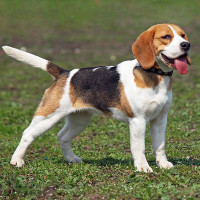
The history of the Beagle parent is sparse; the dog we know today only really developed in the 19th century. Greek history documents dogs much like the Beagle in 400 BC, and the Romans brought with them small dogs ideal for rabbit hunting when they came to England. Talbot Hounds arrived with William the Conqueror in 1066, and it is these dogs that are thought to be the ancestors of the Beagle. Over the years, the Beagle enjoyed popularity, particularly from 1307 to 1509 in the courts of Edward II and Henry VII and was used for fox hunting, but they fell out of favor with the larger Foxhounds which were faster and more agile. Fortunately, farmers in England, Ireland and Wales continued to breed them for rabbit and hare hunting. Around the 1800s, the Beagle was imported to America, where they bred them to be smaller than the English hound. The Beagle patch strain was developed by Willet Randall in New York around 1800, resulting in an attractive dog that was mainly white but with large tricolored patches. The American Kennel Club began registering Beagles in 1884. Since then, the Beagle has gone from strength to strength, diversifying into other careers such as search and rescue, drug detection and as a therapy dog.
Standard of the Beagle

Appearance of the Pomeagle

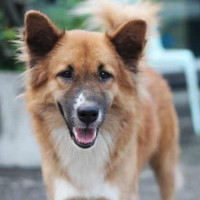
Pomeagle appearance can vary, even within a litter of puppies. Some may inherit more Beagle traits while others may be more German Toy Spitz / Pomeranian oriented. Generally, they're small dogs, but some can be as big as Beagles. They have an elegant, slightly square muzzle, a black button nose and bright, sparkling round eyes. Their ears can be erect or floppy, again depending on the genetic influence of the parent dog. The body is longer than it is tall, and the legs are slender but strong, with small rounded paws. The tail is often curled over the back, and the coat can vary from smooth like the Beagle to soft and fluffy like the German Toy Spitz / Pomeranian. Color can vary from brown, beige, cream, red, brindle, orange, white or sable. As a well-presented model, the Pomeagle has stunning beauty and a gentle, pleasing nature to match.

Temperament of the Pomeagle

The Pomeagle is a cheerful, lively little dog that is intensely loyal to its owners. These intelligent dogs are perfect show or agility dogs. Quick to learn, they love a challenge and as long as it's fun, they'll be easy to train. They can be sensitive to tone, so positive reinforcement is necessary. Pomeagles can also become anxious if left alone for long periods. These are human dogs, and they love being with you and being part of your team. This active, inquisitive dog will want to know everything you do, and will be at your side to help you do it. The Pomeagle has German Toy Spitz / Pomeranian tendencies to warn you of strangers on your territory, they bark to alert you, no one can escape their keen eyesight. They make excellent family dogs and get on well with young children, but as puppies they are very small, so play between children and dog needs to be supervised to ensure that toddlers don't bully these little dogs. On the Beagle side, they inherit strong hunting instincts, so it's natural for them to chase fast-moving furry or feathered creatures. If bred with a cat or dog, this may be different, but knowledge of this characteristic is important for the safety of all pets. These endearing, comical and engaging little dogs make ideal companions for families or a single person. With a Pomeagle by your side, you'll never be lonely.

Needs and activities of the Pomeagle

Pomeagle get most of their exercise by following you around the house or yard. But they still need a daily walk, which is an important part of their socialization skills. Meeting other dogs while they're at the dog park or accompanying you on a walk is a great way to get them used to other dogs and keep them fit and healthy. These dogs love to play, they excel at agility or searching for objects and will enjoy playing at home. As they have a strong hunting instinct, it's advisable to walk them on a leash, otherwise they may run off after a fast-moving bird or furry animal, whatever your shouted instructions to return. If they enjoy the activity, they also like to relax with you, curled up on your lap or next to you on a comfy sofa. True companions, whatever you do, they're fine with it.

Maintenance of the Pomeagle

Pomeagle need brushing every other day just to remove loose hair and avoid tangles, especially if they've inherited the German Toy Spitz / Pomeranian coat. A firm bristle brush should follow the hair fall, but you may need to vacuum more often than normal with a Pomeagle around. These little dogs don't need to bathe too often, but when you do, be sure to use a gentle dog shampoo to maintain the skin's natural oils. Nails should be trimmed if too long, and teeth will benefit from regular brushing. Most dogs need their ears checked, as dirt and debris can build up and trigger infection. A gentle wipe with a damp cloth is all that's needed. Your Pomeagle will love the attention and will remind you when it's time to be pampered again.

Comments

Latest page updates

  • Telomian

    Telomian He is not recognized by the F.C.I. Origin Malaysia Translation Francis Vandersteen A brief presentation of the Telomian The Telomian is a very rare breed of dog, and the only one native to Malaysia to have been bred outside the country. They were originally bred by the indigenous people of Malaysia to combat parasites such as snakes, rats,...
  • King Wheaten -- Cavalier King Charles Spaniel X Irish Soft Coated Wheaten Terrier

    King Wheaten He is not recognized by the F.C.I. Origin Great Britain <> Ireland -> U.S.A. Translation Francis Vandersteen A brief presentation of the King Wheaten The King Wheaten is a small dog with a heart this big and a playful disposition. Borrowing the energy and soft-coated waves of the Irish Soft Coated Wheaten Terrier and the size and...
  • Spanierd -- English Springer Spaniel X German Shepherd

    Spanierd He is not recognized by the F.C.I. Origin Great Britain <> Germany -> U.S.A. Translation Francis Vandersteen A brief presentation of the Spanierd The Spanierd is a hybrid dog. Its parent breeds are the English Springer Spaniel and the German Shepherd. They have an affable personality. He's known for entertaining family and friends with his...
  • Alaskan Goldenmute -- Alaskan Malamute X Golden Retriever

    Alaskan Goldenmute He is not recognized by the F.C.I. Origin U.S.A. <> Great Britain -> U.S.A. Translation Francis Vandersteen This breed is also known as Alaskan GoldenGoldenmuteAlaskan Gold Retriever     A brief presentation of the Alaskan Goldenmute The Alaskan Goldenmute is a descendant of two great dog breeds: the Alaskan Malamute and the Golden...
  • French pointing dog Pyrenean type

    French pointing dog Pyrenean type FCI standard Nº 134 Origin France Translation Mrs. Peggy Davis Group Group 7 Pointing Dogs Section Section 1.1 Continental Pointing Dogs « Braque » Type Working With working trial Acceptance on a definitive basis by the FCI Tuesday 18 January 1955 Publication of the official valid standard Tuesday 01 August 2023 Last...
  • French pointing dog Gascogne type

    French pointing dog Gascogne type FCI standard Nº 133 Origin France Translation Mrs. Peggy Davis Group Group 7 Pointing Dogs Section Section 1.1 Continental Pointing Dogs « Braque » Type Working With working trial Acceptance on a definitive basis by the FCI Monday 17 January 1955 Publication of the official valid standard Tuesday 01 August 2023 Last...
  • Vucciriscu

    Vucciriscu He is not recognized by the F.C.I. Origin Sicily Translation Francis Vandersteen En français, cette race se dit Vucciriscu Diese Norm ist in deutscher Sprache sichtbar Vucciriscu En español, esta raza se dice Vucciriscu In het Nederlands, wordt dit ras gezegd Vucciriscu This breed is also known as Sicilian Vucciriscu Sicilian Butcher...

© 2026 Groupe Milouchouchou ASBL. Tous droits réservés. En savoir plus

Protected by Copyright01
We use cookies

We use cookies on our website. Some of them are essential for the operation of the site, while others help us to improve this site and the user experience (tracking cookies). You can decide for yourself whether you want to allow cookies or not. Please note that if you reject them, you may not be able to use all the functionalities of the site.

Ok