
 |
Pom-A-Pug |
|
He is not recognized by the F.C.I. |
Origin |
Germany <> China -> U.S.A. | |
Translation |
Francis Vandersteen | |
This breed is also known as |
Pug-A-Pom
|
A brief presentation of the Pom-A-Pug |
| The Pom-A-Pug is a hybrid of German Toy Spitz / Pomeranian and Pug. This hybrid is a versatile member of the furry family, capable of going from relaxed and calm to playful and energetic to watchdog, alerting the family to the presence of a stranger in the blink of an eye. This hybrid will melt the hearts of anyone who owns one. Measuring 20.5 to 33 centimeters and weighing 2.5 to 7 kilos, it's a bundle of affection, mischief, alertness, child and pet friendliness, good health and low to moderate maintenance. What more could you ask of your four-legged family member ? |
History of the Pom-A-Pug |
| The Pom-A-Pug is a hybrid mix of German Toy Spitz / Pomeranian and Pug with little or no historical information available on the hybrid itself. We will, however, have some history from what we know of the parent breeds. The Pom-A-Pug hybrid itself is recognized by the following organizations: American Canine Hybrid Club, Designer Breed Registry, Designer Dogs Kennel Club, Dog Registry of America, Inc. and International Designer Canine Registry. |
A little of the German Toy Spitz / Pomeranian |
||
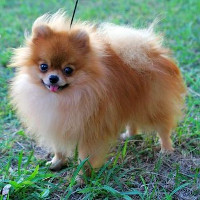
| The German Toy Spitz / Pomeranian is descended from larger Icelandic Spitz-type dogs that were used for sledding duties. Although it may be hard to imagine, the first Spitz was a larger dog, weighing around 14 kilos, used in sheep-raising activities. There is no approximate date of origin, but the largest Spitz breed can be traced back to the Prussian region of Pomerania, now Germany and Poland, where it was prized as a sheepdog. It only became known around 1870 when the Kennel Club in England recognized it. In 1888, on a trip to France, Queen Victoria of England fell in love with a Spitz named Marco, a larger version of the German Toy Spitz / Pomeranian. Queen Victoria wanted the breed to be smaller and, as a result, is credited with breeding methods that reduced the Spitz's size to that we see today. It remains a very popular breed in England and the United States. It was recognized by the American Kennel Club in 1888. | ||
 |
||
| Standard of the German Toy Spitz / Pomeranian |
A little of the Pug |
| The Pug parent breed originated in China and is thought to have been developed there at least 2,400 years ago, before the 6th century. The Pug, also known as the Chinese Pug, with distinctive stocky bodies and prominent eyes, was highly prized by monks and royalty in Europe and China for companionship. The Pug breed made its way to England, where, in the 19th century, Queen Victoria took an active interest in the breed. The Pug was recognized by the American Kennel Club in 1885. |
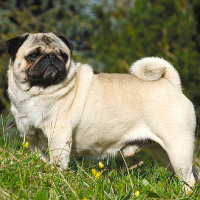 |
| Standard of the Pug |
Appearance of the Pom-A-Pug |
| The Pom-A-Pug, a hybrid mix of German Toy Spitz / Pomeranian and Pug, can take on the appearance traits of one or both parent breeds. We do, however, have information on the appearance of breeders and owners of this hybrid. This is a summary of what we know about the appearance of this hybrid from this source. It is a small canine breed, measuring from 20.5 to 33 centimeters and weighing from 2.5 to 7 kilos, with a curly tail, a short muzzle similar to that of the Pug but not as short, its eyes may be a little more prominent due to the organic Pug influence, a slight to moderate underbite and a lean body with a thick neck. Its coat can be short or medium-length and smooth or semi-coarse with colors of black, black and tan, fawn with scattered markings. |
Temperament of the Pom-A-Pug |
| Your Pom-A-Pug hybrid is truly a pint-sized bundle of intelligence, love, loyalty, affection and fun. What's more, he's described as alert, friendly, cheerful, brave, protective and calm. He is small and robust enough to get along with children of all ages, other dogs and even the family cat. He's protective of his human family and won't hesitate to alert you when there's a stranger on foot. Expect him to be wary of strangers until he feels there is no danger to his family. Since the Pom parent brings a certain independence to the biological mix, he may be moderately easy to train using positive training methods. The Pug parent contributes a strong desire to please, which may moderate your hybrid's independence. This hybrid's energy levels will probably be moderate due to the Pom parent's contribution. They tend to put on weight easily, so a regular exercise program is important. |
Needs and activities of the Pom-A-Pug |
| The Pom-A-Pug hybrid is one that requires moderate levels of exercise. A long daily walk - because he's small, not as long as some larger breeds - combined with playtime in the dog park or fenced yard, will help him manage his energy levels. Be sure to include interactive fetch and Frisbee games to keep his mind challenged too. It's important to remember that he's smart and, if he's not kept mentally as well as physically, some annoying and destructive behaviors could develop due to boredom. Since he's small, he'll do well in an apartment, condo or family home, with or without a fenced-in yard. They can live in urban or rural environments and tolerate moderate temperatures, neither too hot nor too cold. Exposure to these extremes should be limited, and extra protection provided. |
Maintenance of the Pom-A-Pug |
| The Pom-A-Pug hybrid may fall into the low-to-moderate maintenance category, with a coat that will probably only need brushing once a week, weekly ear checks and cleaning with a cotton ball and an approved wash, weekly nail checks with trimming if necessary and teeth brushing at least twice a week, daily is better. Keeping up with tooth brushing and professional examinations and cleanings will help reduce the development of periodontal disease and the tooth loss that accompanies it. This hybrid is generally quite healthy, lacking the respiratory problems that afflict the Pug parent, the health problem most often encountered being related to seasonal allergies and skin conditions. They are considered low excretors, non-hypoallergenic, with a low drooling rate and low odor. |



 English (United Kingdom)

Comments