
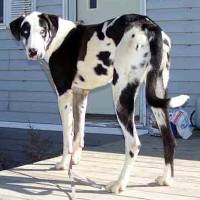
 |
Plush Danois |
|
He is not recognized by the F.C.I. |
Origin |
Turkey <> Germany -> U.S.A. | |
Translation |
Francis Vandersteen | |
This breed is also known as |
Plush Dane |
A brief presentation of the Plush Danois |
| The Danish Plush is a specific cross between the Kangal Sheepdog and the Great Dane. Both are giant breed dogs, and the Danish Plush will also be a giant, measuring between 76 and 91.5 centimeters and weighing around 68 kilos on average. These giant dogs are loyal and protective, making them excellent watchdogs for families without small children. The Danish Plush is not recommended for people who have never owned a large dog, and you must be prepared to train your dog well. In the wrong hands, these dogs can be dangerous due to their protective nature and large size. |
History of the Plush Danois |
| The Danish Plush is a hybrid dog produced by crossing the Kangal Sheepdog and the Great Dane. It's an option for owners who can't choose between the two breeds. With the Danish Plush, you can get a 2-for-1 designer dog offer in its form. He originated in the USA, but the exact year is unknown. He's relatively healthier than his parent breeds and has inherited some of the parent dogs' amazing traits. Here, in this guide, we'll explain everything you need to know about this hybrid and find out if he could be the one for you. |
A little of the Kangal Shepherd Dog |
||
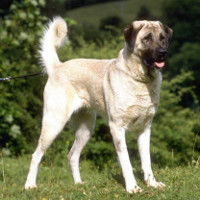
| The Kangal Shepherd Dog is an ancient Turkish giant that has been guarding and herding sheep and cattle since 1800 B.C. They are sometimes known as Blackhead Karabaş, Anatolian Blackhead, Anadolulu Karabaş, Kangal, Coban Kopegi or Akbash Dog. There are exhibitions of these dogs at the British Museum in London in the Assyrian rooms, and they have even been mentioned in the Bible. Although these dogs are excellent for protecting flocks and families, they are not known for being good pets for those with children. They prefer not to fight, but will protect whoever or whatever they consider their flock, be it sheep, cattle or people. They are stubborn and headstrong with a serious protective instinct that cannot be bred out of them. They are the 84th most popular dog breed in the American Kennel Club, where they have been registered members since 1996. | ||
 |
||
| Standard of the Kangal Shepherd Dog | ||
A little of the Great Dane |
||
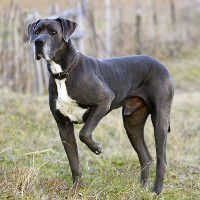
| The Great Dane is another ancient dog breed, although it originated in Germany and has been around since 3000 B.C. They were bred from Greyhounds, Old English Mastiffs and Wolfhounds to be guard dogs and hunting companions. Unlike the Kangal Sheepdog, the Great Dane is a gentle, affectionate dog, but can still be dangerous around small children due to their large size and clumsiness. These giants are thought to have been spread around the world by the Assyrians, who traded them with the Greeks and Romans. They began to be called Boar Hounds because they were used to hunt wild boar. They were then changed to English Dogges in the 1500s, then to Kammerhunde, meaning chamber dog, and then to Great Danes, which were later changed to Great Danish Dog and Danish Mastiff. In 1880, German judges decided they would be called the Deutsche Dogge, meaning German Mastiff. Eventually, the Americans changed their name to Great Dane, which it has remained ever since. They are the 14th most popular breed in the American Kennel Club, where they have been registered since 1887. | ||
 |
||
| Standard of the Great Dane |
Appearance of the Plush Danois |
| Your Dane Plush can be almost any color imaginable, and its nose can also be a wide range of colors such as isabella, blue, brown and black. Eyes are usually brown or blue, but can also be amber or hazel. Their coat can be feathered on their body and ears, and can be short to medium in length. The longest coat is called a Woolly Plush Dane and has a mane and feathers throughout and a feathered tail. White dogs can be deaf. They are huge dogs with a well-muscled body, a long curved tail, cat-like paws, a long neck, well sprung ribs and a drawn belly. |
Temperament of the Plush Danois |
| As mentioned previously, the Danish Plush is not good for families with young children, as they can become aggressive and overprotective. They are territorial and make natural watchdogs, but they need to be properly trained to accept visitors as they are afraid of strangers. They don't take well to direction and need a firm disciplinarian to teach them the rules. Many owners prefer obedience training to properly train their Plush Danes. This breed needs early socialization to get them to be friendly with other pets, and they may not be a good choice for the dog park. |
Needs and activities of the Plush Danois |
| The Danish Plush needs plenty of exercise to keep them from getting bored or anxious. They're a working breed at heart and need to be active most of the time while they're awake, so if you don't have work for them, you'll need to spend a lot of time entertaining them. They like to gather and hunt as well as protect, so giving them the run of a large fenced yard is perfect for them. However, they love to be around humans and want to protect you, so they need to be indoors with you at least part of the time. |
Maintenance of the Plush Danois |
| Plush Danes need to be groomed at least four or five times a week to prevent tangling. Use a pin brush and a metal comb to brush them thoroughly, especially their mane and feathers. The longer the coat, the more brushing they'll need. A few times a month, you should check your dog's ears and give them a good cleaning. Also, trim your dog's nails every 10 to 14 days to prevent them from cracking or ingrowing. They only need to be bathed once a month or so, unless they become particularly dirty. |



 English (United Kingdom)

Comments