
 |
Papimo |
|
He is not recognized by the F.C.I. |
Origin |
France and Belgium <> U.S.A. -> U.S.A. | |
Translation |
Francis Vandersteen |
A brief presentation of the Papimo |
| The definition of a hybrid dog is one that has been created by combining two pure breeds to create a mixed dog. The Papimo is a cross between an American Eskimo Dog and a Continental Toy Spaniel. These dogs can be adapted to apartment living as long as they get enough exercise, around 45 minutes a day. As they have a long, thick coat, hot summer temperatures can be a problem, so it may be necessary to limit exercise. They are small in size and an excellent choice for families with children and other pets, as they are quite sociable and behave with all people and pets, provided they are properly socialized. |
History of the Papimo |
| The Papimo is considered a hybrid or designer dog breed, as it is created from two distinct breeds. For the Papimo, a Continental Toy Spaniel and an American Eskimo are used. These dogs are a new creation and there's not much to say about them yet. What we do know is that they originate from the United States and will share the characteristics and traits of the American Eskimo Dog and the Continental Toy Spaniel. |
A little of the Continental Toy Spaniel |
||
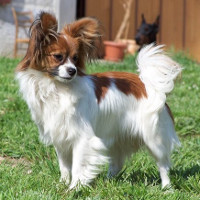
| The Continental Toy Spaniel is a breed of dog that has been around for some time. In fact, it's thought to be one of the oldest dog breeds, having been discovered around 700 years ago. They were first found in Europe, where they were called Miniature Spaniels. The dogs were often depicted sitting on the laps of Spanish noblewomen in Italian Renaissance paintings, which took place between the 13th and 15th centuries. At some point, their name changed to Continental Toy Spaniel, but would later revert to the name we all know them by today. Most dogs at that time had floppy ears, but later a version with erect ears was born. The floppy-eared version was then called Phalene Papillons, and the erect-eared dogs were simply Papillons. | ||
 |
||
| Standard of the Continental Toy Spaniel | ||
A little of the American Eskimo Dog |
||
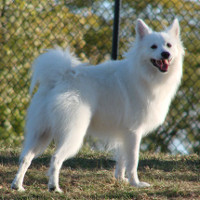
| The American Eskimo Dog comes from a much larger family of Nordic breeds called Spitz. These dogs are almost the same as German Spitzes, but during the war, the dogs that were brought to America had their name changed to American Eskimo Dog. The White Pomeranian, Samoyed, White Keeshond and White Italian Spitz are all other members of the Spitz family of Nordic breeds. The breed found its way to the United States with German settlers and therefore has no connection with Eskimo culture, despite its misleading name. | ||
 |
||
| Presentation of the American Eskimo Dog |
Appearance of the Papimo |
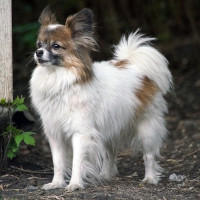
| The appearance of both the Continental Toy Spaniel and the American Eskimo Dog must be taken into account when trying to predict what these designer dogs will look like. The Papimo is generally documented as a small white dog with large patches of tan-covered fur located all over its back. Their paws are also quite small, and the lips and eyes will be black or dark in color. Papimos have adorable ears that are large in relation to their body and match the beige color of their back. The tails, which curl up and rest on the dog's tan-colored back, have wispy hairs that grow straight and are about 10 centimeters long. Their coat is generally of medium length, with longer fur on the tail, elbows, chest and around the dog's pretty face. They have small muzzles and rounded heads. An even more accurate physical description of this dog can be determined if you look for parental characteristics. However, bear in mind that not all hybrid dogs are alike, as certain traits can be adopted by different parents in individual dogs. |
Temperament of the Papimo |
| The Papimo, which is the combination of a Continental Toy Spaniel and an American Eskimo Dog, will have a personality similar to those of both parents. They tend to be energetic dogs with lots of energy. Although they like to please, they can sometimes be difficult to train, but this can be a problem with many small dog breeds. These strong-willed dogs generally bond to a specific master and will obey and adore them unconditionally. On the whole, they are happy, affectionate pets who get on very well with children and other pets. However, strangers can make them nervous, and it can sometimes take time for them to familiarize themselves with people they don't know. They are generally quiet pets who only bark if someone is at the door. A more in-depth display of Papimo temperaments can be found by examining the general behavior of parent dogs. |
Needs and activities of the Papimo |
| As with all breeds of creators, Papimo will have similar requirements to those of the breeds from which they were born. The Continental Toy Spaniel needs to be walked every day, with some play time. Like all dogs, the Continental Toy Spaniel is more likely to misbehave and get into trouble if it doesn't have enough time to play and exercise every day. Playtime and free time in the yard are important for this breed. American Eskimo Dogs also have similar needs. A long daily walk will be appreciated, as will free time to roam in a safe, enclosed space. Playing with your dog is also a great way to bond with him and burn off energy. |
Maintenance of the Papimo |
| Given the coats of the two purebred parent breeds, we can assume that the Papimo will have similar characteristics and needs. They generally shed their long coats and will need brushing at least once a week to keep them clean and healthy. There are other maintenance needs that are necessary for all breeds of dog, without exception. These include teeth brushing, which will be necessary around two or three times a week. However, brushing your dog's teeth every day is the best and most reliable way to avoid infections and cavities. Your dog's nails should also be trimmed from time to time. For most dogs, every month or two is a good time to check nail length. Finally, ear infections are another concern that will require a little work to avoid. Wipe and check your dog's ears every week. |



 English (United Kingdom)

Comments