
 |
Papeagle |
|
He is not recognized by the F.C.I. |
Origin |
France and Belgium <> Great Britain -> U.S.A. | |
Translation |
Francis Vandersteen |
A brief presentation of the Papeagle |
| The Papeagle is a gentle, adorable hybrid of the Continental Toy Spaniel and the Beagle. Little is known about the hybrid itself, including its approximate date and place of origin. Both parent breeds have histories shrouded in mystery, but both are thought to date back to before the time of King Arthur, although the parent breeds originated in different countries. The Papeagle hybrid will melt your heart and become part of the family unit wherever it is, bonding closely with family members. |
History of the Papeagle |
| The Papeagle hybrid is a cross between the Continental Toy Spaniel and the Beagle. There is little history on the hybrid itself available at present, but there is plenty of information available on the parent breeds. So, to get the full picture of the hybrid, we'll need to examine the histories of each parent breed. The Papeagle hybrid itself is recognized by the following organizations: Designer Breed Registry and International Designer Canine Registry. |
A little of the Continental Toy Spaniel |
||
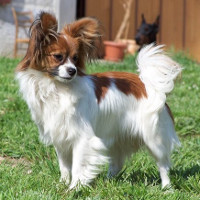
| The Continental Toy Spaniel is a breed whose history is shrouded in mystery, perhaps mainly due to the lack of documentation for most dogs originating in China. There are a few theories about the Continental Toy Spaniel's heritage. Some believe that Asian toy dog breeds, such as the Japanese Chin, are in its ancestry, others believe that Far Eastern breeds were not involved but rather the reduction in size of the Continental Toy Spaniel came from breeding the smaller dogs of the breed together. Whether you subscribe to one theory of breeding or another is irrelevant. What matters is that today's Continental Toy Spaniel is the product of breeding tiny Toy Spaniels, going back beyond the 1200s in artistic representations of the time. Great artists such as Titian, Goya, Rubens, Rembrandt, Fraggonard, Watteau and others depicted these tiny treasures sitting on the laps of the king's rich and famous ladies. Even Marie-Antoinette was a proud lover and owner of the Continental Toy Spaniel. It seems that France, Spain and Italy have all contributed to promoting the breed to its current level of popularity. The breed's original purpose seems to have been purely companionship, a purpose and function it fulfills expertly today. Today's Continental Toy Spaniel is known for its erect, fringed ears, but ears weren't always like this. In the early days, the ears drooped and the breed was called “Phalene”. This name continues today as the type of Continental Toy Spaniel, the nickname “Papillon” being given to the variety with the pricked and fringed “butterfly”. The Continental Toy Spaniel arrived in England in 1901 and was recognized by the Kennel Club in 1923 and by the American Kennel Club in 1935, although it had already been accepted for registration in the AKC in 1915. | ||
 |
||
| Standard of the Continental Toy Spaniel | ||
A little of the Beagle |
||
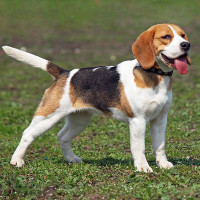
| The Beagle is a breed whose date of origin is also obscure. Predecessors known as white dogs are thought to date back to the time of King Arthur. While there is some disagreement in this theory, most would agree that there are dogs in the Beagle's ancestry, some being hunting dogs that hunt specifically by sight and others being true dogs that hunt specifically by scent. Of all the breeds that have blended together over the centuries, the Beagle is now, and always has been, classified as a hunting dog. Originating in the United Kingdom, their scent-hunting abilities have been appreciated by British hunters for centuries. Even hunters in the early years of the American deep south used this and similar breeds for their scent-hunting abilities. The Beagle breed was recognized by the American Kennel Club in 1885, calling them curious and comical and citing that they frequently follow their noses into all sorts of mischief. | ||
 |
||
| Standard of the Beagle |
Appearance of the Papeagle |
| The Papeagle is a hybrid of the Continental Toy Spaniel and Beagle breeds and, as such, can take on the appearance traits of one or both parent breeds. Described as being built like a small Beagle, breeders and owners of Papeagles describe the dog as docile and alert as well as gentle and loyal with dark, brown or hazel eyes that are sad and expressive, a slightly athletic build, a triangular head with floppy ears and a big black nose on a medium-length muzzle with a scissor bite. Your Papeagle will probably measure from 20 to 38 centimeters in height at the withers and weigh from 2 to 13.5 kilos, depending on which parent breed dominates the biological pool. The tail will probably be proportional to the size of the dog's body, set high and carried high. The coat is likely to be of medium length and smooth, with these colors available: black, light brown, beige patches on a white base. |
Temperament of the Papeagle |
| Your Papeagle hybrid is a mix of the Continental Toy Spaniel and the Beagle and, as such, is likely to take on the temperament qualities of one or both of the parent breeds. Owners and breeders of these affectionate dogs describe their temperament as docile and alert, but can also be shy. Other terms used to describe this calm, docile dog are: gentle, affectionate, loyal, kind, friendly and well-mannered. This hybrid is one that will quickly bond with its human family and desire to be with them as much as possible, really not liking to be left alone for long periods. He is said to be such a friendly dog that he gets on well with strangers and may not be the dog you want if you need a watchdog. He gets on well with children and other animals, but don't be surprised if there's a bit of a chase with the family cat, his heritage is a hunter on the Beagle side. He's intelligent and eager to please, which makes him fairly easy to train. His energy level is moderate, but that doesn't mean he doesn't need his daily walks and playtime in the backyard or dog park. |
Needs and activities of the Papeagle |
| The Papeagle is not an overly active dog, but it still needs daily exercise. He loves walking and jogging with you, letting off steam and playing in the dog park or backyard. He has a moderate tendency to wander, following his nose into any mischief, so it's advisable to keep him on a leash when outside the house or fenced yard. He'll love to play fetch and Frisbee, but won't hesitate to snuggle up to you or curl up on your lap while you sip hot chocolate and watch a good fancy movie. He'll get along just fine in an urban or rural setting and, because of his size and energy level, can live very well in an apartment, condo or family home with or without a fenced yard. Its coat offers adequate protection for moderate climates, but will need extra protection if it lives in extreme temperature zones. |
Maintenance of the Papeagle |
| The Papeagle is a hybrid of the Continental Toy Spaniel and the Beagle, and is considered low- to moderate-maintenance. As a general rule, breeders and owners of the Papeagle say the coat is generally smooth with minimal to moderate shedding, requiring brushing twice a week and bathing monthly or as needed when your dog feels dirty. The soft ears, which he inherits from the Beagle parent, will need to be checked and cleaned weekly with a cotton ball and ear cleaning solution. Toenails should also be checked weekly, trimmed if necessary. Teeth should be brushed at least twice a week, as with most canine breeds, to reduce the risk of developing periodontal disease and the accompanying tooth loss. Odor and drool levels are considered low for this hybrid. |



 English (United Kingdom)

Comments