Nortese

He is not recognized by the F.C.I.

Origin
Great Britain <> Central Mediterranean Basin -> U.S.A.
Translation
Francis Vandersteen

A brief presentation of the Nortese

The Nortese, whatever its preferred parent breed, is generally very happy in a larger house or small apartment, but may not be the best companion for young children due to the possibility of possessive behavior and the fragility of this small dog.

History of the Nortese

The Nortese is a designer dog, the deliberate cross between an extremely popular and extremely old Mediterranean companion breed, the Maltese, and a much more recent breed, the Norwich Terrier, developed in England as exemplary ratiers as recently as the 20th century.


A little of the Norwich Terrier

        
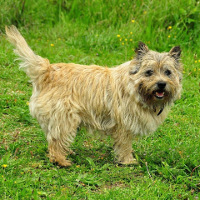
The Norwich Terrier breed is in its infancy compared to the Maltese, just over a century old, and was developed to hunt and kill vermin, particularly rats. Their development began when students at Cambridge University bought small farm Terriers to help control the rats that populated the area. These little dogs became so popular with the students that they became known as Trumpington Terriers, named after the street in which the students lived. One of these dogs, a stallion named Rags, was mated to a smooth-haired white female Terrier with erect ears, and their puppies were used by several different breeders in individual attempts to develop the breed, and in 1932 the breed was standardized and recognized by the Kennel Club of England and the American Kennel Club in 1936.
Standard of the Norwich Terrier

A little of the Maltese

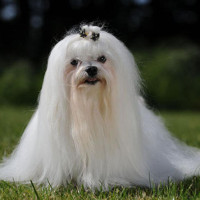
The Maltese takes its name from the small island of Malta, off the coast of Italy, and is one of the many small, silky-haired dogs that have developed in the Mediterranean. Their first ancestor was an ancient water dog, which gave rise to several intelligent and sociable breeds, including the Havanese, the Poodle and, of course, the Maltese. Maltese separated from their cousins at some point as early as 3500 BC and have often been favored by the rich and famous since the time of the ancient Greeks, not only in Malta, but throughout the known world. Interest in these little pets waned for a short time in the 17th century, but they had regained their status by the mid-19th century and were recognized by the American Kennel Club in 1888.
Standard of the Maltese

Appearance of the Nortese

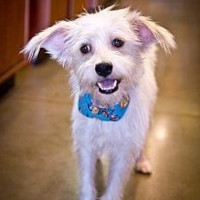
The Nortese is a very small dog, even the largest of them measuring less than 30 centimeters and weighing less than 7 kilos. These small companion dogs can vary considerably in structure, appearance and temperament from one dog to the next, even within the same litter, due to differences in parental breeds. Although the Nortese is certainly a little longer than it is tall, its bone structure can range from the robust, thick bones of the Norwich Terrier to the fine, straight bones of the Maltese. The skull is slightly rounded, although slightly narrower for dogs that prefer the Maltese, and the hybrid may sport either the finely tapered muzzle of the Maltese or the strong wedge-shaped muzzle of the Norwich Terrier. Their round or oval eyes are generally very dark, with a lively, intelligent expression, and although they may inherit the straight triangular ears of the Norwich Terrier or the low-set floppy ears of the Maltese, most end up with ears that rest high on their head and flap forward or to the sides.

Temperament of the Nortese

The temperament of this hybrid can vary considerably from one individual to another, as the parent breeds can have very different personalities. The Maltese is a very friendly dog that gets along with just about everyone, regardless of age, size or species, while the Norwich Terrier is more likely to be more reserved, especially with strangers. While Maltese Terriers can generally trust smaller children, Norwich Terriers can sometimes be possessive and jealous, and may occasionally resort to slapping. Interactions with small children need to be supervised even with the calmest of these dogs, not only for the safety of the child, but for the safety of the dog. In most cases, this hybrid will be pleasant with other animals, but some may not be able to resist the urge to chase them, and if not socialized, some Nortese dogs can develop aggression or frightening behaviors. Although sometimes stubborn, they should be fairly easy to train as they are quite bright and eager to learn new things, although home training can be more of a challenge with these dogs than with most.

Needs and activities of the Nortese

Although this hybrid is a lively, energetic dog, it is able to expend large amounts of that energy without too much effort on your part, mainly because of its small size. Forty-five minutes a day is usually enough to keep these little dogs satisfied, and is most effective when divided into at least two or three shorter sessions throughout the day. While dogs that inherit the Norwich Terrier's double-layered coat are generally fine in mildly cold weather, those with just a single layer of silky hair can be more sensitive to the cold and may require outerwear designed for dogs to keep them comfortable on walks.

Maintenance of the Nortese

It's not a wash-and-wear hybrid, but the amount of grooming required for a Nortese is generally a little simpler than it may first appear. Grooming methods may differ a little depending on the coat your Nortese inherits, dogs with the silkier coat characteristic of the Maltese will need baths more often than most other breeds, usually around once a month, while those with the wiry double coat of the Norwich Terrier only need to be bathed a few times a year. Both coats need brushing, although this is a daily affair for the softer Maltese coat to prevent tangles and matting, and those with the Norwich coat can get away with it a few times a week. Nortese coats can sometimes reach Maltese lengths, requiring scissors and frequent trimming, but more often than not, their silky coats stay at a short to medium length and only need occasional trimming to tidy things up. Those who inherit the Norwich Terrier's extremely dense coat may also require scissor work, trimming the coat to keep it neat and tidy, and thinning it with tapering scissors.e century. A number of similar dogs were used in its creation, including the Border Terrier and the Cairn Terrier. Interestingly, they were created with the intention of having a breeding dog hardy enough to live outdoors in barns and outbuildings and hunter enough to hunt vermin. Many agree that the breed became popular among students at Cambridge's elite university, and that several breeders were Cambridge alumni. It was in the mid-1900s that the original breed was split into two groups: dogs with erect ears, now the Norwich Terrier, and those with hanging ears, the Norfolk Terrier. Although Norfolk Terriers make good pets, they are not a particularly well-known breed worldwide.

Comments

Latest page updates

  • Telomian

    Telomian He is not recognized by the F.C.I. Origin Malaysia Translation Francis Vandersteen A brief presentation of the Telomian The Telomian is a very rare breed of dog, and the only one native to Malaysia to have been bred outside the country. They were originally bred by the indigenous people of Malaysia to combat parasites such as snakes, rats,...
  • King Wheaten -- Cavalier King Charles Spaniel X Irish Soft Coated Wheaten Terrier

    King Wheaten He is not recognized by the F.C.I. Origin Great Britain <> Ireland -> U.S.A. Translation Francis Vandersteen A brief presentation of the King Wheaten The King Wheaten is a small dog with a heart this big and a playful disposition. Borrowing the energy and soft-coated waves of the Irish Soft Coated Wheaten Terrier and the size and...
  • Spanierd -- English Springer Spaniel X German Shepherd

    Spanierd He is not recognized by the F.C.I. Origin Great Britain <> Germany -> U.S.A. Translation Francis Vandersteen A brief presentation of the Spanierd The Spanierd is a hybrid dog. Its parent breeds are the English Springer Spaniel and the German Shepherd. They have an affable personality. He's known for entertaining family and friends with his...
  • Alaskan Goldenmute -- Alaskan Malamute X Golden Retriever

    Alaskan Goldenmute He is not recognized by the F.C.I. Origin U.S.A. <> Great Britain -> U.S.A. Translation Francis Vandersteen This breed is also known as Alaskan GoldenGoldenmuteAlaskan Gold Retriever     A brief presentation of the Alaskan Goldenmute The Alaskan Goldenmute is a descendant of two great dog breeds: the Alaskan Malamute and the Golden...
  • French pointing dog Pyrenean type

    French pointing dog Pyrenean type FCI standard Nº 134 Origin France Translation Mrs. Peggy Davis Group Group 7 Pointing Dogs Section Section 1.1 Continental Pointing Dogs « Braque » Type Working With working trial Acceptance on a definitive basis by the FCI Tuesday 18 January 1955 Publication of the official valid standard Tuesday 01 August 2023 Last...
  • French pointing dog Gascogne type

    French pointing dog Gascogne type FCI standard Nº 133 Origin France Translation Mrs. Peggy Davis Group Group 7 Pointing Dogs Section Section 1.1 Continental Pointing Dogs « Braque » Type Working With working trial Acceptance on a definitive basis by the FCI Monday 17 January 1955 Publication of the official valid standard Tuesday 01 August 2023 Last...
  • Vucciriscu

    Vucciriscu He is not recognized by the F.C.I. Origin Sicily Translation Francis Vandersteen En français, cette race se dit Vucciriscu Diese Norm ist in deutscher Sprache sichtbar Vucciriscu En español, esta raza se dice Vucciriscu In het Nederlands, wordt dit ras gezegd Vucciriscu This breed is also known as Sicilian Vucciriscu Sicilian Butcher...

© 2026 Groupe Milouchouchou ASBL. Tous droits réservés. En savoir plus

Protected by Copyright01
We use cookies

We use cookies on our website. Some of them are essential for the operation of the site, while others help us to improve this site and the user experience (tracking cookies). You can decide for yourself whether you want to allow cookies or not. Please note that if you reject them, you may not be able to use all the functionalities of the site.

Ok