
 |
Muscle Mastiff |
|
He is not recognized by the F.C.I. |
Origin |
Great Britain <> France -> U.S.A. | |
Translation |
Francis Vandersteen |
A brief presentation of the Muscle Mastiff |
| The Muscle Mastiff is a specific cross between the Mastiff and the Bordeaux Mastiff. The hybrid is a giant breed with an average adult weight of between 65 and 86 kilos. Hybrid dogs have large, strong bodies and big heads. Muscle Mastiffs generally have drooping jowls and floppy ears. The hybrid is seen in black, black and tan, brown, red and silver. Although large, the Muscle Mastiff will be a gentle, loyal and loving dog towards its humans. Moderate grooming is required, and shedding will be minimal. |
History of the Muscle Mastiff |
| The Muscle Mastiff is not a pure-bred dog. It is a cross between the Bordeaux Mastiff, also known as the Dogue Français, and the Mastiff. This dog is also known as the Bordeaux Mastiff. It is recognized by the American Canine Hybrid Club, the Designer Breed Registry and the Dog Registry of America. This unique-looking dog has a powerful body, square muzzle and loose lips that hang slightly from its jaw. |
A little of the Mastiff |
||
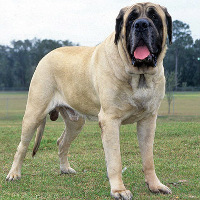
| The Mastiff is another giant breed from the Molossus family. Dogs are thought to have been brought to the British Isles on Phoenician trading ships between 2000 and 1500 BC. The modern-day Mastiff is a descendant of these dogs, isolated on an island and bred to protect those who lived there. In 55 BC, during the Roman invasion, the Mastiff worked as a war dog to resist the Romans. Julius Caesar was impressed by the Mastiff's size and courage, and brought a pack of dogs to Rome to fight lions and gladiators. For over 100 years, the Mastiff continued to provide protection and was also used by humans to bait bulls and bears, as well as for pit fighting. A selective breed has emerged in recent years to reduce some of the Mastiff's more aggressive qualities. The breed developed into a large, docile dog and was recognized by the American Kennel Club in 1885. | ||
 |
||
| Standard of the Mastiff | ||
A little of the Bordeaux Mastiff |
||
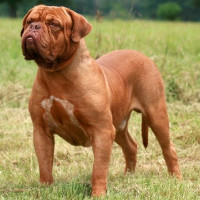
| The Bordeaux Mastiff is a giant breed in the Molossus group, known for the strong, solid bodies of its dogs. The Molossus group includes Mastiffs, St. Bernards and Carlins, all of which are thought to be descended from the Molossus. The Molossus is an ancient breed that can still be seen in the mountainous regions of Albania. From the Molossus onwards, the ancestry of the Bordeaux Mastiff becomes unclear. Some believe the dogs are descended from a Spanish dog known as Alano, now extinct. Others think the Bordeaux Mastiff is a descendant of the Tibetan Mastiff, while others believe the dogs were formerly known as Dogues de Bordeaux d'Aquitaine, an ancient French breed. Sources are unclear as to whether the Bordeaux Mastiff contributed to the Bulldog and Bullmastiff lineages, or whether it's actually the other way around, with the Bulldog and Bullmastiff contributing to the Bordeaux Mastiff. In the 1800s, dogs of the breed were working in France, where they were trained to bait bulls and jaguars, guard livestock and secure property. The breed only became known in the United States in 1982 following an article in “Dog World”, and was not recognized by the American Kennel Club until 2008. | ||
 |
||
| Standard of the Bordeaux Mastiff |
Appearance of the Muscle Mastiff |
| The Muscle Mastiff is a large dog with an average weight of between 65 and 86 kilos. The hybrid is seen in a variety of colors to include black, black and tan, brown, red and silver, and its coat will be short, fine and soft. The Muscle Mastiff's appearance will be the result of the traits the dog inherits from each parent. A broad, powerful body will be inherited from both the Mastiff and the Bordeaux Mastiff. Traits inherited from the Mastiff include a large head, short muzzle and wide-set dark eyes. The loose skin around the face and neck that forms wrinkles and large jowls can be inherited from the Bordeaux Mastiff. |
Temperament of the Muscle Mastiff |
| The Muscle Mastiff can be described as a giant teddy bear because of its gentle nature and gentle temperament. The hybrid will be loving and devoted to its humans, and will seek to protect them. Your Muscle Mastiff will probably do well with children, expressing patience with them and also getting along with the other animals in your home. While the hybrid may appear large and intimidating, the Muscle Mastiff is generally calm and gentle, able to remain alert but not aggressive. On occasion, the Muscle Mastiff may be stubborn and try to be responsible, whether for its human or another pet in the home, this can be helped by early socialization and training. Because of the hybrid's desire to protect its humans and its ability to be vigilant, the Muscle Mastiff makes an excellent watchdog. |
Needs and activities of the Muscle Mastiff |
| To maintain its physical and emotional health, the Muscle Mastiff needs regular exercise. The hybrid's activity level is not above average, and it's important that you don't overwork your Muscle Mastiff. One or two short walks a day with some indoor or outdoor play time should suffice. When the weather is particularly hot, you'll want to make sure you minimize your dog's outdoor activity to ensure he doesn't overheat. Even though your Muscle Mastiff is a large dog that doesn't require a lot of activity, it can live very well in an apartment. |
Maintenance of the Muscle Mastiff |
| The Muscle Mastiff will require a moderate amount of grooming, brushing several times a week will help remove loose and dead hairs and keep its coat healthy. How often your Muscle Mastiff should be bathed will depend on the coat it inherits. A monthly bath is usually sufficient for the Bordeaux Mastiff, while the Mastiff may need to be bathed more often. If your Muscle Mastiff has skin folds, you'll want to check them regularly to make sure there's no trapped moisture, as this could irritate his skin and lead to bad odor. It's also a good idea to wipe his face and muzzle weekly to make sure no infection develops, as he can drool profusely. Hybrids do better in cold temperatures than in very hot ones. For the most part, hybrids are easy to train but will not respond to harsh methods. |



 English (United Kingdom)

Comments