Miniature Border Schnollie

He is not recognized by the F.C.I.

Origin
Great Britain <> Germany -> U.S.A.
Translation
Francis Vandersteen

A brief presentation of the Miniature Border Schnollie

The Miniature Border Schnollie, a specific cross between the Border Collie and the Miniature Schnauzer, is a more recent hybrid and there is little information available on the hybrid itself. The parent breeds are described as intelligent, alert, energetic and friendly, making them excellent pets. Both parent breeds are versatile, and willingly participate in a variety of activities such as agility and obedience competition, narcotics detection, scent detection, search and rescue, breeding, hunting and land dog activities, as well as tracking. Add to these activities their playful clowning and protection, and you have a delightful mix of furry entertainment.

History of the Miniature Border Schnollie

The Miniature Border Schnollie is a hybrid resulting from the breeding of a Border Collie with a Miniature Schnauzer. This is a fairly new hybrid and there isn't much information available on the hybrid itself, but there is plenty of history available on the two parent breeds. We'll be gleaning information about the hybrid from each of the parent breeds.


A little of the Border Collie

        
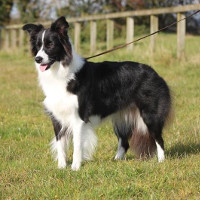
The Border Collie originated in the United Kingdom and Ireland, and the breed's history can be traced back to at least the first century BC. It was during this period that the Romans conquered the British and, as part of their baggage and booty, brought their own sheepdogs to help manage their livestock. Later, some time after the collapse of the empire, the Vikings entered the scene. It is thought that the Viking aggressors also brought their own dogs, a Spitz type, smaller than the Roman dogs found in Britain at the time. It is thought that the mix of these breeds created a dog with greater agility and a smaller size to perform better in the topography of the highlands bordering Wales, England and Scotland. The Border Collie breed can work long and hard, with little human supervision, on the rugged terrain in which it was bred. This robust, hard-working breed remains invaluable for these very traits today. The Border Collie was recognized by the American Kennel Club in 1995.
Standard of the Border Collie

A little of the Miniature Schnauzer

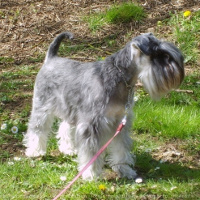
The Miniature Schnauzer originated in Germany in at least the 1400's. This miniature version of the larger Standard Schnauzer is thought to be descended from the Poodle, Affenpinscher, Wire Fox Terrier, Zwerzgspitz and Miniature Pinscher. Its small size is attributed to crossbreeding and inbreeding of the smallest of the litters to reduce the size to the miniature version. This feisty miniature version of the Schnauzer was created for a variety of farming activities, including rodent control, an activity in which it excelled. Breeding of the Miniature Schnauzer in North America is thought to have begun around 1924, the breed being officially recognized by the American Kennel Club in 1926. Today, this feisty little dog, with its high level of intelligence and loving nature, is not only used as a family companion, but also makes an excellent watchdog.
Standard of the Miniature Schnauzer

Appearance of the Miniature Border Schnollie

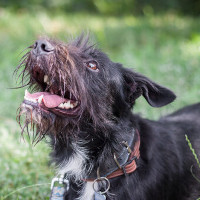
The Miniature Border Schmollie is a newer hybrid resulting from the breeding of Border Collie with Miniature Schnauzer and, as such, can take on some or all of the appearance traits of one or both of the parent breeds. Your adult hybrid will measure between 30.5 and 58.5 centimeters and weigh from 6 to 20.5 kilos, with males being slightly taller and heavier than females. The body may be square-shaped, small and sturdy or medium-sized and athletic, with a strong, blunt rectangular muzzle or a strong, slightly tapering muzzle of similar length to the tapering head, a nose that is solid black or of a color closely matching the coat color, ears set high on the head, V-shaped carried erect or partially or completely drooping, and a tail set low or high and of varying lengths. The eyes may be sunken and dark, making them sometimes grumpy, or they may be of any color depending on the coat color, and the two eyes may be of different colors. The coat can be wiry, rough or smooth with a thick undercoat and can be virtually any color. Colors you might see in your pet are: solid black, solid white, salt and pepper, black or silver, solid, bicolor, tricolor or merle composed of black, brown, red, beige, fawn or white. Your hybrid will probably inherit the scissor bite of both parent breeds. Your dog's feet may be oval and compact, or round and cat-like with arched toes.

Temperament of the Miniature Border Schnollie

Your Miniature Border Schnollie hybrid is a mix of Border Collie and Miniature Schnauzer and, as such, may inherit some or all of the temperament and personality traits of the parent breeds. Your hybrid pet could be alert, intelligent, friendly, playful, energetic, protective and responsive. It will be loyal and protective of its human family, being good with children as well as the family cat and other animals, although early socialization will help ensure this. This hybrid gets high levels of intelligence and energy from both sides of the biological equation, giving it a great desire to please. This makes this dog quite easy to train, provided you firmly establish from the outset exactly who is in charge. Stay positive in the areas of discipline and encouragement and you'll get much better results. It's prudent to mention one trait that could be important in the training arena. As previously mentioned, your hybrid can inherit personality traits from both sides of the organic mix. The Border Collie parent brings an almost eternal puppy formula to the organic mix. This means that your hybrid may not fully mature, physically and emotionally, until it reaches the ripe old age of 3 or 4 years. The playfulness doesn't detract from the obvious intelligence of this frisky hybrid mix. Your pet will probably also do well with strangers, but don't be surprised if he's a little noisier than usual until he's convinced the stranger's presence is safe.

Needs and activities of the Miniature Border Schnollie

Your Miniature Border Schnollie is a hybrid mix of Border Collie and Miniature Schnauzer and, as such, this hybrid will inherit large amounts of energy from both sides of the biological mix. These high levels of energy will need to be expended to keep your hybrid, and your family members, happy, fit and healthy. The energy and intelligence provided by the parent breeds create a canine dynamo in this hybrid mix. Both sides bring heritages that have engendered in them a need to keep moving, scanning, hunting, watching and guarding. These characteristics can force your hybrid to be kept mentally and physically challenged. Long daily walks, several times a day, combined with time to let off steam and play in the dog park or fenced backyard, retrieving and Frisbee games, earth dog activities, obedience and agility training are things that can help keep him busy, both mentally and physically. It's important to avoid boredom and the annoying destructive behaviors that can accompany it. Both parent breeds are considered “human” breeds and like to be around people, especially their human family. That said, it's important to note that your hybrid won't like to be left alone for long periods, suffering from separation anxiety. Your hybrid can tolerate both hot and cold temperatures, and can live in both urban and rural environments, although homes with open spaces may be better suited to his frontier side. It can, with a few modifications for exercise, live in apartments, condos or family homes with or without fenced yards.

Maintenance of the Miniature Border Schnollie

The Miniature Border Schnollie hybrid is considered a moderate maintenance dog, inheriting a minimal to moderate level of shedding from its parent breeds, the Border Collie and Miniature Schnauzer. The hybrid may or may not be hypoallergenic, as only the Miniature Schnauzer parent contributes to this trait. Since both parent breeds contribute dense double coats to the biological mix, you should expect to brush your dog at least once a week to remove loose hairs and other debris that may be present. Bathing your hybrid should be done only as needed, perhaps every few months, unless your pet likes to play in mud and puddles. Less frequent bathing will help preserve the oils his coat needs for good health. Your hybrid's ears should be checked at least once a week and cleaned without inserting anything into the ear canal to keep them clean and infection-free. Regular dental check-ups and cleanings, combined with at-home tooth brushing at least three times a week, will help reduce the risk of developing periodontal disease and the tooth loss that goes with it. Toenails should also be checked weekly and trimmed if necessary, unless the dog can keep them worn in normal daily physical activities. This hybrid inherits the low odor and drool of its parent breeds.

Comments

Latest page updates

  • Telomian

    Telomian He is not recognized by the F.C.I. Origin Malaysia Translation Francis Vandersteen A brief presentation of the Telomian The Telomian is a very rare breed of dog, and the only one native to Malaysia to have been bred outside the country. They were originally bred by the indigenous people of Malaysia to combat parasites such as snakes, rats,...
  • King Wheaten -- Cavalier King Charles Spaniel X Irish Soft Coated Wheaten Terrier

    King Wheaten He is not recognized by the F.C.I. Origin Great Britain <> Ireland -> U.S.A. Translation Francis Vandersteen A brief presentation of the King Wheaten The King Wheaten is a small dog with a heart this big and a playful disposition. Borrowing the energy and soft-coated waves of the Irish Soft Coated Wheaten Terrier and the size and...
  • Spanierd -- English Springer Spaniel X German Shepherd

    Spanierd He is not recognized by the F.C.I. Origin Great Britain <> Germany -> U.S.A. Translation Francis Vandersteen A brief presentation of the Spanierd The Spanierd is a hybrid dog. Its parent breeds are the English Springer Spaniel and the German Shepherd. They have an affable personality. He's known for entertaining family and friends with his...
  • Alaskan Goldenmute -- Alaskan Malamute X Golden Retriever

    Alaskan Goldenmute He is not recognized by the F.C.I. Origin U.S.A. <> Great Britain -> U.S.A. Translation Francis Vandersteen This breed is also known as Alaskan GoldenGoldenmuteAlaskan Gold Retriever     A brief presentation of the Alaskan Goldenmute The Alaskan Goldenmute is a descendant of two great dog breeds: the Alaskan Malamute and the Golden...
  • French pointing dog Pyrenean type

    French pointing dog Pyrenean type FCI standard Nº 134 Origin France Translation Mrs. Peggy Davis Group Group 7 Pointing Dogs Section Section 1.1 Continental Pointing Dogs « Braque » Type Working With working trial Acceptance on a definitive basis by the FCI Tuesday 18 January 1955 Publication of the official valid standard Tuesday 01 August 2023 Last...
  • French pointing dog Gascogne type

    French pointing dog Gascogne type FCI standard Nº 133 Origin France Translation Mrs. Peggy Davis Group Group 7 Pointing Dogs Section Section 1.1 Continental Pointing Dogs « Braque » Type Working With working trial Acceptance on a definitive basis by the FCI Monday 17 January 1955 Publication of the official valid standard Tuesday 01 August 2023 Last...
  • Vucciriscu

    Vucciriscu He is not recognized by the F.C.I. Origin Sicily Translation Francis Vandersteen En français, cette race se dit Vucciriscu Diese Norm ist in deutscher Sprache sichtbar Vucciriscu En español, esta raza se dice Vucciriscu In het Nederlands, wordt dit ras gezegd Vucciriscu This breed is also known as Sicilian Vucciriscu Sicilian Butcher...

© 2026 Groupe Milouchouchou ASBL. Tous droits réservés. En savoir plus

Protected by Copyright01
We use cookies

We use cookies on our website. Some of them are essential for the operation of the site, while others help us to improve this site and the user experience (tracking cookies). You can decide for yourself whether you want to allow cookies or not. Please note that if you reject them, you may not be able to use all the functionalities of the site.

Ok