Miniature Ausseippet

He is not recognized by the F.C.I.

Origin
U.S.A. <> Great Britain -> U.S.A.
Translation
Francis Vandersteen

A brief presentation of the Miniature Ausseippet

The Miniature Ausseippet, a hybrid of the Miniature American Shepherd and the Whippet, is a very interesting breed, with the Whippet resembling a medium-sized Greyhound and the Miniature American Shepherd having a colorful history. These two very active parent breeds have been combined to create an active, versatile dog that can take part in virtually any activity you wish for it, with the friendly, social traits of the Aussie combining with the calm, reserved traits of the Whippet to create a versatile, affectionate pet.

History of the Miniature Ausseippet

The Miniature Ausseippet hybrid is a cross between the Miniature American Shepherd and the Whippet. There's no information available on the hybrid, so we'll have to get our hybrid history from the parent breeds.


A little of the Miniature American Shepherd

        
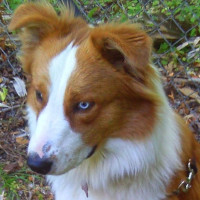
The Miniature American Shepherd has an interesting history, that's for sure. For a start, it doesn't specifically come from Australia, as its name suggests, but is rather the result of shepherds from the Basque region of France and Spain bringing their working dogs from the European continent to northwest North America in the 19th century. These shepherds are said to have come from Australia, and this is suggested as the reason for the “Australian” part of the nickname. These working dogs were bred for a variety of shepherding tasks, in which they excelled. When they were brought to the USA, their hard-working traits were used in the same way as where they came from. Eventually, the breeding characteristics of the Australian Shepherd, which were quite different in the early years, were standardized and the larger breed was recognized by the American Kennel Club in 1993. In the 1960s, a Californian obtained several small Australian Shepherds, their compact size capturing his interest and heart. He began working with local veterinarians to create a smaller version of the larger breed. He succeeded in obtaining litters containing both larger and smaller versions of the Australian Shepherd, which piqued the interest of professional breeders. They entered the fray and worked to create the smaller “mini” version and to develop standardized breed characteristics for this new mini breed. But the road to getting this new mini-breed recognized by the American Kennel Club was not an easy one. After much discussion and deliberation between leading Australian breed enthusiasts and the AKC, the American Miniature Shepherd Dog was recognized by the American Kennel Club in 2015. This mini version is currently very popular as a family companion, in agility and obedience competitions. Dating back to British imports, they arrived here in the late 1800s and remain a very popular breed today.
Standard of the Miniature American Shepherd

A little of the Whippet

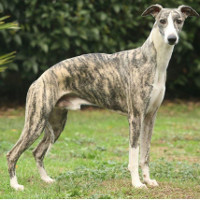
The parent Whippet breed originated in the UK, probably in the 19th century. While its ancestry and actual date of origin are shrouded in mystery, small greyhound-like dogs were found depicted in artistic images and sculptures for centuries before that. Furthermore, some believe that the breeds in his ancestry could include small Spaniels, the Italian Greyhound and perhaps the Manchester Terrier. Another theory or explanation for the Whippet's small size is based on the breeding practice of using the smallest “runts” of the litter as breeding stock to reduce the size of the offspring. Whichever theory one adheres to, the official facts revolve around the breed being developed in England in the 19th century for rabbit luring purposes. This compact canine breed quickly became popular with the working class as well as the rich, royal and famous. They appreciated them for their hunting skills as well as their speed on the race track. The Whippet breed made its way to the United States with English immigrants to the New England region in the late 19th and early 20th centuries. The breed's qualities spread rapidly in the United States and were recognized by the American Kennel Club in 1888.
Standard of the Whippet

Appearance of the Miniature Ausseippet

The Miniature Ausseippet is a hybrid of the Miniature American Shepherd and the Whippet and, as such, can take on the appearance characteristics of one or both parent breeds. As a result, your hybrid may measure from 35.5 to 56 centimeters in height at the withers, weigh between 9 and 18 kilos and have the appearance of a solid, medium-boned body that is proportional to the dog's weight and size, or that of a medium-sized dog with an elegant, muscular body. Your hybrid may have a clean-cut head in proportion to the body, an expression of alertness and intelligence, dark oval or brown, blue, amber or hazel and almond eyes. Ears can be medium-sized, triangular, V-shaped and set high on the head, or rose ears, which are small, thin and held at rest and folded back along the neck. The muzzle can be of medium length and thickness, or long and powerful with scissor-like teeth and a black or red nose, or the nose can be black, dark blue or dark brown. Your hybrid's paws may be oval, compact with well arched toes and thick pads, or hare-shaped with long, well arched toes and thick pads. The tail, although generally shortened in the Mini Aussie parent, can be long and curved, carried low or long and tapering. The coat can be medium-length and textured, straight to wavy and weather-resistant with variable undercoat thickness, or short-textured, firm, smooth and firm, and can be seen in any combination of these colors: blue merle, black, red merle, red or liver with mottling or color spotting in the merles.

Temperament of the Miniature Ausseippet

Your Miniature Ausseippet will make an excellent pet. As a hybrid mix, the Miniature Ausseippet can adopt the breed temperaments of one or both parent breeds. Both parent breeds have been described as: affectionate, energetic, courageous, cheerful, intelligent, friendly, loyal, gentle, calm, protective and social. Early socialization is recommended for best results when living with children, the family cat and other pets. Although neither parent breed is particularly aggressive, both protect their human families and bond closely with them. As such, don't be surprised if your normally calm and friendly furry family member becomes vocal and agitated when confronted with strangers in the presence of family or in the family home. He'll probably be wary of strangers until he's assured that the family is safe. Because they maintain close bonds with family members, both parent breeds are known to develop separation anxiety when left alone for long periods. Their high level of intelligence, which is provided by both biological parents, makes it essential that they are maintained mentally and physically in their daily activities. Although eager to please, they are likely to be moderately difficult to train and may try to control the situation. It then becomes necessary that, during training, the identity of who is really in charge is established and maintained.

Needs and activities of the Miniature Ausseippet

The Miniature Ausseippet is active, with high activity and energy levels coming from both sides of the biological mix. It will be important for him to be exercised both mentally and physically on a daily basis to keep him happy, fit and content, avoiding boredom and the annoying destructive behaviors that accompany it. Long daily walks, letting off steam and playing in the dog park or fenced backyard, retrieving, fly ball and Frisbee games, combined with agility and obedience exercises and earth dog games and activities will go a long way to keeping your hybrid mentally and physically challenged. Your hybrid will probably tolerate hot weather better than cold, unless the Mini Aussie parent dominates the biological mix. He can live in an urban or rural setting in an apartment, condo or family home with or without a fenced yard, provided he commits to daily exercise appropriate for him.

Maintenance of the Miniature Ausseippet

Your Miniature Ausseippet hybrid will require very little grooming, as parent breeds have coats that require only weekly brushing to remove loose hairs, debris and matting, and infrequent bathing to preserve the oils necessary for the weather resistance provided by the Miniature Australian Parent. Both breed parents are considered minimal to moderate excretors; no breed is hypoallergenic. Both parent breeds are also considered low in odor and drool. While you're brushing your hybrid family member every week, be sure to check the ears and clean them as needed without inserting anything into the ear canal. It's also a good idea to check the nails during this weekly grooming session and trim them if necessary. Although daily tooth brushing is strongly recommended for almost all breeds of dog and hybrids, it may not be possible in every situation. However, it's important to brush two or three times a week, and to keep up with dental check-ups and cleanings with your vet, to avoid the development of periodontal disease, which can lead to tooth loss over time.

Comments

Latest page updates

  • Telomian

    Telomian He is not recognized by the F.C.I. Origin Malaysia Translation Francis Vandersteen A brief presentation of the Telomian The Telomian is a very rare breed of dog, and the only one native to Malaysia to have been bred outside the country. They were originally bred by the indigenous people of Malaysia to combat parasites such as snakes, rats,...
  • King Wheaten -- Cavalier King Charles Spaniel X Irish Soft Coated Wheaten Terrier

    King Wheaten He is not recognized by the F.C.I. Origin Great Britain <> Ireland -> U.S.A. Translation Francis Vandersteen A brief presentation of the King Wheaten The King Wheaten is a small dog with a heart this big and a playful disposition. Borrowing the energy and soft-coated waves of the Irish Soft Coated Wheaten Terrier and the size and...
  • Spanierd -- English Springer Spaniel X German Shepherd

    Spanierd He is not recognized by the F.C.I. Origin Great Britain <> Germany -> U.S.A. Translation Francis Vandersteen A brief presentation of the Spanierd The Spanierd is a hybrid dog. Its parent breeds are the English Springer Spaniel and the German Shepherd. They have an affable personality. He's known for entertaining family and friends with his...
  • Alaskan Goldenmute -- Alaskan Malamute X Golden Retriever

    Alaskan Goldenmute He is not recognized by the F.C.I. Origin U.S.A. <> Great Britain -> U.S.A. Translation Francis Vandersteen This breed is also known as Alaskan GoldenGoldenmuteAlaskan Gold Retriever     A brief presentation of the Alaskan Goldenmute The Alaskan Goldenmute is a descendant of two great dog breeds: the Alaskan Malamute and the Golden...
  • French pointing dog Pyrenean type

    French pointing dog Pyrenean type FCI standard Nº 134 Origin France Translation Mrs. Peggy Davis Group Group 7 Pointing Dogs Section Section 1.1 Continental Pointing Dogs « Braque » Type Working With working trial Acceptance on a definitive basis by the FCI Tuesday 18 January 1955 Publication of the official valid standard Tuesday 01 August 2023 Last...
  • French pointing dog Gascogne type

    French pointing dog Gascogne type FCI standard Nº 133 Origin France Translation Mrs. Peggy Davis Group Group 7 Pointing Dogs Section Section 1.1 Continental Pointing Dogs « Braque » Type Working With working trial Acceptance on a definitive basis by the FCI Monday 17 January 1955 Publication of the official valid standard Tuesday 01 August 2023 Last...
  • Vucciriscu

    Vucciriscu He is not recognized by the F.C.I. Origin Sicily Translation Francis Vandersteen En français, cette race se dit Vucciriscu Diese Norm ist in deutscher Sprache sichtbar Vucciriscu En español, esta raza se dice Vucciriscu In het Nederlands, wordt dit ras gezegd Vucciriscu This breed is also known as Sicilian Vucciriscu Sicilian Butcher...

© 2026 Groupe Milouchouchou ASBL. Tous droits réservés. En savoir plus

Protected by Copyright01
We use cookies

We use cookies on our website. Some of them are essential for the operation of the site, while others help us to improve this site and the user experience (tracking cookies). You can decide for yourself whether you want to allow cookies or not. Please note that if you reject them, you may not be able to use all the functionalities of the site.

Ok