 |
Ja-Chon |
|
He is not recognized by the F.C.I. |
Origin |
China <> France / Belgium -> U.S.A. | |
Translation |
Francis Vandersteen |
A brief presentation of the Ja-Chon |
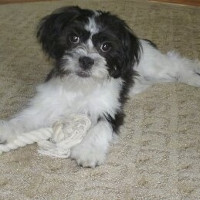
| The Ja-Chon is a hybrid dog whose parent breeds are the Japanese Spaniel and the Bichon frise. Ja-Chons can have long, curly coats, or short, dense coats. They are very affectionate and child-friendly, and are unlikely to be hyperactive. He's happy to be a companion dog. He doesn't require much maintenance and may not shed much, no more than average. He will be very gentle and affectionate and, because of his size, will need an indoor home. It is ideal for apartment living, but is equally at home in a large house. |
History of the Ja-Chon |
| The origins of the Ja-Chon are not yet in the history books, but the stories of its parent breeds may shed some light. |
A little of the Japanese Spaniel |
||
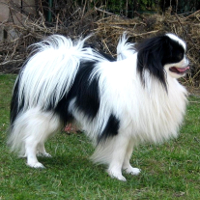
| The Japanese Spaniel is an ancient breed, supposedly related to the Pekingese. Depicted on artifacts found in Chinese temples, some believe that around 1000 AD, the Chinese emperor gave this popular dog to the Japanese emperor as a gift. Often described as cat-like, it is also thought that the Japanese Spaniel may have been brought to Europe by Portuguese sailors who had traded in Japan. Princess Catherine de Bragance was given a Japanese Spaniel by Portuguese sailors, lending credence to the story. Commodore Matthew Perry officially brought the Chin to Europe in 1854, giving a pair to Queen Victoria. The breed eventually made its way to the United States. | ||
 |
||
| Standard of the Japanese Spaniel | ||
A little of the Bichon frise |
||
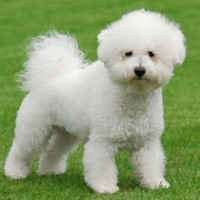
| The exact origins of the Bichon frise are unknown. It belongs to the Barbichon family of dogs, believed to be descended from the Barbet, a medium-sized woolly water dog. Some historians believe that the Bichon frise was brought to the Canary Islands by Spanish sailors, then brought back to Europe by Italians. In fact, supposedly, the Bichon frise was part of the "spoils of war" brought back to France after a French invasion of Italy. The breed has always been a favorite of the nobility, even in Napoleon's time. At one time, the dog belonged to organ grinders and circus performers and was part of their acts. After the First World War, French breeders took an interest in the dog and began working to preserve the breed. The Bichon frise was introduced to the United States in 1956. It is presented as a non-sporting breed. | ||
 |
||
| Standard of the Bichon frise |
Appearance of the Ja-Chon |
| The Ja-Chon is a small dog like its two parent breeds. The Japanese Spaniel has a broad head with large, wide-set eyes and a flat brachiocephalic face. Its ears are small and V-shaped, with long hair covering them. These dogs have an underbite. The tail is curled over the back with feathered hairs along the tail. The coat is white with colored patches, the most common colors being black, red, lemon, orange, sable, black and white with tan points or brindle. The Bichon frise is generally all white, with a double coat. Its coat is soft, but always stands out from the body, giving the Bichon a "puffy" appearance. The Ja-Chon is likely to have medium-length hair that can be wavy. It may also have colored patches on its body. The exact color will depend on the Chin's color palette. |
Temperament of the Ja-Chon |
| The Ja-Chon will be a blend of the personalities of its parent breeds. Owners describe their hybrid as having a sense of humor, a gift for entertaining and a tendency towards independence. He's no stranger to separation anxiety, even if left alone for long periods. He likes to be the center of attention and is appreciated by everyone who comes into contact with him. He is highly intelligent and easily trained. With kind and considerate handling, your Ja-Chon will thrive on obedience due to its eager-to-please personality. |
Needs and activities of the Ja-Chon |
| The Ja-Chon is a low-activity dog. He likes to play, however, and will do well in an apartment or house as long as he gets daily exercise. This can take the form of outdoor play in a fenced yard or brisk walks with the owner. He could also enjoy a trip to the dog park. However, remember that this small dog doesn't need to overwork himself physically, but will be happiest when his inquisitive mind also has the opportunity to work. Short training sessions will allow him to excel at pleasing as he loves to do, while allowing him to practice his concentration skills. |
Maintenance of the Ja-Chon |
| The Ja-Chon will have medium-length hair, and it can be wavy. It can stand out from the body as the hair of the parent breed Bichon frise tends to do. It can also be short and dense. Brush your Ja-Chon at least once a week to make sure there's no matting. Bathe only when necessary. You should brush your Ja-Chon's teeth at least three times a week, however, if you want to prevent gum disease, brush the dog's teeth every day. Trim your dog's nails every two weeks. If grooming time is enjoyable for your Ja-Chon, he'll look forward to the time spent together and allow a proper check of his teeth, nails and ears. |



 English (United Kingdom)

Comments