
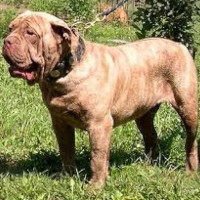
 |
Italian Bulldogge |
|
He is not recognized by the F.C.I. |
Origin |
Great Britain <> Italy -> U.S.A. | |
Translation |
Francis Vandersteen |
A brief presentation of the Italian Bulldogge |
| Powerful, intimidating and a great protector, the Italian Bulldogge is a giant breed dog that is a cross between the Neapolitan Mastiff and the Olde English Bulldog. These hybrids are above-average maintenance dogs, as they are seasonal excretors, heavy droolers and need to have their wrinkles specially cleaned regularly. Although they are a giant breed, they are actually quite well suited to an apartment lifestyle, provided they are walked several times a day and have a park nearby where they can go stretch and explore the world several times a week. Italian Bulldogs are not recommended for new owners, however, and are best suited to experienced, dominant owners. |
History of the Italian Bulldogge |
| Italian Bulldogge parents have rich histories that we can study to get to know these dogs well. |
A little of the Olde English Bulldogge |
||
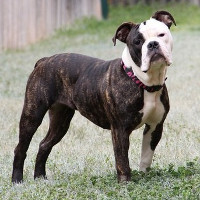
| The Olde English Bulldogge is a relatively new breed in terms of development with Mr. David Leavitt's breeding program starting in 1971. Although the breed's ancestors were mainly used for bull baiting and pit fighting, Mr. Leavitt sought to bring out the good in this wonderful canine by concentrating on athleticism (less intense than in predecessors) and gentle temperament traits. He carefully bred the American Bulldog, Bullmastiff, English Bulldog and American Pit Bull Terrier to develop the Olde English Bulldogge we see today. | ||
 |
||
| Presentation of the Olde English Bulldogge | ||
A little of the Neapolitan Mastiff |
||
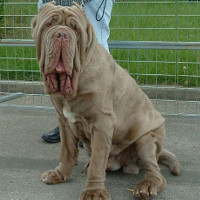
| Considered to be descended from British and Roman war dogs, the giant Neapolitan Mastiff originated in Italy, most likely Naples. Excellent for guarding and protecting in the past, Neapolitan Mastiffs now excel on the home front as valuable companions and in the show ring as much-admired giants. They were almost wiped out as a breed during the Second World War, but thanks to the promotion of Piere Scanziana, Neapolitan Mastiff enthusiast and owner, this magnificent giant was once again a favorite dog. In 1973, the first Neapolitan Mastiff entered the United States, and the breed was recognized by the American Kennel Club in 2004. | ||
 |
||
| Standard of the Neapolitan Mastiff |
Appearance of the Italian Bulldogge |
| Bony, tall and deep-chested, the Italian Bulldogge is a giant breed that tends to have a broad head, flat, rounded skull and deep-set eyes. These breeds are very muscular and powerful. Their muzzles tend to be square, deep and wide, with large nostrils on a brown or black nose. Their ears are often semi-erect, but can be cropped. They have powerful jaws and a generally inferior bite. A distinctive feature of these hybrids is that they generally have strong wrinkles and folds all over their bodies, with the greatest amount of folding in the facial region. These dogs tend to have a very short, straight coat that measures no more than 2.5 centimeters in length. Their amble gait is determined and strong. |
Temperament of the Italian Bulldogge |
| This hybrid can be quite dominant. They are not for the light-hearted and are best suited to strong owners who have experience with giant breeds with lots of personality. The person taking the Italian Bulldogge as a pet must understand that, because of the size of this hybrid, the master must maintain control. This hybrid is happy to obey, but will need constant leadership to keep it as happy as possible. It doesn't mind children at all, but needs to be supervised during interaction. He's a natural protector, so obedience classes will not only socialize him with other people and dogs, but teach him to obey your commands and trust that the visitor at the door is welcome. |
Needs and activities of the Italian Bulldogge |
| These hybrids need plenty of exercise and should be walked at least twice a day. They are not swimmers and are not comfortable as runners, so intellectual activity will be welcome as much as physical activity. He's affectionate and will happily go where you go, as long as you don't mind going at his own pace. The Italian Bulldogge is really too big to live happily in an apartment, preferring the comfort of a large house with a good-sized, well-fenced backyard. He won't be happy being left alone outside and will make an excellent gardening companion. In the heat of the day, however, provide plenty of shade and water to drink. |
Maintenance of the Italian Bulldogge |
| A seasonal excretor, these dogs need a little year-round maintenance when it comes to grooming. A weekly brushing with the smooth brush should suffice, and when your hybrid is in a heavier shedding phase, you can brush daily. The folds and wrinkles found on the Italian Bulldogge's face and body should be checked daily for moisture and dirt build-up, in particular, his facial folds will need to be kept dry as he can be a bit slobbery. His nails will be strong and hard, so keep control of their length by trimming them every two weeks. When he's a puppy, get him used to having his teeth brushed a few times a week, and you'll avoid unnecessary dental expenses in the future. |



 English (United Kingdom)

Comments