Irish Mastiff

He is not recognized by the F.C.I.

Origin
Ireland <> Great Britain -> U.S.A.
Translation
Francis Vandersteen

A brief presentation of the Irish Mastiff

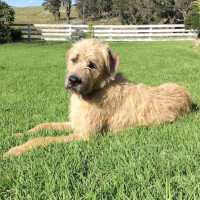
The Irish Mastiff is a hybrid of two of the tallest dog breeds known to man, the Mastiff, also known as the English Mastiff, and the Irish Greyhound. This crossbreed can reach up to 91.5 centimeters high at the shoulder and usually weighs more than 45 kilos, but both parent breeds have been described as gentle giants, at least as far as their families are concerned, and they are generally easygoing dogs. that adapt well to most families. Because of their laid-back nature, these dogs can adapt to an apartment if certain considerations are taken to ensure that they have enough space to move around furniture and in hallways, and at least one patch of floor near the rest of the family that's big enough to lie on. In general, however, they are happiest living in a larger house with a fenced-in yard.

History of the Irish Mastiff

This hybrid is a combination of two giant breeds from ancient history, the massive, powerful English Mastiff and the giant, galloping Greyhound known as the Irish Wolfhound.


A little of the Irish Wolfhound

        
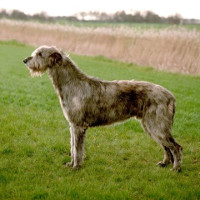
The Irish Wolfhound is also an ancient breed, noted as far back as 391 AD, when several of them were presented to the Royal Consul of Ireland. They were used to hunt very large prey such as elk, wild boar and, of course, the now extinct Irish wolf for which they were named. Once the last of the wolves was killed in 1786, the Irish Wolfhound population also began to decline, and by the mid-1800s there were very few left. If it hadn't been for the work of Captain George Augustus Graham, a Scotsman enlisted in the British Army, they might have disappeared altogether. In 1862, he gathered together all the Irish Wolfhound he could find and attempted to resurrect the breed. To do this, crosses with Scottish Deerhounds, Great Danes, Russian Wolfhounds and other dogs were used to bring the breed back to health and vitality. The Irish Wolfhound was recognized by the American Kennel Club in 1897 and by the Kennel Club of England in 1925.
Standard of the Irish Wolfhound

A little of the Mastiff

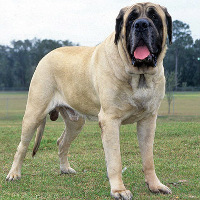
Mastiff-like dogs have been depicted in ancient Asian artwork dating back to 2500 BC, and these substantial canines were even recorded marching alongside Hannibal and his armies as they crossed the Alps. Because they are accomplished watchdogs and hunting companions, they became a favorite of landowners and farmers for their easy-going, unflinching nature when they reached England. Sadly, the world wars had an extremely negative impact on Europe's dog population, particularly where larger dogs like English Mastiffs were concerned. They were often placed in double jeopardy during the wars because they were too big to be easily fed during rationing, and they were also considered useful on the front lines, pulling ammunition wagons and most likely causing many deaths. By the end of both wars, the English Mastiff was almost extinct, at one point leaving only fifteen dogs known worldwide and capable of contributing to the gene pool. Mastiff puppies were imported to England from limited populations in the U.S.A. and Canada to help revive the breed, and they have since enjoyed a resurgence in popularity, becoming the 28th most popular breed according to the AKC.
Standard of the Mastiff

Appearance of the Irish Mastiff

The Irish Mastiff is a large dog, both in size and girth. This crossbreed generally measures up to 91.5 centimeters high at the shoulder and weighs over 45 kilos. The head will be large, though generally not as massive or as wide as the English Mastiff's head, and although you may see some of the wrinkles you'd find on the Mastiff's face, this trait is usually somewhat diminished by a longer muzzle, courtesy of the Irish Wolfhound. The eyes can be round or almond-shaped and are medium to dark brown in color, and the ears are small relative to the head and set high on the top of the head. Depending on which parent breed they resemble, their ears may be pulled back against the head or hang down, elongated near the cheek. Both parent breeds have a thick, downy undercoat protected by a layer of weather-resistant fur that can be straight, short and coarse, or rough and stiff.

Temperament of the Irish Mastiff

In most cases, this will be a calm, well-behaved hybrid, although it can be a little more active and clumsy during its adolescence, which usually lasts the first three years of the Irish Mastiff's life. Both parent breeds are very tolerant of children and naturally protective, however, these canines are extremely powerful animals and can get overexcited on occasion, so interactions with toddlers and young children must be carefully supervised at all times. The Irish Mastiff tends to be wary but polite with strangers, and socialization is necessary to ensure that this dog doesn't become too shy, timid or aggressive. The Irish Wolfhound, like most sighthounds, has an extremely high prey drive and in most cases neither they nor their offspring should be entirely trusting of small animals, especially fast-moving ones. They are eager to please and enjoy training, which should be started as soon as possible to get the maximum benefit from training.

Needs and activities of the Irish Mastiff

Although the Mastiff is a rather laid-back breed that generally requires less exercise than other large dogs, the Irish Wolfhound is quite active for its size, and at least 40 to 60 minutes of vigorous activity a day are needed to keep this hybrid in top condition. In addition to daily walks, these dogs are adept at a variety of activities, such as drawing and carting, coursing ability and tracking. During your dog's formative years, it's important to keep exercise sessions fairly short and not too intense to avoid damaging developing bones and joints. This can be done by interrupting exercise sessions throughout the day and ensuring that your dog doesn't jostle or jump from great heights. This crossbreed prefers the room that a larger home offers, but as they are not prone to barking unnecessarily, they may be able to adapt to apartment life if they get plenty of extra exercise in several short sessions throughout the day. Slippery surfaces should be avoided, however, to prevent joint and ligament damage.

Maintenance of the Irish Mastiff

This hybrid has a short, simple coat that makes grooming this dog quite manageable. Regular brushing with a smooth brush, soft bristle brush or curry comb is necessary to control shedding and distribute body oils, however, baths are only necessary every few months. If your Irish Mastiff inherits the folds and wrinkles characteristic of English Mastiffs, these folds should be examined and wiped to ensure that they do not contain trapped moisture or food particles, as these can lead to skin irritation and infection, possibly causing the development of a foul odor, especially around the face. Those with short, straight, hard coats will shed moderately throughout the year, while those who develop stiff coats may have very little shedding. Those with wiry coats may also require stripping, a process that can be carried out by hand or with a stripping comb.

Comments

Latest page updates

  • Telomian

    Telomian He is not recognized by the F.C.I. Origin Malaysia Translation Francis Vandersteen A brief presentation of the Telomian The Telomian is a very rare breed of dog, and the only one native to Malaysia to have been bred outside the country. They were originally bred by the indigenous people of Malaysia to combat parasites such as snakes, rats,...
  • King Wheaten -- Cavalier King Charles Spaniel X Irish Soft Coated Wheaten Terrier

    King Wheaten He is not recognized by the F.C.I. Origin Great Britain <> Ireland -> U.S.A. Translation Francis Vandersteen A brief presentation of the King Wheaten The King Wheaten is a small dog with a heart this big and a playful disposition. Borrowing the energy and soft-coated waves of the Irish Soft Coated Wheaten Terrier and the size and...
  • Spanierd -- English Springer Spaniel X German Shepherd

    Spanierd He is not recognized by the F.C.I. Origin Great Britain <> Germany -> U.S.A. Translation Francis Vandersteen A brief presentation of the Spanierd The Spanierd is a hybrid dog. Its parent breeds are the English Springer Spaniel and the German Shepherd. They have an affable personality. He's known for entertaining family and friends with his...
  • Alaskan Goldenmute -- Alaskan Malamute X Golden Retriever

    Alaskan Goldenmute He is not recognized by the F.C.I. Origin U.S.A. <> Great Britain -> U.S.A. Translation Francis Vandersteen This breed is also known as Alaskan GoldenGoldenmuteAlaskan Gold Retriever     A brief presentation of the Alaskan Goldenmute The Alaskan Goldenmute is a descendant of two great dog breeds: the Alaskan Malamute and the Golden...
  • French pointing dog Pyrenean type

    French pointing dog Pyrenean type FCI standard Nº 134 Origin France Translation Mrs. Peggy Davis Group Group 7 Pointing Dogs Section Section 1.1 Continental Pointing Dogs « Braque » Type Working With working trial Acceptance on a definitive basis by the FCI Tuesday 18 January 1955 Publication of the official valid standard Tuesday 01 August 2023 Last...
  • French pointing dog Gascogne type

    French pointing dog Gascogne type FCI standard Nº 133 Origin France Translation Mrs. Peggy Davis Group Group 7 Pointing Dogs Section Section 1.1 Continental Pointing Dogs « Braque » Type Working With working trial Acceptance on a definitive basis by the FCI Monday 17 January 1955 Publication of the official valid standard Tuesday 01 August 2023 Last...
  • Vucciriscu

    Vucciriscu He is not recognized by the F.C.I. Origin Sicily Translation Francis Vandersteen En français, cette race se dit Vucciriscu Diese Norm ist in deutscher Sprache sichtbar Vucciriscu En español, esta raza se dice Vucciriscu In het Nederlands, wordt dit ras gezegd Vucciriscu This breed is also known as Sicilian Vucciriscu Sicilian Butcher...

© 2026 Groupe Milouchouchou ASBL. Tous droits réservés. En savoir plus

Protected by Copyright01
We use cookies

We use cookies on our website. Some of them are essential for the operation of the site, while others help us to improve this site and the user experience (tracking cookies). You can decide for yourself whether you want to allow cookies or not. Please note that if you reject them, you may not be able to use all the functionalities of the site.

Ok