
 |
Great Wolfhound |
|
He is not recognized by the F.C.I. |
Origin |
France <> Ireland -> U.S.A. | |
Translation |
Francis Vandersteen |
A brief presentation of the Great Wolfhound |
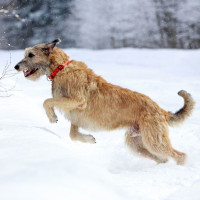
| The Great Wolfhound is a cross between the Pyrenean Mountain Dog and the Irish Greyhound. Your Great Wolfhound will be a large to giant dog with a dense coat of medium to long length. Falling will be moderate to high, so regular brushing is necessary. They are highly intelligent, loyal and faithful. The Great Wolfhound is also protective of its family, making it a good watchdog. Both parent breeds are good with children. His Irish Greyhound side can make him territorial towards other dogs. Because it is a large dog, it needs to be supervised with young children, although the Great Wolfhound is a wonderful family dog. This hybrid is best suited to a home with a large, fenced-in yard in which to play and explore. |
History of the Great Wolfhound |
| The Great Wolfhound is a blend of two ancient and lovable dog breeds. This dog doesn't have a well-documented history, and its origin isn't clear either, so let's look at the history of its parents to get an idea. |
A little of the Pyrenean Mountain Dog |
||
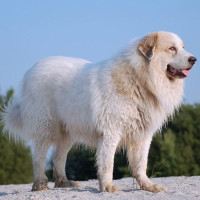
| Pyrenean Mountain Dogs are thought to be an ancient working breed originating from Central Asia or Siberia. They migrated with shepherds and their flocks of sheep to the Pyrenees around 3000 BC. The breed is named after this mountain range. They were loyal companions and hard-working dogs, protecting the sheep from predators. They would bark and charge the predator to alert the shepherd that the sheep were in danger. Pyrenean Mountain Dogs were affectionately called "pastou" by shepherds, which means pasture in Old French. The first pair of Pyrenean Mountain Dogs was brought to the United States in 1824 by General Lafayette and J.S. Skinner. A breeding program was established in 1931 by Mr. and Mrs. Francis V. Crane, who founded the Basquaerie Kennels in Needham, Massachusetts. Pyrenean Mountain Dogs were first recognized by the American Kennel Club in February 1933. Today, Pyrenean Mountain Dogs are still a working dog as well as a companion. They work as therapy dogs on farms and ranches, and as search and rescue heroes. | ||
 |
||
| Standard of the Pyrenean Mountain Dog | ||
A little of the Irish Greyhound |
||
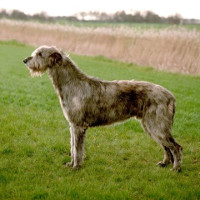
| The Irish Greyhound is an ancient breed. It is mentioned as far back as 7000 B.C. There are Irish laws and literature that mention the Irish Greyhound. Sighthounds were bred as hunting and guarding dogs. Irish Greyhounds hunted wolves and elk, working in packs. They were called "Cú Faoil", which in Celtic means Irish Greyhound. The Irish Greyhound came close to extinction due to the decline in game in the countryside and the Great Irish Famine (1845-1852). In 1862, a Scotsman named Captain George Augustus Graham dedicated his life to saving the breed from extinction. He bred the remaining Irish Greyhounds along with the Scottish Deerhound, Great Dane, Russian Wolfhound and Pyrenean Mountain Dogs. The English Kennel Club recognized the Irish Greyhound in 1925. The Irish Greyhound was officially recognized by the AKC in 1897. Today's Irish Greyhounds excel in the sport of lure coursing and trail running. Decoy racing is a sighted sighthound sport using a mechanical decoy. | ||
 |
||
| Standard of the Irish Greyhound |
Appearance of the Great Wolfhound |
| The Great Wolfhound is a hybrid between the Pyrenean Mountain Dog and the Irish Greyhound. Your puppy may have characteristics of both breeds. It will be a large to giant dog with dense, stiff, medium to long hair. Coat color may be white, fawn, gray, black, brindle or red. The Great Wolfhound will be a strong, muscular dog, although its body may be slim and tall like the Irish Greyhound. Your hybrid's ears may droop and prick up when excited. He may have a narrow muzzle. As a rule, the eyes are almond-shaped and dark brown. The eye rims, nose and lips are black. The tail is generally feathery and carried low. |
Temperament of the Great Wolfhound |
| The Great Wolfhound will have the personality and character traits of both its parents. As a puppy, it will be more energetic and playful, although exuberant jumping should be discouraged. As an adult, he'll be more laid-back. He will be reliable and loving with his family, but can be over-protective. It's important for him to have early obedience training and socialization with other dogs and strangers. His Irish Greyhound side can bring out separation anxiety, which can be expressed through chewing and vocalization such as howling and barking. These gentle giants love to spend time with their owners. Great Wolfhounds are intelligent, gentle and affectionate dogs. They can be a little stubborn, so patience, a firm but encouraging hand and constant daily training are essential. |
Needs and activities of the Great Wolfhound |
| Your Great Wolfhound will have low to moderate energy levels. He'll enjoy daily walks and playtime in the yard. In addition, your Great Wolfhound may enjoy visiting a dog park. Dog parks can also be beneficial for socializing your puppy with other dogs. Play should be limited during high temperatures. His energy levels will be higher when he's a puppy, but as a large breed, he'll grow quickly, so it's important that he doesn't overdo it. Excessive exercise for a growing large-breed puppy can damage his joints and bones. As he gets older, he may want to become a couch potato, but daily exercise is essential to prevent obesity. |
Maintenance of the Great Wolfhound |
| The Great Wolfhound can have a dense medium to long coat that should be brushed daily. Great Wolfhounds should be washed with a mild shampoo every few months. If your Great Wolfhound has a long coat, it may occasionally need to be trimmed by a professional groomer. His ears should be cleaned with an earwash product every month. To prevent tartar build-up, his teeth should be brushed several times a week. His nails may need trimming every month, so it's a good idea to trim them like a puppy so he gets used to the practice. A dog's nails contain blood vessels, so you need to be careful not to cut too far. If you train your puppy to accept the routine when he's young, he'll cooperate, reducing the risk of injury to a minimum. |



 English (United Kingdom)

Comments