
 |
German Wirehaired Lab |
|
He is not recognized by the F.C.I. |
Origin |
Germany <> Canada -> U.S.A. | |
Translation |
Francis Vandersteen | |
This breed is also known as |
German Wirehaired Labrador Retriever |
A brief presentation of the German Wirehaired Lab |
| Willing, water-loving and eager to please describe the medium-sized, well-built German Wirehaired Lab. A cross between the German Wirehaired Pointer and the Labrador Retriever, these dogs are hunters and trackers, friendly and get on well with children and other pets. Because of their high energy levels, they are best suited to active families. The owners of the German Wirehaired Lab say they are intelligent, gentle and love a job well done. |
History of the German Wirehaired Lab |
| Little information is currently documented about the German Wirehaired Lab hybrid. However, based on the history of the parents, it is assumed that this hybrid was designed for the purpose of hunting, tracking and retrieving game in water, as well as for companionship. They were probably developed over the last 15 years, from the early to mid-2000s, and are currently only registered with the Dog Registry of America. |
A little of the German Wirehaired Pointer |
||
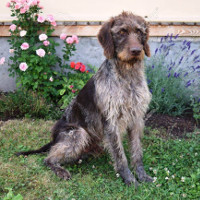
| Bred for sport and hunting, the German Wirehaired Pointer originated in Germany in the 1800s. These hunting dogs are said to have developed from many other breeds such as crosses between other Pointers, Poodles, Polish Water Dogs, Foxhounds and more. The main reason why so many breeds were used in the creation of the German Wirehaired Pointer is that enthusiasts of the time wanted to create a strong, versatile dog that could withstand adverse climates and traverse difficult terrain. He was a sought-after hunting partner because he was equally at home on land and in water. He arrived in the United States in the 1920s and joined the American Kennel Club's list of dogs in 1959 in the sporting dog category. | ||
 |
||
| Standard of the German Wirehaired Pointer | ||
A little of the Labrador Retriever |
||
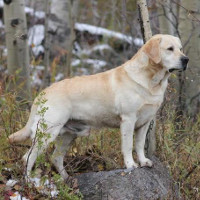
| The Labrador Retriever is also a sporting breed, designed to retrieve prey from the water. It is said to have originated in Canada, most probably Newfoundland, in the 16th century, from another large-breed dog known as the Newfoundland. The American Kennel Club recognized the Labrador Retriever in 1917 and it is currently the most popular dog in the United States, according to AKC records. | ||
 |
||
| Standard of the Labrador Retriever |
Appearance of the German Wirehaired Lab |
| Your German Wirehaired Lab may adopt the physical characteristics of one parent more than the other, but in general, these hybrids, like their parent breeds, will have a dense, water- and weather-resistant coat. These coats can be a mixture of stiff or straight fur with feathering, stiff hair concentrated on the muzzle area, often giving the dog a bit of a moustache. Ears are flat and floppy with a rounded tip. The head is of medium length and slightly broad. His good dark eyes will always be alert and generally almond-shaped. The German Wirehaired Lab will be muscular and may have a slightly arched neck. His chest may be deep and his legs will be athletically built and strong. He will hold his tail high, there may be feathering here, in addition to the legs and belly. |
Temperament of the German Wirehaired Lab |
| Both parent breeds are outgoing, playful and people-pleasers. You can expect your hybrid to retain many of these personality traits. This lively hybrid makes an excellent addition to a home with children and other pets, but because of its size, it needs to be supervised when interaction takes place. They are gentle and generally not considered aggressive towards people. When strangers approach, your hybrid, if more like a German Wirehaired Pointer, will show some form of aggression and alert you with vigorous barking. But if your dog looks more like a Labrador Retriever, chances are he's simply greeting a stranger. |
Needs and activities of the German Wirehaired Lab |
| Water-loving and outgoing, this hybrid is a fast, playful dog with lots of energy. He'll need an active family who will take him to the lake or for a run, and who are willing to spend time bonding with him through a game of retrieve. Give him a chance to try obedience classes and maybe participate in a few trials. He has the power and intelligence to succeed at flyball, and activities like these will also allow him to use his mind. Your German Wirehaired Lab is best suited to urban and rural living, an apartment may be too small for his temperament, he loves to run, so a house with a fenced back yard is the best choice. |
Maintenance of the German Wirehaired Lab |
| Labradors tend to be heavy seasonal excretors, so this may be a trait inherited from your hybrid. German Wirehaired Pointers also tend to shed all year round, but not as much as Labradors. For the most part, your German Wirehaired Lab is a low-maintenance dog, it will need brushing every week at least twice to remove dirt and loose hair. They have water- and weather-resistant coats, and won't need regular bathing unless they run through mud or roll in something nasty, as most dogs like to do. If kept active, most dogs will wear down their nails. Check them several times a month for length and condition. Brush his teeth three times a week to prevent tartar build-up and keep his gums healthy. |



 English (United Kingdom)

Comments