
 |
Eskifon |
|
He is not recognized by the F.C.I. |
Origin |
U.S.A. <> Belgium -> U.S.A. | |
Translation |
Francis Vandersteen |
A brief presentation of the Eskifon |
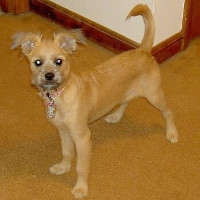
| The Eskifon is a mix of the American Eskimo Dog and the Griffon Bruxellois. It is likely to be a small dog and can come in a variety of colors. He will probably need a lot of maintenance, as both his parent breeds require moderate grooming. He will be friendly and affectionate with his family, although he may be wary of strangers for a time. He should live indoors with you, but giving him the opportunity for supervised exercise outdoors is a great way to help him stay in top shape. Be careful not to let him overheat, especially if he inherits the short nose of the Brussels Griffon. He may be a little stubborn or even a little bossy, but he's certainly loyal to his family. |
History of the Eskifon |
| There isn't much information on the Eskifon breed itself, but we can learn more about the parent breeds to understand what to expect from the hybrid breed. |
A little of the American Eskimo Dog |
||
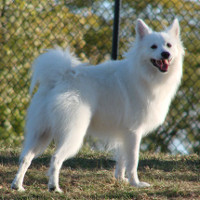
| The American Eskimo Dog has German roots. Of European descent, it has links with the Pomeranian, German, Keeshond and Italian Spitz. The American Eskimo Dog, formerly known as the American Spitz, began to gain popularity in the USA when he took to the stage as a circus performer. His glossy white coat made him stand out in the crowd. Before his circus career brought him to the USA, he was mainly a companion on farms. Today, he is a member of the non-sporting group of the American Kennel Club, and has been since 1994. | ||
 |
||
| Presentation of the American Eskimo Dog | ||
A little of the Brussels Griffon |
||
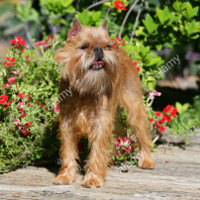
| The Brussels Griffon is a dog that originated in Belgium. This is where small Terrier-like dogs were bred to hunt and kill vermin. The Affenpinscher, Pug and English King Charles Spaniel may all be related to today's Brussels Griffon. Belgian Queen Marie Henriette owned a Brussels Griffon, and began breeding and promoting the breed throughout Europe. In the early 1890s, the Brussels Griffon made its way to England and then the United States. By the end of the Second World War, the Brussels Griffon was almost extinct because people couldn't afford the luxury of owning a dog. However, English breeders saved the breed from total extinction. The Brussels Griffon is still a rare breed today, but in the 1990s the breed became popular again after a Brussels Griffon starred in "For Better or for Worse" alongside Jack Nicholson. | ||
 |
||
| Standard of the Brussels Griffon |
Appearance of the Eskifon |
| The Eskifon will be a combination of the two parent breeds, the American Eskimo Dog and the Griffon Bruxellois. Although there isn't much information on the Eskifon breed itself, we can study the parent breeds to determine what the Eskifon will look like. The American Eskimo Dog is white and soft. It has a double coat with a dense undercoat. The outer coat is long, thick and silky. It has a pronounced ruff around the neck. Feathery legs and abundant fur on the tail. It can be cream-colored, but more often its coat color is white. The Brussels Griffon generally comes in one of four colors: red with black whiskers and chin, beige with black mask and whiskers, black and tan, and black. Older Griffons bruxellois may develop gray around the muzzle. Your Eskifon will most likely be beige or white, with the typical Brussels Griffon beard. His tail will be erect and may curl over his back. |
Temperament of the Eskifon |
| The American Eskimo Dog is courageous, intelligent, plays hard and loves activities of all kinds. They are also excellent watchdogs. Regular and ample exercise is recommended. If he gets bored, he can become destructive. He can sometimes be boisterous and stubborn. However, consistent and firm training will help make the American Eskimo Dog the dog you can appreciate. He can bark a lot and chew if left alone for long periods. The Griffon Bruxellois can be somewhat reserved, only becoming friendly once he's used to someone new. He can be slightly bossy. He likes to be with his family. Sometimes the Brussels Griffon is called a "Velcro dog" because it wants to stay right next to its family members. He may suffer from separation anxiety, and may resort to mischief to get your attention if he feels he's being ignored. Early socialization is recommended for the Brussels Griffon so he knows what's expected of him. Your Eskifon will be a fun combination of both parents and will be a dog who loves to be where you are. Train him with a gentle but firm hand and give him plenty of opportunities to meet and greet in the dog park to make sure he's comfortable in all situations. |
Needs and activities of the Eskifon |
| The Eskifon is a fairly active dog. Eskifons often require a lot of exercise. In fact, if he doesn't get the exercise he needs, he can become destructive. He likes to be part of an active household. Even if he likes to play outside with you, he needs to be inside at night. He's not happy outside his family. He'll be happy living in an apartment or house with a yard as long as he can spend enough time with his family. If your Eskifon has a shortened nose like the Brussels Griffon, don't allow him to exercise to the point of overexertion. If you notice him becoming lethargic or panting heavily, be sure to bring him indoors immediately. It's imperative that he always has access to fresh water. |
Maintenance of the Eskifon |
| The Eskifon shouldn't be an above-average excretor, but will need brushing at least twice a week. Parent breeds will either contribute to a short, smooth coat, or a longer coat that can be prone to matting. During periods of heavy shedding, a detangling tool should be used, but for the rest of the year, a pincushion brush will do just fine. If your Eskifon has the beard and eyebrows of the Griffon bruxellois, trimming them with scissors can keep them clean. The Griffon bruxellois coat, if your hybrid has one, will need a professional trim a few times a year to keep it looking impeccable. Check ears for dirt build-up and trim nails if they're too long. Teeth should be brushed at least twice a week. That's about it for maintaining a beautiful Eskifon. |



 English (United Kingdom)

Comments