
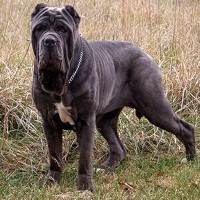
 |
English Neo Bull |
|
He is not recognized by the F.C.I. |
Origin |
Great Britain <> Italy -> U.S.A. | |
Translation |
Francis Vandersteen | |
This breed is also known as |
Neo Bull
|
A brief presentation of the English Neo Bull |
| The English Neo Bull is a specific cross between two molosser-type guard dogs, the English Bulldog and the Neapolitan Mastiff, one quite small and the other very large. The resulting hybrid tends to be big, but not as big as the Mastiff. They are generally gentle dogs when dealing with their families, but can become aggressive towards strangers and other animals if not properly socialized. These dogs have below-average grooming and exercise requirements for their size, and as they grow they may be a suitable candidate for apartment living, although they are more content with the space a larger home can provide. |
History of the English Neo Bull |
| The English Neo Bull's two parent breeds are both considered molosser-type dogs, canids characterized by their thick bone structure, short, powerful necks and massive heads, which were primarily used to protect livestock and property, but were also well known as war dogs and fighting dogs. |
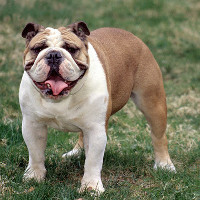
A little of the English Bulldog |
||
| The English Bulldog is also quite an ancient breed, and its origins are obscured by history. Although much smaller than the Neapolitan Mastiff, Bulldogs are powerful, courageous dogs that were frequently employed by farmers and butchers to control, guard and bait bulls throughout England. To this end, Bulldogs of the 1800s were bred to be much more tenacious and aggressive dogs than they are today, with an extremely high pain tolerance. This made them excellent candidates for fighting other dogs and, because of this trait, they were instrumental in the development of the American Pit Bull Terrier and the American Staffordshire Terrier. When these violent sports became illegal in 1885, the breed was maintained by Bulldog enthusiasts who chose to breed for a more pleasurable nature, and today's English Bulldog is generally a docile animal that is able to adapt to many situations. | ||
 |
||
| Standard of the English Bulldog | ||
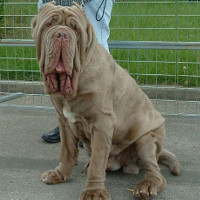
A little of the Neapolitan Mastiff |
||
| The Neapolitan Mastiff comes from Italy, where it is known as the Mastino Napolitano. This massive animal was originally used as a farm and family guard in the southern Italian countryside, using its mass to fearlessly protect its charges from thieves, wolves and perhaps even bear. After the Second World War, Neapolitan Mastiff enthusiasts began to focus on the breed, and the breed standard was drafted in 1948. | ||
 |
||
| Standard of the Neapolitan Mastiff |
Appearance of the English Neo Bull |
| The English Neo Bull has the thick body, strong neck and broad head of the molosser-type dog, and short-to-medium triangular ears that fold to the sides. Neapolitan Mastiffs are generally 30 to 50 centimeters taller than the average English Bulldog, and English Neo-Bulls can be found at either end of the spectrum, or anywhere in between. They have dark round eyes and their muzzle is probably shorter than average, sometimes with the lower jaw of the English Bulldog. If the dog in question favors Neapolitan Mastiff genetics, folds of loose skin may fall over the eyes, sometimes covering them completely, and those favoring the Bulldog will have shorter legs and a shorter muzzle. This hybrid sports a short, single-layer coat that requires very little maintenance, although the texture can be soft or coarse, depending on which parent breed their coat prefers. |
Temperament of the English Neo Bull |
| Neapolitan Mastiffs and English Bulldogs have been bred to be good-natured with their families and excellent with children. The modern English Bulldog tends to be friendly and easy-going with new people, but the Neapolitan Mastiff tends to be more discriminating as it ages, and if not properly socialized can become aggressive towards others. Interactions with young children must be closely supervised, even with the gentlest of these dogs due to their large size and power. In some cases, protection can become overprotective, and although this crossbreed is unlikely to intentionally harm a child, it can react quickly and decisively to anything it sees as a threat to its family. Their reaction to other animals can be somewhat variable, and while some get on well with other dogs, others can be aloof or even aggressive. |
Needs and activities of the English Neo Bull |
| To maintain its health, this dog needs to be active for at least 40 to 60 minutes a day, especially as it has a tendency to obesity. It's important to remember to shorten exercise sessions during your dog's formative years, separating them throughout the day and ensuring that your dog doesn't hurt himself at home or jump from great heights, as this can damage still-forming bones and joints. Swimming can be a particularly beneficial form of exercise for these dogs, as it can improve cardiovascular health and muscle mass without stressing the joints. Young English Neo Bulls may be too energetic for apartment living, but as they mature, they also become much calmer dogs. Although this crossbreed prefers the space offered by a house, it should be able to adapt fairly well to apartment living, as it has little tendency to bark and requires only moderate exercise. |
Maintenance of the English Neo Bull |
| The English Neo Bull is a fairly easy dog to groom. The short, single-ply coat of this crossbreed is quite manageable and although it requires regular brushing with a curry comb or soft bristle brush to remove dead hairs and distribute healthy body oils throughout the coat, monthly baths are usually sufficient to keep these dogs clean and fresh. Care must be taken to ensure that dirt and moisture are not trapped in wrinkles and folds of the skin, as this often leads to skin irritation and a foul odor can develop. The face and muzzle area should be checked daily and wiped down regularly to prevent the growth of red yeast and other fungal or bacterial infestations. |



 English (United Kingdom)

Comments