
 |
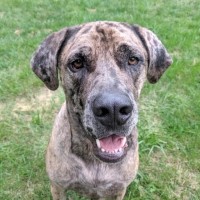
English Mastahoula |
|
He is not recognized by the F.C.I. |
Origin |
Great Britain <> U.S.A. -> U.S.A. | |
Translation |
Francis Vandersteen | |
This breed is also known as |
Mastahoula
|
A brief presentation of the English Mastahoula |
| The English Mastahoula is a hybrid of the Mastiff, a giant-sized guard dog with a laid-back attitude, and a Catahoula Leopard Dog, a medium to large-sized dog developed in the southern United States of America for hunting and breeding. The combination is generally a very large dog with a high intellect and a fairly calm demeanor, although it may not get along well with strangers or other animals. It is a versatile dog and can be suited to many different types of work, including breeding, hunting and guarding, but can be too assertive and stubborn for the first-time dog owner. |
History of the English Mastahoula |
| The English Mastahoula is a specific cross between a Louisiana breeding and hunting dog, known as the Catahoula Leopard Dog, and the Mastiff, a massive guard dog with an ancient history that has played a role in the development of many more recent breeds. |
A little of the Mastiff |
||
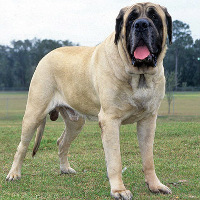
| Mastiff-like dogs were depicted in ancient Asian artwork as early as 2500 BC, and traveled across the Alps with Hannibal. When the breed arrived in England, it became a popular watchdog and hunting companion for both landowners and farmers. The two world wars had a negative impact on Europe's dog population and by the end of the conflicts, the Mastiff was almost extinct and had to be revived by importing Mastiffs from the USA and Canada to England for breeding. | ||
 |
||
| Standard of the Mastiff | ||
A little of the Catahoula Leopard Dog |
||
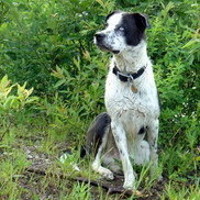
| The story of the Catahoula Leopard Dog's development is based almost entirely on conjecture and mythology, but we do know that the French who settled in Louisiana brought Beauceron herding dogs with them, and that these same settlers frequently described mysterious hunting dogs with haunting glass eyes that were kept by Native Americans. Most believe that the Catahoula is descended primarily from these two dogs, but as there was no record of the breed's formation, there's no way of knowing for sure. Catahoula Leopard Dogs, also known as Catahoula Curs, Catahoula Hounds and Catahoula Hog Dogs, have been used as both herding and hunting dogs, and have excelled in both professions. The English Mastahoula is generally less exuberant and arrogant than the Catahoula Leopard Dog, but with more energy and less mess than the Mastiff. | ||
 |
||
| Presentation of the Catahoula Leopard Dog |
Appearance of the English Mastahoula |
| The English Mastahoula can vary in size from large to giant, and generally has a bulky but athletic appearance. Their head is broad, with a substantially built muzzle, which can vary from short to medium. Their small to medium-sized ears rest high on the head and fold forward or to the side, and their eyes are generally round, although they can be many colors due to their Catahoula Leopard Dog heritage, including eyes that include several colors a single eye and a blue so light it's almost white, a color known as glass. Like the Mastiff, the English Mastahoula will generally have loose, wrinkle-forming skin, especially around the head and neck, although this is probably less exaggerated in the crossbreed. This dog will generally have an easy-care double-layered coat consisting of a soft, dense undercoat covered by a short, stiff outer layer that lies flat against the body, although some of these dogs may have a short, stiff coat without an underlying layer. English Mastahoulas can come in a variety of colors, and robin is frequently seen in both the Catahoula and its offspring, the Mastahoula. |
Temperament of the English Mastahoula |
| The Mastiff is generally a laid-back, dignified individual, while the Catahoula Leopard Dog has the focus, drive and energy that are characteristic of a serious working dog, and your English Mastahoula will most likely fall somewhere in between. Like their parent breeds, this hybrid requires daily interaction with their humans and can become quite destructive if bored or lonely. Training must also start at an early age, as both parent breeds are naturally protective and can become nervous or aggressive towards strangers and other animals if not properly socialized, and they can have a tendency to adopt dominant behaviors that can be mitigated by training. Their reactions to young children can be variable, as the Mastiff is generally very good with children, but the Catahoula Leopard Dog can be jealous and possessive, traits that don't sit well with small children. These dogs are very large and powerful, and all interactions between young children and dogs must be closely supervised to ensure the safety of everyone involved. |
Needs and activities of the English Mastahoula |
| Although the Catahoula Leopard Dog is a very active breed, the Mastiff generally requires much less exercise than average for a dog of its size, so 60 to 90 minutes of vigorous activity a day is usually enough to keep this hybrid strong and healthy. In addition to daily walks, these dogs are adept at drawing and carting, agility training, tracking and hunting. During your dog's formative years, it's important to reduce the duration of exercise sessions by interrupting them throughout the day. Make sure your dog doesn't scramble or jump from great heights, as this can cause lifelong damage by affecting bones and joints still in formation. |
Maintenance of the English Mastahoula |
| This hybrid has a short coat that makes grooming requirements quite manageable. Regular brushing with a soft bristle brush or curry comb is necessary to control shedding and distribute body oils, however, monthly baths are usually sufficient for these dogs. If your dog has inherited the folds and wrinkles commonly seen on Great Danes, precautions must be taken regularly to ensure that the skin folds have not trapped moisture, as this can cause skin irritation and a foul odor can develop, particularly around the face. They shed moderately all year round, although English Mastahoula with a double layer tend to shed more heavily than those with a single layer. |



 English (United Kingdom)

Comments