 |
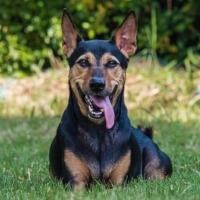
Doberman Shepherd |
|
He is not recognized by the F.C.I. |
Origin |
Germany -> U.S.A. | |
Translation |
Francis Vandersteen |
A brief presentation of the Doberman Shepherd |
| The Doberman Shepherd is a hybrid dog breed in which the Doberman is crossed with the German Shepherd. This hybrid breed will be a large dog, with an average weight of 41 to 50 kilos. Highly intelligent and with lots of energy, this dog will need a family that can offer it a significant amount of daily activity. The Doberman Shepherd dog breed can be stubborn, so it's important that its pet parent is clear that it, and not the dog, is in charge. |
History of the Doberman Shepherd |
| The Doberman Shepherd's history book has yet to be written, but we can turn to its parent breeds. |
A little of the Dobermann |
||
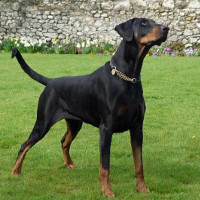
| The Dobermann dog breed originated in Apolda, Thueringen, Germany, thanks to the efforts of Karl Friedrich Louis Dobermann around 1890. He combined several dog breeds while perfecting the dog breed, including the Rottweiler, Weimar Pointer, German Pinscher and more. Mr. Dobermann was looking for a dog that would be competent at guarding. He succeeded in his quest; in fact, the breed continued to work as sentries, scouts and brave messengers in wartime. Many dogs are buried on the island of Guam, in the War Dog Cemetery. The Dobermann was added to the list of the American Kennel Club in 1908. In 1921, the Dobermann Club of America was formed. The first Dobermann to win Best in Show at the Westminster Kennel Club Show was in 1939. | ||
 |
||
| Standard of the Dobermann | ||
A little of the German Shepherd |
||
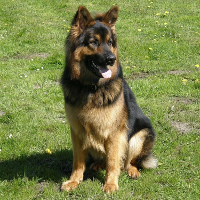
| The roots of the German Shepherd go back to the 7th century A.D. to a mountain sheepdog in Germany. Between the late 1800s and early 1900s, Captain Max von Stephanitz took local sheepdogs of the longhaired, shorthaired and wirehaired varieties and developed the modern German Shepherd, an all-purpose working dog. An organization called Verein fur Deutsche Scharferhunde SV was set up in 1899 to oversee German Shepherd breeding, with the aim of developing a courageous, athletic and intelligent herding dog. The first German Shepherd Dog was registered by von Stephanitz in 1899. Dogs of the breed worked as war sentries during the First World War, during which the breed name was changed from German Shepherd Dog to Shepherd Dog by the American Kennel Club. In 1931, the breed was renamed the German Shepherd Dog. | ||
 |
||
| Standard of the German Shepherd |
Appearance of the Doberman Shepherd |
| The Doberman Shepherd is a large dog, averaging 41 to 50 kilos and 56 to 66 centimeters in length. Muscular and agile, these attractive dogs have a short but soft coat. Seen in black, brown and tan, the Doberman Shepherd will most likely have large ears that stand on their own. His muzzle will be long and dignified, and his eyes will indicate his intelligence. His tail will be full and carried straight with a little curve. |
Temperament of the Doberman Shepherd |
| The Doberman Shepherd inherits loyalty, intelligence and observation skills from both parents, making it an excellent watchdog. He can be strong-willed and stubborn, but at the same time loving and affectionate. This is the kind of dog that prefers to be with its family, and will suffer from separation anxiety if left alone for too long. Early socialization and training will help the Doberman Shepherd avoid trying to dominate family members. The Doberman Shepherd tends to behave badly in cold weather and should be kept indoors when temperatures are low. |
Needs and activities of the Doberman Shepherd |
| The Doberman Shepherd is a very active dog with a lot of energy. Keeping him busy is important not only for his health, but also to make sure he doesn't become destructive at home. This hybrid is intelligent and has been bred for work, so he always likes to have a job to do or a mission to accomplish. Activities can include several long walks a day, accompanying you on errands and hikes, playing games and visiting the dog park. He may enjoy obedience trials to keep his mind stimulated. Not suited to apartment living, this big dog needs space. A rural environment or an urban home with a large yard are best for him. |
Maintenance of the Doberman Shepherd |
| Doberman Shepherds require very little maintenance, as they are weak to moderate excretors. We recommend brushing your Doberman Shepherd three to four times a week with the smoother brush, and bathing him when he's dirty. It's a good idea to train your Doberman Shepherd to get in and out of the bathtub from an early age, so that you'll find it easier to bathe him when he reaches adult size. Getting him used to having his nails trimmed like a puppy will be beneficial, as will having his teeth brushed. The Doberman Shepherd's ears should be cleaned every week, wiping all the parts you can reach. |



 English (United Kingdom)

Comments