
 |
Clumberstiff |
|
He is not recognized by the F.C.I. |
Origin |
Great Britain -> U.S.A. | |
Translation |
Francis Vandersteen |
A brief presentation of the Clumberstiff |
| The Clumberstiff is a cross between the Clumber Spaniel, a heavy-boned hunting spaniel, and the Bullmastiff, a dog bred to guard and protect large estates. These dogs are generally quite affectionate and sometimes even clownish with their families, but can be a little reserved with strangers. Socialization, early training and good nutrition are doubly important for these large dogs, to avoid aggression and ensure that their bones don't develop too quickly. Despite their size, these dogs are relatively calm and have only moderate exercise requirements, making them surprisingly easy to adapt to life in an apartment. |
History of the Clumberstiff |
| The Clumberstiff is a designer dog and an intentional cross between the Bullmastiff, a guard breed, and the Clumber Spaniel, a hunting dog, adept at hunting and retrieving game. |
A little of the Clumber Spaniel |
||
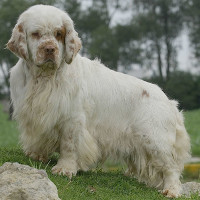
| The Clumber Spaniel was also developed in England, but the history of breeds used in conjunction with traditional Spaniel breeds is murky at best. The Clumber Spaniel breed is thought to have been developed in the late 18th and early 19th centuries, perhaps employing dogs such as Basset Hound, although records of the breeds that were used to create the Clumber Spaniel are non-existent. The most likely scenario is that they were developed for function rather than form by gamekeepers who worked with the dogs at the turn of the century. The Clumber was named after Clumber Park, an estate of almost four thousand acres that belonged to the Duke of Newcastle. Clumber Spaniel dogs were a popular hunting breed and were frequently depicted in artwork of the period, as well as having the honor of being one of the first nine dog breeds recognized by the American Kennel Club when it was formed in 1883. | ||
 |
||
| Standard of the Clumber Spaniel | ||
A little of the Bullmastiff |
||
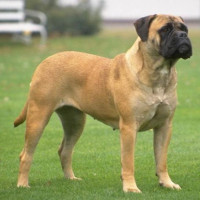
| The Bullmastiff is the only purebred guard dog to have been developed in England, and was originally a crossbreed itself. A hybrid of the English Bulldog and the English Mastiff, these imposing dogs were developed to guard land and game on the great English estates, protecting them from poachers and thieves. Mastiffs proved too big and slow for the job, and the Bulldogs of the time lacked the restraint to prevent poachers from maiming. The combination of the two, the Bullmastiff, is a smaller, more agile breed than the Mastiff and a larger, more controlled dog than the Bulldog of the time. | ||
 |
||
| Standard of the Bullmastiff |
Appearance of the Clumberstiff |
| This crossbreed is a large dog, although generally not as large as the Bullmastiff breed. Both parent breeds are solid, substantial animals, with large, flat heads and muzzles that are both broad and deep. They will generally have round or oval eyes ranging from amber to dark brown and may have a diamond or V-shaped rim, and their ears will be triangular, although they may sit on the sides of the head or on top of it. The Clumber Spaniel is considerably longer than it is tall, with fairly short legs, while the Bullmastiff has a squarer outline and longer legs. The Clumberstiff can inherit any of these traits, but in most cases they will be slightly longer than tall, but not as low as the Clumber Spaniel. Clumberstiffs are generally double-coated, with a dense undercoat covered by a short, weather-resistant outer layer that can be either harsh or soft, although some inherit the short, single coat of the Bullmastiff. |
Temperament of the Clumberstiff |
| This is a fairly large dog that tends to be more laid-back than active, with a dash of a clownish nature. They tend to be affectionate and gentle dogs with their families, both children and adults, although they can be a little stubborn. Some Clumberstiffs can have a somewhat exuberant sequence while still young, making them an unsuitable companion for the very young, although they tend to grow out of it by the time they reach maturity around the age of three. These dogs are very large and powerful, and interactions between young children and dogs must be closely supervised to ensure the safety of all involved. Their interactions with other animals can be variable, as the Clumber Spaniel tends to be quite sociable, but the Bullmastiff is known to sometimes show aggression towards other dogs. For this reason, socialization is particularly important for this crossbreed, and training should start early. |
Needs and activities of the Clumberstiff |
| Although this dog is unlikely to come begging for a workout, he needs to be active for at least 40-60 minutes every day to maintain his health, especially as he tends towards obesity. It's important to remember to shorten exercise sessions during your dog's formative years by separating them throughout the day and ensuring that your dog doesn't make noise or jump from great heights as this can damage bones and joints still in formation, especially for those who have inherited the Clumber Spaniel's longer back. Swimming can be a particularly positive experience for these dogs, as it will help build mass and cardiovascular health without stressing the joints. Mature Clumberstiffs will do better in an apartment than younger ones due to their energy levels, and although this cross prefers the space that a house offers, they should be able to adapt fairly well to apartment living as they don't tend to bark a lot and only require moderate exercise. |
Maintenance of the Clumberstiff |
| These hybrids are fairly easy to handle as far as grooming is concerned, as their short coats are generally quite manageable. Although they require regular brushing with a curry comb or soft bristle brush to control shedding and properly distribute their body oils, monthly baths are generally adequate for these dogs, unless they become dirty or muddy. If your dog has inherited the Bullmastiff's characteristic folds or wrinkles, the skin folds should be checked regularly to make sure they haven't trapped moisture or dirt, as this can lead to skin irritation and a foul odor. They shed moderately all year round, and Clumberstiffs with a double coat tend to shed more heavily than those with a single coat. |



 English (United Kingdom)

Comments