
 |
Chilier |
|
He is not recognized by the F.C.I. |
Origin |
Mexico <> Great Britain -> U.S.A. | |
Translation |
Francis Vandersteen | |
This breed is also known as |
Chivalier |
A brief presentation of the Chilier |
| The Chilier is a hybrid breed. It's a combination of the parent breeds Chihuahua and Cavalier King Charles Spaniel. It's a wonderful, family-oriented dog. He's very affectionate and playful. He's a laid-back, happy dog, and bonds quickly with his family. He can be a variety of colors, depending on his direct parentage. It can be a better watchdog than comparable breeds. It is suited to living in many environments, including apartments or larger houses with a fenced-in area in which it can play. |
History of the Chilier |
| Although there isn't much information on the Chilier breed itself, we can still learn a lot about the breed by studying its parent breeds. |
A little of the Chihuahua |
||
| Two main theories abound as to the history of the living Chihuahua. Said to have come from China to Mexico aboard trading ships, or to have descended from the Techichi dog of South or Central America, this little dog was treated like a king because it was thought to have healing powers of a magical nature. Placed on the pillows of those who were ill, it was also cremated and buried with its owners when they died. The Aztecs, who involved the Chihuahua in their medical and spiritual rituals, depicted these events on ancient works. This breed was added to the list of the American Kennel Club in 1904. | ||
 |
||
| Standard of the Chihuahua | ||
A little of the Cavalier KIng Charles Spaniel |
||
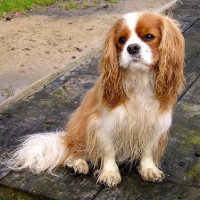
| The Cavalier King Charles Spaniel is a relatively new breed, or so described, as it has undergone many changes as it has developed over the years. From the long-nosed version favored by King Charles II to the shorter-nosed version that emerged when it was crossed with the Carlins after the kings' reign ended, today's Cavalier King Charles Spaniel arrived in the USA in the early 1940s and breed standards were finally put in place with the formation of the Cavalier KIng Charles Spaniel Club in the 1950s. Nicknamed the Quilted Spaniel, President Ronald Reagan and his wife Nancy had one of these Royal Spaniels at the White House. The American Kennel Club recognized the Cavalier King Charles breed in 1995. | ||
 |
||
| Standard of the Cavalier KIng Charles Spaniel |
Appearance of the Chilier |
| The color, coat type and coat length of the Chilier all depend on the Chilier's immediate parentage. The Chilier's parent breeds differ slightly in size and coat construction. Some Chihuahuas have longer coats. Others have short coats. The Cavalier King Charles Spaniel has a medium to long coat. The smooth-haired Chihuahua has a smooth, glossy coat that is close to the body, with a thicker collar of hair on the neck. The long-haired Chihuahua has a soft coat that can be slightly curly. The ears will have an extra fringe of hair and a feathered tail. They may also have feathers on their feet. Chihuahuas can have a variety of colors, so it's difficult to predict a color for its offspring. Colors range from black, white, fawn, chocolate, gray, silver, tricolor, brindle, spotted and merle. It's also important to know the Cavalier King Charles Spaniel's appearance to determine what the Chilier might look like. The Cavalier King Charles Spaniel generally has a medium-length coat that is usually silky to the touch with wavy hairs. It can come in a variety of colors: Blenheim, tricolor, black and tan or ruby. Generally, Blenheim is the Cavalier King Charles Spaniel's most common color makeup, which is a brown and white coat. He'll have feathered hair on his ears and tail. Your Chilier will most likely have long hair with a soft coat. His eyes will be round and slightly domed, as seen in related breeds. |
Temperament of the Chilier |
| Although there isn't much information about the Chilier, we can study information about its parent breeds to find out what to expect from this hybrid. The Chihuahua can be a temperamental breed. They often bond with one person in their family and may simply tolerate other humans around them. This is not always true, and socialization is important so that your dog knows how to behave and what is expected of him at all times. The Chihuahua is confident, often acting like a Terrier. He's alert and doesn't like strangers. However, it can also be very affectionate. The Cavalier King Charles Spaniel loves people; in fact, it never meets a stranger. The Cavalier is not a great watchdog, it doesn't bark often, and even if it alerts you to a stranger, if the stranger is remotely friendly, the Cavalier will reciprocate. A fine balance between the parents will be seen in your hybrid. Reserved but friendly, cautious but warming once you've agreed, the Chilier will be happy to oblige. |
Needs and activities of the Chilier |
| The Chilier is an active little dog. He loves to chase small animals like squirrels, and will play as long as you allow him to. However, be careful not to let the Chilier overexert itself. Your hybrid can adapt well to apartment life, or live in a small house with or without a yard. He loves to lie on your lap, but he's also very athletic and can be an excellent companion throwing a Frisbee or playing fetch. Always keep him on a leash outside the house or an unfenced area. Be aware of your Chilier's condition at any given temperature. He may be sensitive to heat or cold. |
Maintenance of the Chilier |
| The Chilier has moderate grooming requirements. It's not difficult to maintain, and grooming once a week is often more than enough to keep your Chilier in tip-top shape. He's a minimal excretor, so brushing once a week with a bristle brush is all that's needed to massage his natural oils into his coat and remove any excess hair. Of course, during shedding season, you may need to do this more than once a week. He'll only need a bath when he gets dirty. You should brush your Chilier's teeth at least three times a week, but if you want to prevent gum disease, brush your dog's teeth daily. Trim your dog's nails every two weeks, as nail breakage can be painful if it occurs. |



 English (United Kingdom)

Comments