
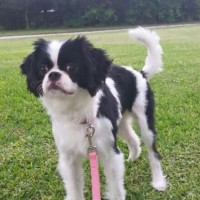
 |
Cava-Chin |
|
He is not recognized by the F.C.I. |
Origin |
Great Britain <> China -> U.S.A. | |
Translation |
Francis Vandersteen |
A brief presentation of the Cava-Chin |
| The Cava-Chin is a hybrid breed. Its parents are the Cavalier King Charles Spaniel and the Japanese Spaniel. It's a small dog that will probably weigh less than 8 kilos, depending on the size of its parents. It is suitable for children and is an excellent dog for new dog owners. He's actually a very easy-going dog, not overly active. He's likely to have a variety of colors, and he's actually low-maintenance, although his parent breeds often need more grooming. They're perfect for apartment-dwellers and families with fenced backyards. |
History of the Cava-Chin |
| Although there isn't much information on the Cava-Chin breed itself, you can still learn a lot about the breed by studying its parent breeds. |
A little of the Cavalier King Charles Spaniel |
||
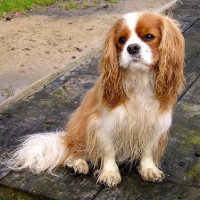
| The Cavalier King Charles Spaniel itself is a relatively new breed that has gone through several transitions, particularly in appearance, to become the dog it is today. A valued companion of nobility and royalty, it was Mary Queen of Scots' favorite palace attendant, and her grandson and great-grandson, Charles I and II, owned numerous Spaniels, ultimately giving the breed its name. Cavalier King Charles Spaniels emigrated to the USA in the 1940s and soon afterwards, in the 1950s, the Cavalier King Charles Spaniel Club was formed. Once an excellent hunter, the breed is often referred to as the Quilted Spaniel and they have become the chosen addition to many families. They joined the American Kennel Club in 1995. | ||
 |
||
| Standard of the Cavalier King Charles Spaniel | ||
A little of the Japanese Spaniel |
||
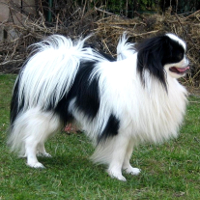
| Although the exact origin of the Japanese Spaniel breed is unknown, some believe the breed is related to the Pekingese and was brought to Japan by Buddhist teachers around 520 AD. Others believe that around 1000 AD, the Chinese emperor presented the dogs to the Japanese emperor as a gift. Since its arrival in Japan, it has become a very popular dog. The Japanese nobility were very fond of the dog. Most believe that the Chin was brought to Europe by Portuguese sailors who had traded in Japan. We know for certain that Princess Catherine de Bragance was given a Japanese Spaniel by Portuguese sailors. Commodore Matthew Perry officially brought the Chin to Europe in 1854. Perry gave a pair to Queen Victoria and would later give another to the President of the United States. In the late 1800s, the Chin was recognized by the American Kennel Club as the Japanese Spaniel. In 1977, the AKC officially changed the name to Japanese Spaniel. This dog is still very popular in Japan. | ||
 |
||
| Standard of the Japanese Spaniel |
Appearance of the Cava-Chin |
| The Cava-Chin is generally quite small. Ultimately, this will depend on the dominant genes of the parents, but this hybrid usually weighs no more than 8 kilos and measures around 30.5 centimeters high at the shoulder. Females tend to be slightly larger than their male counterparts. Its hair will generally be of medium to long length. Occasionally, it may have wavy or curly hair. It can have a variety of colors, but often will be modeled much like the parent Cavalier King Charles Spaniel breed. It can be white with brown, red, fawn or black markings. It's also important to know the Japanese Spaniel's appearance to determine what the Cava-Chin might look like. The Japanese Spaniel actually comes in a variety of shapes and sizes due to the introduction of different breeds into the gene pool over the years. Some Chin are significantly larger than their counterparts. Your Cava-Chin may have a broad head with large, wide eyes and a flat, brachycephalic face, meaning the muzzle is short. Their ears are small and V-shaped, with long hair covering them. These dogs have an underbite. The tail may be curled over the back with feathered hairs along the tail. The coat, if similar to the Japanese Spaniel, could be white with colored patches, the most common colors being black, red, lemon, orange, sable, black and white with brown or brindle points. Without a standard for the Cava-Chin hybrid, your pet may take on characteristics inherited from either parent. Either way, he'll be adorable. |
Temperament of the Cava-Chin |
| The Cava-Chin is a very gentle dog. He's energetic and lively. He is most certainly a companion dog, although with a sense of humor and a mischievous temperament, he may have a talent for pursuing his own interests. He has a great memory and remembers well anyone who disturbs him in any way. He loves people and likes to be surrounded by his family; Cava-Chins can experience separation anxiety. He needs reinforcement with treats and other positive measures during training. He is known for obeying commands and listening to his owner. It has a reputation for being playful and energetic with children, as well as being very affectionate. The Cava-Chin is an excellent dog for novice owners. |
Needs and activities of the Cava-Chin |
| The Cava-Chin is a lively, playful little dog. However, he needs a minimum of thirty minutes of daily exercise to prevent him from having pent-up energy, which could lead him to be destructive. Dog parks are recommended for the Cava-Chin, as it will certainly enjoy interaction with other dogs. If you don't have a dog park in your area, perhaps he could accompany you on a walk or jog. Leaving your Cava-Chin outside in an unfenced yard is not recommended, nor is leaving it unattended. It has a reputation for chasing cars, so if you're outside with it, it should be on a leash or in a fenced-in area. It's also important not to put too much strain on your Cava-Chin. It's always possible that the Cava-Chin inherits the brachycephalic muzzle of its Japanese Spaniel parent. If this is the case, overheating can lead to breathing difficulties for the Cava-Chin. |
Maintenance of the Cava-Chin |
| Cava-Chins have moderate grooming requirements. It's not difficult to maintain, but grooming really depends on the type of coat it inherits. Generally, the Cava-Chin doesn't shed as much as its Cavalier King Charles Spaniel relative. He will need to have his coat brushed with a pin brush at least once a week. If he needs a bath, be sure to remove tangles and mats from his coat before wetting him, otherwise the tangles will be almost impossible to remove. During shedding season, daily care may be the best idea. Nail and tooth care are also important, as the Cava-Chin can be prone to tooth decay like all small canine breeds. If his nails make a clicking sound when he walks, then his nails should be trimmed immediately. |



 English (United Kingdom)

Comments