
 |
Boxerman |
|
He is not recognized by the F.C.I. |
Origin |
Germany -> U.S.A. | |
Translation |
Francis Vandersteen |
A brief presentation of the Boxerman |
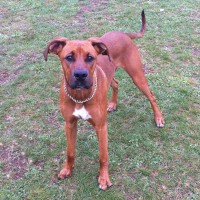
| The Boxerman is a large dog created by crossing a Boxer and a Dobermann. This breed is very social and friendly, but can also make an excellent watchdog because of its bravery and loyalty. At around 27 kilos and 61 centimetres in height on average, the Boxerman makes a rather intimidating guard dog. However, the Boxerman is a gentle dog that is excellent with other animals and children (under supervision) and enjoys playing as well as working. Their coat is short and fine and can take on just about any color, but is usually brown and white; black and white; or black and brown. Their fur is not weather-resistant, so should not be left outside in extreme temperatures. |
History of the Boxerman |
| The history of the Boxerman belongs to that of its august parent breeds. |
A little of the Boxer |
||
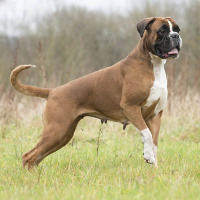
| The Boxer originated in Germany in the 1800s as a guard dog, but was used as a fighting dog and bull baiter before these activities were banned. Many believe the breed comes from a line of European dogs that were used in dog fighting in Tibet. Others believe it is a relative of the Tibetan Bulldog and Mastiff, and that all European dogs have some relation to the Boxer. Their relatives were also used to hunt deer and wild boar in the 16th and 17th centuries. The Boxer is a strong, fearless dog and was the first breed to be used as a police dog. They were registered with the American Kennel Club (AKC) in 1904 and are the 10th most popular dog in America. | ||
 |
||
| Standard of the Boxer | ||
A little of the Dobermann |
||
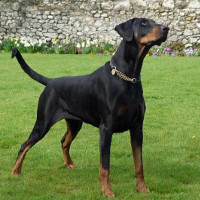
| Another guard dog, the Dobermann has been around since the 1800s and originated in Germany. They were named after Louis Dobermann of Thuringen, Germany, who developed the breed to guard him in his door-to-door tax-collecting job. It's a breed that was so popular that they were already registered with the AKC when they crossed the Atlantic Ocean to America in 1908. They are now the 15th most common dog in America. The Dobermann is thought to be a product of Manchester Terriers, Greyhounds, Great Danes and Rottweilers, although some say there are also German Shepherds, Weimaraners and Schnauzers in the breed. During World War II, the breed earned the nickname Devil Dog as they were used to flush out the enemy. Your Boxerman should have a mix of these wonderful characteristics in both breeds. | ||
 |
||
| Standard of the Dobermann |
Appearance of the Boxerman |
| The Boxerman is a large dog with a solid body and long, muscular legs. They tend to have a square head with a long muzzle, short coat, soft triangular ears and a wise expression. This breed has large feet and a long tail that usually wags unless they're on guard. Their features are more like a Dobermann but have the stockiness of a Boxer. They generally measure around 53 to 63.5 centimeters in height and between 23 and 32 kilos. This intelligent dog can be any color, but you'll usually see them in brown and white; black and white; or black and brown. |
Temperament of the Boxerman |
| This breed is exceptionally intelligent and can be trained easily, although it can be stubborn, so you need to be consistent. Positive reinforcement rather than discipline is recommended, as with all dogs. They are known for their alertness and loyalty, and make excellent pets as well as watchdogs. Although both parent breeds were bred as fighters, they have no aggressive tendencies. The Boxerman loves to play with children and other pets, but, like other dogs, should not be left alone with young children. They love to run and seem to have a humorous side like the Boxer. |
Needs and activities of the Boxerman |
| Although the Boxerman loves to run and play, it's just as happy to spend time with you. They enjoy a long walk or jog or a long game of fetch, but they don't like to stay outside for long when it's extremely hot or cold because of their short coat. Having a fenced yard for them to run around in during the day when the weather is fine is a bonus, as they can recover their pent-up energy while you sit back and relax. Visits to the dog park or the beach are also great ideas for your Boxerman. |
Maintenance of the Boxerman |
| Since Boxermans have short coats, their grooming needs are minimal. You can brush them with a soft or hard bristle brush or straightener once or twice a week, and bathe them when absolutely necessary. However, don't shampoo too often, as this removes the essential oils needed for healthy skin and hair. Brushing is also important to minimize shedding, which can be quite heavy during the summer months. Their nails should be trimmed regularly, and you should brush their teeth several times a week to prevent dental disease. Clean their ears once a week and watch out for any redness or irritation. |



 English (United Kingdom)

Comments