 |
Biton |
|
He is not recognized by the F.C.I. |
Origin |
France / Belgium <> Madagascar -> U.S.A. | |
Translation |
Francis Vandersteen |
A brief presentation of the Biton |
| The Biton is a hybrid dog created in the United States. Bred as a family companion after crossing a Bichon à poil frisé with a Coton de Tuléar, the Biton retains the small size and adorable fluffy or long, curly coat of its parents. It's a dog that gets on well with children and other pets, and can alert you from afar with its bark. Cheerful and adorable, Bitons are attached to their family and can suffer from separation anxiety if left alone for too long. Daily brushing and an occasional bath will keep this dog adorable, while daily walks will keep him out of trouble. |
History of the Biton |
| The Biton is a hybrid dog native to the United States. It was created by crossing the Bichon à poil frisé with a Coton de Tuléar to make a wonderful family companion. Although not much is known about the origin of this hybrid, there is a lot of documentation on the parent breeds. |
A little of the Bichon frise |
||
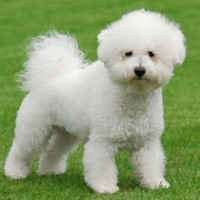
| Ironically, the Bichon à poil frisé and the Coton de Tuléar are actually related. They are both descended from the Barbet, or Barbichon breed, a dog that was variously placed in Europe and the Mediterranean. At one point, this woolly water dog was brought to the island of Tenerife in the Canary Islands by Spanish or Portuguese sailors. In the 14th century, Italian and French sailors introduced the breed to Europe. This strain of Barbichon was to become the Bichon à poil frisé. In Europe, the Bichon Frise enjoyed popularity among the royal houses of Spain, France and England until the late 1800s. As their status as favorite royal pets faded, they began to appear as circus performers and organ grinders. After the First World War, breeders in France sought to preserve the breed, and an official standard was adopted in 1933. They were then called Bichon or Tenerife, and later, the French name that translated as Bichon à poil frisé was anglicized into Bichon Frise. The breed arrived in the United States in 1956 and was recognized by the AKC in 1971. | ||
 |
||
| Standard of the Bichon frise | ||
A little of the Coton de Tuléar |
||
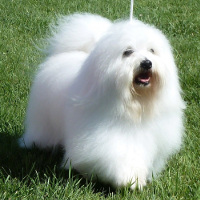
| Back on the island of Tenerife, the Barbichon breed was taken by sailors in the 16th and 17th centuries to the Indian Ocean islands of Mauritius and Reunion. By then, the breed had evolved a long cottony coat and was called the Coton de la Réunion. The dog became a prized possession of sailors, merchants, officials and pirates aboard their ships, and was brought to the trading port of Tuléar in Madagascar during the 17th century. Here, it was prized by the Marina tribal monarchy and soon became the country's royal dog. For a long time, anyone other than royalty was forbidden to own the dog. Over time, it crossed with the Morondava hunting dog. In the 1970s, the breed was imported to France and the United States and acquired the name Coton de Tuléar. The AKC did not recognize the Coton as a distinct breed until 2014. | ||
 |
||
| Standard of the Coton de Tuléar |
Appearance of the Biton |
| The Biton is a small dog with many of the characteristics of its parent breeds, the Bichon à poil frisé and the Coton de Tuléar. They are robust, well-proportioned dogs with round, dark eyes set in a round head. Their expression is alert, cheerful and curious. A short muzzle ends in a black nose. Ears hang over the sides of the head. The coat is the most distinctive element revealing its lineage. Hair can be soft and thick, like the Bichon Frise, or long, smooth and curly, like the Coton de Tuléar. Colors can range from solid white to white with different areas of apricot, cream or gray. |
Temperament of the Biton |
| As a general rule, the Biton does best in a large family. This intelligent dog is easy to train and is known to listen and obey its owner's commands. The Biton can, however, become nervous about noises outside its territory, causing it to bark. He may need training to avoid excessive barking. The Biton's energy levels are moderate, and it does well with walks and playing indoors and out. This breed can also benefit from dog sports such as agility trials and catching. |
Needs and activities of the Biton |
| The Biton is an energetic, cheerful and loving breed, just like its parent breeds. It's a happy dog that warms hearts with its gentle expression and fluffy coat. This mild-mannered breed is good with children and can also be good with other pets, as long as proper socialization occurs. Socialization can also help curb any shy or suspicious behavior, as well as separation anxiety. |
Maintenance of the Biton |
| The Biton is a hypoallergenic dog not known for shedding heavily. The thick or long coat should be brushed daily to avoid mats and tangles. An occasional bath when needed will keep the Biton's coat looking and smelling good, but make sure you don't bathe it too often as this can cause dry skin. Take care with dental care, as the Bichon Frise's parent breed is known to be prone to gum infections. Ear infections can also be a concern, so keep ears clean and hair-free. |



 English (United Kingdom)

Comments