
 |
Aussie-Flat |
|
He is not recognized by the F.C.I. |
Origin |
U.S.A. <> Great Britain -> U.S.A. | |
Translation |
Francis Vandersteen |
A brief presentation of the Aussie-Flat |
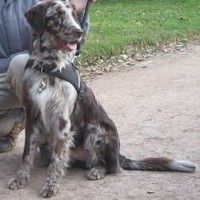
| The Aussie-Flat, a combination of the Australian Shepherd and the flat-coated Retriever, is a new customizable hybrid that is not yet registrable with the American Canine Hybrid Club or the National Hybrid Registry. These large dogs are friendly, bright animals that are frequently used as guide dogs for the blind. They are good with children and small animals, and the breeding tendency of the Australian Shepherd is somewhat mitigated by the Retriever's general personality. Relatively easy to care for, the Aussie-Flat is also a responsive, energetic companion who will need plenty of exercise to stay happy and healthy. |
History of the Aussie-Flat |
| The new hybrid known as the Aussie-Flat is either so new or so rare that it is not yet registrable with the American Canine Hybrid Club or the National Hybrid Registry. The Australian Shepherd and Flat-Coated Retriever mix is frequently bred and well-suited to the job of guide dog for the blind. The Australian Shepherd tends to be an efficient guide dog moving quickly with little hesitation, and the Flat-Coated Retriever is a more cautious and deliberate guide. In most cases, the Aussie-Flat is an F1 cross, meaning that the parents are both purebred rather than hybrid dogs bred with other such hybrids. At this stage, breeding only F1 crosses can help avoid many of the problems such as blindness and deafness associated with a dog that has a double copy of the Merle coloring gene. Dogs of this variety that are not used as guide dogs can make suitable hunting partners and will certainly make a companionable and somewhat protective family dog. |
A little of the Australian Shepherd |
||
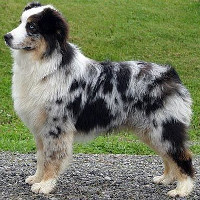
| The modern Australian Shepherd was actually developed in the farmlands of the USA in the late 19th century, rather than in Australia, as its name suggests. The breed was developed by cattle and sheep breeders, probably from Basque sheepdogs that traveled from Australia to America in the early 1800s. The herding dogs developed by the Basque people, most likely Pyrenean sheepdogs that had been crossed with a Collie-type breed, would have been crossed with other stock dogs in America to develop an agile and durable herding animal. | ||
 |
||
| Standard of the Australian Shepherd | ||
A little of the Flat-Coated Retriever |
||
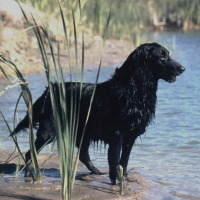
| The Flat-Coated Retriever, like most pointing breeds, was developed as a hunting dog, used to flush out birds and retrieve them when shot. The original Retriever was a large Newfoundland mixed with Setters, Spaniels and Water Dogs. It wasn't until the mid-to-late 1800s that a distinction was made between a curly coat and a flat coat, then known as a smooth coat. The Flat-Coated Retriever was recognized by the Kennel Club of England in 1874 and by the American Kennel Club in 1909. | ||
 |
||
| Standard of the Flat-Coated Retriever |
Appearance of the Aussie-Flat |
| The Aussie-Flat cross is so new that no appearance standard has been established, and there can be many variations even within the same litter of puppies. These are fairly large dogs, generally between 51 and 61 centimeters in height and weighing between 18 and 34 kilos. The structure of the top of the head is usually relatively flat, although some Aussie-Flats can have a slightly rounded skull. The muzzle, eyes and ears of these hybrids can vary considerably. The muzzle itself can range from the powerful, broad muzzle of the Retriever to the more tapered muzzle of the Australian Shepherd, but the lips should be close to the body rather than pendulous. Both parent breeds have almond-shaped eyes, and this is usually what we see for the hybrid too, and they can come in brown, hazel and blue. Their ears tend to sit high on their heads, but they can fold forward like the Australian Shepherd, or they can hang to the side like the Wirehaired Retriever. Both dogs have somewhat waterproof, medium-length coats that are straight or slightly wavy. The Australian Shepherd, however, has a thick undercoat that is not present in the Flat-Coated Retriever, so the Aussie-Flat may have the double or single coat. |
Temperament of the Aussie-Flat |
| Both parent breeds are highly intelligent and can be trained for many situations, however, they can tend towards stubbornness if their early training has been neglected. They tend to be patient and companionable with children and small animals, and most date strangers. This breed combination tends to be both vocal and talkative, and may try to guide their owners or other family members by the hand. If this behavior is unwanted, it should be treated promptly; if these behavioral traits become ingrained when the dog is young, it can become very difficult to train them. |
Needs and activities of the Aussie-Flat |
| These dogs are generally friendly, alert and intelligent animals that are exceptionally sensitive to their owners. They are generally bred for the qualities that make a good guide dog, and if properly socialized, these dogs should be confident, attentive animals with a keen awareness of their surroundings. Australian Shepherd prey and herding can make an appearance, but are more likely to be moderated by the nature of the flat coat. |
Maintenance of the Aussie-Flat |
| The grooming involved for this particular crossbreed is relatively straightforward, but regular grooming should never be neglected. Bathing is generally an exercise in need, and too frequent a bath can strip these dogs of the oils essential for coating their coats. Both parent breeds shed moderately for most of the year, and will require thorough brushing at least once a week. In spring and autumn, the amount of shedding increases considerably, and brushing sessions should take place several times a week to remove dead hairs and avoid tangles. Although Australians are unlikely to drool in large quantities, Retrievers can sometimes be big droolers. Fortunately, the flat-haired Retriever has no such tendency, and the Aussie-Flat remains a relatively drool-free companion. |



 English (United Kingdom)

Comments