
 |
Amstiff |
|
He is not recognized by the F.C.I. |
Origin |
U.S.A. <> Great Britain -> U.S.A. | |
Translation |
Francis Vandersteen | |
This breed is also known as |
Bandogge
|
A brief presentation of the Amstiff |
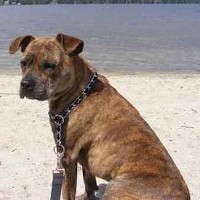
| The Amstiff is a cross between the American Staffordshire Terrier and the Mastiff. The nickname Bandogge refers to a cross between the Mastiff and one of the Bulldogs. This hybrid breed is easy to care for when it comes to grooming. They are large dogs that are great guardians and need a moderate amount of exercise, which can be done by walking or jogging with him on a leash. It can also take place in a fenced yard. While the Amstiff can be an apartment dog, it will need some exercise to keep it out of mischief that can be caused simply because it's bored. Amstiffs are considered great family dogs, but they need to be socialized with children at an early age. |
History of the Amstiff |
| The Amstiff's name is a blend of the names of its parent breeds, the American Staffordshire Terrier and the Mastiff. This makes the Amstiff an excellent companion, watchdog and versatile family dog. |
A little of the American Staffordshire Terrier |
||
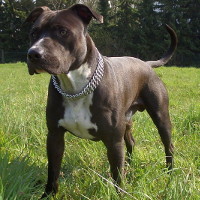
| With the American Staffordshire Terrier, also known as the Am Staff, we discover an interesting fact: this breed and the American Pit Bull Terrier have very similar origins. Created by combining the Bulldog and Terrier breeds, the Am Staff was mainly used for entertainment during the 19th and 20th centuries, when dog fighting was legal and popular in the USA. This was a terrible tradition, as it made dogs extremely aggressive and the mistreatment encouraged even more terrible behavior. While the Am Staff was used in these entertainment circles, it seems that the Pit Bull was most affected by these problems, as this breed wasn't even registered by the American Kennel Club, whereas the Am Staff was from 1936 onwards. These breeds weren't all bad, despite what people tried to make them believe. Both the Am Staff and the Pit Bull were also used by families as farm and guard dogs. They were excellent raiders and defenders against animals such as bears and wild pigs. Their fearlessness and bravery made them ideal for the job. Today, the Am Staff is still a working dog, but is mostly seen at shows and as a family companion. | ||
 |
||
| Standard of the American Staffordshire Terrier | ||
A little of the Mastiff |
||
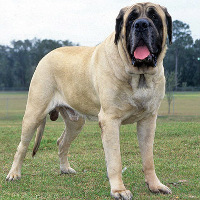
| The Mastiff is a descendant of the Molossus family and is thought to have been brought to the British Isles on Phoenician trading ships somewhere between 2000 and 1500 B.C. These dogs were isolated on an island and bred to protect the tribes who lived on the islands for hundreds of years. During the Roman invasion in 55 BC, Mastiffs took part in the resistance against Rome. Julius Caesar was impressed by the breed's size and courage, and brought them to Rome to fight lions and gladiators. Over the centuries, the Mastiff continued to play its role as protector and guardian, but also participated in bull and bear baiting and pit fighting. The modern Mastiff is a descendant of these dogs as well as of the Lyme Hall Mastiffs. The foundation of Lyme Hall Mastiffs and future English Mastiffs was the dog of Sir Peers Legh, who was mortally wounded in battle on October 23, 1415 in northern France. His Mastiff defended him for hours during the battle and returned home with a litter of puppies. The Mastiff was eventually bred selectively to minimize problematic qualities, creating a large, docile dog that was recognized by the American Kennel Club in 1885. | ||
 |
||
| Standard of the Mastiff |
Appearance of the Amstiff |
| You can expect an Amstiff to display the characteristics of its two parent breeds. The American Staffordshire Terrier is available in several colors: red, fawn, white, black or blue, they can also have any of these colors with white markings. The Mastiff has a short, straight fawn or apricot outer coat, often with black markings. Most Amstiffs resemble the American Staffordshire Terrier only in size, but some Amstiffs have a Mastiff-like head. The American Staffordshire Terrier has a short, straight coat, while the Mastiff has a short, dense undercoat. Expect a mix of both in your Amstiff. |
Temperament of the Amstiff |
| Although American Staffordshire Terriers and Mastiffs have been used as fighting dogs in the past, the big dogs are actually gentle giants. They're great with children, though it's recommended that they be socialized from an early age. Mastiffs are wary of strangers and have been known to step between their human family and strangers if they sense a threat. Mastiffs are more stubborn than American Staffordshire Terriers, and although your puppy may have the personality of an American Staffordshire Terrier, it's best to enroll your Amstiff in obedience classes. Working with an Amstiff will require patience, firmness, consistency and loving correction. |
Needs and activities of the Amstiff |
| The Amstiff is a mix of a large-breed dog and a giant-breed dog, so you can expect the Amstiff to grow rather large himself. However, Mastiffs and American Staffordshire Terriers can live in an apartment if they get plenty of exercise, although they thrive in a home that has a fenced yard. Both parent breeds require a fairly moderate amount of exercise and activity. Neither the Mastiff nor the American Staffordshire Terrier tolerates heat well, so make sure the Amstiff has access to water during playtime. Mastiffs especially tend to be destructive when bored, so daily exercise is a must for the Amstiff. |
Maintenance of the Amstiff |
| The American Staffordshire Terrier and Mastiff have short, straight coats, so grooming an Amstiff should be pretty easy. Weekly brushing with a rubber glove is recommended. Mastiffs tend to shed more than American Staffordshire Terriers, so you may need to brush more than once a week. If your Amstiff puppy inherits Mastiff wrinkles, you'll need to clean the wrinkles daily to prevent bacterial infections. To clean, use a damp washcloth to wipe between the wrinkles. Make sure you don't leave the area damp, as this could encourage bacterial growth. You should brush your dog's teeth at least three times a week, but if you want to prevent gum disease, brush daily. Trim your dog's nails every two weeks. The general rule is that if you hear your dog's nails clicking on the floor, it's time to trim them. |



 English (United Kingdom)

Comments