
 |
Sprocker Spaniel |
|
He is not recognized by the F.C.I. |
Origin |
Great Britain -> U.S.A. | |
Translation |
Francis Vandersteen |
A brief presentation of the Sprocker Spaniel |
| As the Springer Spaniel and Cocker Spaniel were the same breed not so long ago, by breeding them together to create the Sprocker Spaniel, it would seem we've come full circle. Known for their abundant energy, gentle soul and intelligence, it's no wonder this newly developed breed has quickly gained in popularity. Sprockers are a pleasure to train, as they live to please their master and have the brains to master a range of complex tasks. A medium-sized dog, the Sprocker Spaniel has hanging ears, expressive eyes and a glossy, curly coat. The coat comes in a wide range of colors and patterns, with white and brown and white and black being the two most popular color combinations. |
History of the Sprocker Spaniel |
| The Sprocker Spaniel is one of the best-known crosses between the Cocker Spaniel and the English Springer Spaniel. As these two breeds are considered to be one and the same, this hybrid shows less variation than most. Although many use the English Cocker Spaniel in the mix, it's also possible to use the American Cocker Spaniel, which shares many of the same genes. Unsurprisingly, the Cocker Spaniel and Springer Spaniel share much of the same history. They were first intentionally bred together 20 or 30 years ago, although it's likely that Cockers and Springers had already mated, as many would have worked and lived together, although their offspring may not have been bred in an attempt to preserve the pedigree. All Spaniels are thought to have once derived from Spain, hence the name. While they may have existed for a long time, it wasn't until the 14th century that the breed type was refined for the specific purpose of hunting. Traditionally used as hunting dogs, Spaniels were comfortable working on both land and water, and were trained to pursue and retrieve prey such as waterfowl. A few hundred years later, these dogs were subdivided into what were known as Crouching Spaniels and Springing Spaniels. Over time, Springing Spaniels were classified as Cocker Spaniels and Springer Spaniels. In fact, it was during the second half of the 19th century that these hunting dogs were officially declared to be two distinct breeds. Springers and Cockers are both working dogs, companion dogs and show dogs, with individuals often differing in appearance, depending on the purpose for which they were bred. The American Cocker Spaniel differs from the English Cocker Spaniel in that it was perfected in America during the 1900s to become smaller and lighter, and has lost much of its athletic and hunting ability. |
A little of the English Springer Spaniel |
||
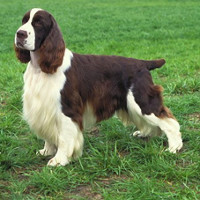
| As for the Spaniel in history, they were originally hunting dogs too. The first dogs probably came from Spain and were widely distributed by traders to develop further in England. An interesting feature of the breed is that Cocker Spaniels and Springers are very closely related. Indeed, in the 19th century, both types could be born in the same litter, the distinction being only one of size. The smaller ones were trained for woodcock hunting and became Cockers, while the larger ones were used for hunting or spring play, hence the name Springer Spaniels. In 1902, the British Kennel Club recognized them as separate breeds. | ||
 |
||
| Standard of the English Springer Spaniel | ||
A little of the English Cocker Spaniel |
||
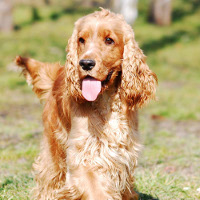
| The English Cocker Spaniel is a small dog belonging to the sporting and hunting breed group. It's energetic, gentle and affectionate, with an extreme desire to please its owner. Originally bred as Terrestrial Spaniels to hunt Woodcocks during shooting sessions, English Cocker Spaniels love work and mental stimulation, making them excellent pets for active families, while also excelling as sniffer dogs. English Cocker Spaniels are quick learners and this, combined with their willingness and desire to please, makes them highly trainable. | ||
 |
||
| Standard of the English Cocker Spaniel |
Appearance of the Sprocker Spaniel |
| The Sprocker Spaniel actually has a fairly uniform appearance for a breed, as its parents are very similar. Sprockers are notoriously handsome dogs with noble features and a well-proportioned body. Those descended from American Cockers will have a more domed skull. Their muzzle is relatively long and broad, ending in a remarkably sensitive nose that can be black or brown. Their jaws are strong and should meet in a perfect scissor bite. Their ears are one of their most endearing features, hanging gently to the face, covered with glossy, wavy fur. An athletically built dog, their body is muscular with well-sprung ribs. Although the shortened tail was once the norm, it's a trend that's going out of fashion, even among working dogs. The Sprocker's tail should be of medium length, with a good plume of fur at the end. These dogs should move with elegance and speed, exerting minimal effort to cover a good distance. Measuring from 36 cm to 51 cm and weighing between 13.5 kg and 20 kg, the Sprocker is considerably larger than the smallest Cocker Spaniel and a little shorter and lighter than the Springer Spaniel. The Sprocker Spaniel's long, wavy coat adds to their beauty and sophistication. They should be feathered on ears, hind legs and tail. The coat can be offered in a wide variety of colors, including solid colors such as black, red or fawn, roan markings of all colors, liver and white, black and white and tricolor. |
Temperament of the Sprocker Spaniel |
| A real advantage of the Sprocker Spaniel breed is that it has a heart of gold and is generally very affectionate, often with fervor. They tend to adore their families and will form close bonds with all family members, eager to be with them whenever possible. They have a gentle, docile nature and should do well with the children they've grown up with. Although bred for work, these dogs are just as happy to relax at home as they are in the field. Sprockers are rich in energy and full of life, a trait that can be a real double-edged sword. While this makes them great athletes and dogs to train, many dogs purchased as pets will find that they are under-stimulated and under-exercised. This inevitably leads to frustration and behavioral problems. Unfortunately, breeds such as Sprocker Spaniels are over-represented when it comes to developing anxieties and destructive behaviors, such as chewing or barking, mainly because they don't receive the basic physical and mental stimulation they need. |
Needs and activities of the Sprocker Spaniel |
| As these dogs are very active and not very adaptable, they won't be suited to apartment living. They need to keep busy and, as they have very high energy levels, are best suited to life in the country or in a house with a large yard that will allow them to stay outside as often as possible throughout the day. This active breed will be happiest living with a human who shares the same love of exercise and activity. The Sprocker Spaniel should do around 60 to 80 minutes of intense physical activity every day. They should go for several walks a day and have time to run on their own or fetch from the leash. The more exercise you give these dogs, the happier they'll be. |
Maintenance of the Sprocker Spaniel |
| These dogs have a beautiful, silky-smooth coat that requires a little maintenance to keep it that way. The Sprocker Spaniel should be brushed every day, leaving extra time on the coat around the ears, on the belly, legs and paws, as the fur around this area is extremely prone to knots and tangles. In addition to brushing the dog's coat, Sprocker Spaniel should let his teeth be brushed at least two or three times a week. This will help prevent tartar and cavities, while keeping breath fresh. Nails should also be trimmed regularly, as they should not grow too long. The exact frequency will depend on the individual dog. However, as the Sprocker Spaniel is a very active breed, nails may naturally wear down more quickly than in other breeds. The final maintenance requirement that is often overlooked is cleaning their ears. Once a week, gently clean your dog's ears to prevent infection. |



 English (United Kingdom)

Comments