Schnug

He is not recognized by the F.C.I.

Origin
Germany <> China -> U.S.A.
Translation
Francis Vandersteen

A brief presentation of the Schnug

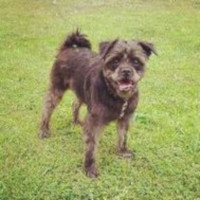
Crossing the Miniature Schnauzer with the Pug has resulted in an odd-looking dog with a super character. Most have retained the Pug's classic fawn coat with a black face mask, although other coat colors, such as brown or black, are not uncommon. With its dark eyes and black nose, the Schnug's expressive face has won it many fans around the world. As the Schnug is very family-oriented, they will always want to be in the same room as their owners and don't appreciate being left behind. Owners who work full-time or spend a lot of time away from home should consider a more independent breed.

History of the Schnug

While the Schnug may sound more like something you carry on your feet or wrap around you when you're cold at night, this unusual word is actually the correct term for the specific cross-breed dog we get when we cross the Miniature Schnauzer with the Pug. A small but courageous crossbreed, it's likely that the first Schnug was created within the last two or three decades.
        

A little of the Miniature Schnauzer

        
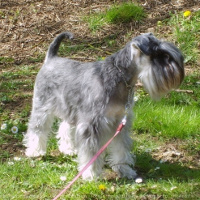
The Schnauzer is a German breed from Bavaria, distinguished by a facial coat that includes long eyebrows and a large moustache. A versatile working dog, in addition to hunting vermin, the Schnauzer would have been used on farms to herd animals, guard property and even pull carts. Farmers developed three different breed sizes to ensure that every farm task could be performed by the most appropriate sized dog. To create the smaller variant, local breeds such as Affenpinschers and Poodles were mixed, while breeds such as the Great Dane would have enriched the gene pool of the Giant Schnauzer.
Standard of the Miniature Schnauzer

A little of the Pug

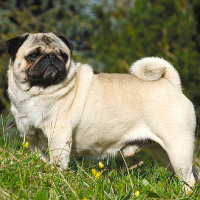
The Pug is a breed with a long and interesting history. Their origins date back some 2,000 years to ancient China. These flat-faced dogs were a common ancestor for another instantly recognizable dog breed, the Pekingese. The Pug was introduced to Europe in the 16th century by Dutch merchants and quickly became a popular companion dog for aristocrats and royalty. Over the centuries, their appearance has changed somewhat, with the modern dog having a much flatter face than their more robust ancestors.
Standard of the Pug

Appearance of the Schnug

The Schnug is a rather unusual-looking dog that couldn't be described as handsome in the classical sense. With a relatively small skull and short muzzle, as well as large, round eyes, they have a rather unique look. Add to this a wavy coat that can look unkempt, and you have a distinctive dog. As with their parent breeds, Schnugs have semi-erect triangular ears that tilt towards the front of the head. Their body is long and, although their limbs are longer than those of the Pug, they cannot be described as long. The Schnug's tail can be straight, but often folds over the back like that of the Pug. The Schnug's coat can be short or medium length, and the fur is straight. While some will retain the Schnauzer's distinctive beard and moustache, others will not. It's common for dogs to wear a dark face mask or at least a dark muzzle, although this isn't true for all individuals. Many will have the classic fawn-colored Pug coat, although their fur can also be brown, gray or black. A fully developed Schnug will reach heights of 25 to 36 cm and weights of 7 to 11 kg, with the female often considerably smaller than the male.

Temperament of the Schnug

Although the Schnug's appearance may not appeal to everyone, their personality is virtually flawless. Happy, sweet and gentle little dogs, Schnugs really shine as pets. Although they can be both curious and mischievous, they're too eager to please to be described as truly naughty or troublesome. Happiest playing with their owners and in the company of children, Schnugs enjoy most people's company, although it can take some time to open up to new people. As these dogs are highly dependent on human companionship, they should not be left alone at home all day. Always alert and on the lookout for anything that might happen, the Schnug will immediately alert its owner to any newcomer with a loud, persistent bark. Although they rarely act aggressively or hostile to an intruder, their incessant barking can be enough to drive them away. Outgoing and sociable with people and other animals, the Schnug likes to make friends with dogs of all shapes and sizes, and is often the most popular dog in the dog park. Although they can coexist with cats if introduced when young, they have retained some of their prey drive and should not mix with smaller animals, such as rabbits or gerbils.

Needs and activities of the Schnug

The Schnug is a small dog with a lot of energy, but it's not excessive. They will need a daily walk to keep fit and to enable socialization with other dogs and people, an important part of their development. They are best kept on a leash, as they have a fairly high hunting instinct and can take off after small animals, regardless of your repeated calls to stop him. These social loving dogs will also enjoy time running free with other dogs in secure dog parks. They'll love a selection of toys to play with, and adore family games or a well-defined task that will challenge their inquisitive nature. But if the activity suits them, they'll also want to spend time with you. This means your lap will be considered theirs, and they'll snuggle up to you at every opportunity. The Schnug is a dog that will also be at home in an apartment or house with a small yard. They're indoor dogs, so they'll be shocked if you suggest they sleep outside in a kennel, and will protest loudly if you try to do so. If you don't want a dog in the house, then this isn't the dog for you. They want to be glued to your side and become part of your life, and will entertain the family with their friendly nature.

Maintenance of the Schnug

The Schnug is relatively easy to care for, simply brushing every few days to keep their coat healthy and braid-free. A stiff bristle brush or comb will even out the coat and remove dead hairs. When bathing your dog, be sure to use a special dog shampoo that's gentler on the skin and preserves the coat's natural oils and weather resistance. Training young puppies to accept brushing will save problems later on. Simply start with short sessions to familiarize them with this new procedure. Another area to check is the ears, where dirt and wax can build up and become infected, leading to all sorts of health problems. Gently clean the inside of the ear with a soft, damp cloth, then dry the area to keep it healthy. Your Schnug's nails may need trimming if they're too long, but a light trim once a month should be enough to keep them at the right length. Most dogs enjoy the grooming process. It's the ideal time to look for sores or infections, because dogs never complain when they're in pain - they keep it to themselves. Taking the time to groom your pet dog will be appreciated by them, and they'll get all the attention.

Comments

Latest page updates

  • Telomian

    Telomian He is not recognized by the F.C.I. Origin Malaysia Translation Francis Vandersteen A brief presentation of the Telomian The Telomian is a very rare breed of dog, and the only one native to Malaysia to have been bred outside the country. They were originally bred by the indigenous people of Malaysia to combat parasites such as snakes, rats,...
  • King Wheaten -- Cavalier King Charles Spaniel X Irish Soft Coated Wheaten Terrier

    King Wheaten He is not recognized by the F.C.I. Origin Great Britain <> Ireland -> U.S.A. Translation Francis Vandersteen A brief presentation of the King Wheaten The King Wheaten is a small dog with a heart this big and a playful disposition. Borrowing the energy and soft-coated waves of the Irish Soft Coated Wheaten Terrier and the size and...
  • Spanierd -- English Springer Spaniel X German Shepherd

    Spanierd He is not recognized by the F.C.I. Origin Great Britain <> Germany -> U.S.A. Translation Francis Vandersteen A brief presentation of the Spanierd The Spanierd is a hybrid dog. Its parent breeds are the English Springer Spaniel and the German Shepherd. They have an affable personality. He's known for entertaining family and friends with his...
  • Alaskan Goldenmute -- Alaskan Malamute X Golden Retriever

    Alaskan Goldenmute He is not recognized by the F.C.I. Origin U.S.A. <> Great Britain -> U.S.A. Translation Francis Vandersteen This breed is also known as Alaskan GoldenGoldenmuteAlaskan Gold Retriever     A brief presentation of the Alaskan Goldenmute The Alaskan Goldenmute is a descendant of two great dog breeds: the Alaskan Malamute and the Golden...
  • French pointing dog Pyrenean type

    French pointing dog Pyrenean type FCI standard Nº 134 Origin France Translation Mrs. Peggy Davis Group Group 7 Pointing Dogs Section Section 1.1 Continental Pointing Dogs « Braque » Type Working With working trial Acceptance on a definitive basis by the FCI Tuesday 18 January 1955 Publication of the official valid standard Tuesday 01 August 2023 Last...
  • French pointing dog Gascogne type

    French pointing dog Gascogne type FCI standard Nº 133 Origin France Translation Mrs. Peggy Davis Group Group 7 Pointing Dogs Section Section 1.1 Continental Pointing Dogs « Braque » Type Working With working trial Acceptance on a definitive basis by the FCI Monday 17 January 1955 Publication of the official valid standard Tuesday 01 August 2023 Last...
  • Vucciriscu

    Vucciriscu He is not recognized by the F.C.I. Origin Sicily Translation Francis Vandersteen En français, cette race se dit Vucciriscu Diese Norm ist in deutscher Sprache sichtbar Vucciriscu En español, esta raza se dice Vucciriscu In het Nederlands, wordt dit ras gezegd Vucciriscu This breed is also known as Sicilian Vucciriscu Sicilian Butcher...

© 2026 Groupe Milouchouchou ASBL. Tous droits réservés. En savoir plus

Protected by Copyright01
We use cookies

We use cookies on our website. Some of them are essential for the operation of the site, while others help us to improve this site and the user experience (tracking cookies). You can decide for yourself whether you want to allow cookies or not. Please note that if you reject them, you may not be able to use all the functionalities of the site.

Ok