Papitese

He is not recognized by the F.C.I.

Origin
France and Belgium <> Central Mediterranean Basin -> U.S.A.
Translation
Francis Vandersteen
This breed is also known as
Maltillon

A brief presentation of the Papitese

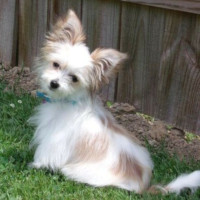
The Papitese is a small dog with long silky fur and generally semi-erect ears resulting from a cross between a Papillon and a Maltese. These good-natured dogs seem to have a smile on their lips at all times and have bright, vibrant eyes. Smaller in size, they are sturdier than their Papillon parent, but they are undeniably delicate and need to be supervised around large dogs and young children. Loyal and loving, those looking for a dedicated pet should look no further. As well as becoming very attached to their family, Papitese also associate well with other pets. Curious and quick to learn, training this breed can be great fun, and the whole family can get involved.

History of the Papitese

The Papitese can also be called the Maltillon and is a small dog from a specific cross between the Papillon and the Maltese. Miniature breed dogs are extremely popular these days, due to society's current trend towards apartment living and the desire to own dogs as pets rather than working animals. There has been a recent increase in demand for first-generation crossbreeds that are both new and unusual. Most specific crossbreed dogs have been developed over the last few decades, and their creation is an ongoing phase. As Papiteses have only been around for a limited number of years, there's little to write about their history. However, the same cannot be said of the two parent breeds, each of which has a rich and interesting history. Today, Papillons and Maltese are much-loved family pets, and many take part in dog shows.
        

A little of the Continental Toy Spaniel

        
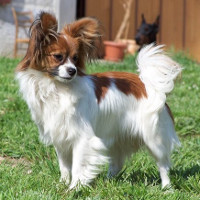
The Papillon dates back to the 1500s and was originally established in France or Italy. Their name is very French, translating the word papillon in a nod to the shape of their ears. Adored by aristocrats through the ages, this high-flying social butterfly remains a sought-after breed that makes a devoted and docile companion.
Standard of the Continental Toy Spaniel

A little of the Maltese

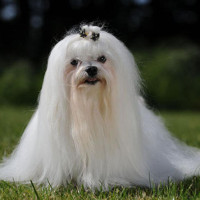
The Maltese is also a continental European dog, and although it may be assumed to have originated in Malta, it probably developed a little to the east of Malta. The original Maltese dog has been around for over 2,000 years and was believed to have medicinal healing powers.
Standard of the Maltese

Appearance of the Papitese

A good mix of its two parents, the pretty Papitese has a long, silky coat and a slim, lean body. While the Papillon is very fine with a delicate bone structure, the Papitese is a little more robust and muscular. With their brown eyes and smiling expression, these attractive dogs always seem happy. Their hairy ears flop down, although not all of them have the butterfly-shaped ears of their Papillon parent. Although small, they are not a brachycephalic breed and should have a medium-sized muzzle and a good-sized black nose with wide-open nostrils. Papiteses' long, silky coat is one of their most attractive features and can be made up of a multitude of colors, including white, black and brown. In fact, most dogs are essentially white with brown or black patches. Tiny dogs, most reach heights of between 20 and 25 cm at adulthood. With a weight of just 3 kg to 4.5 kg, they are one of the smallest dogs around.

Temperament of the Papitese

A sensitive, gentle soul, the Papitese needs a wise owner who will meet its needs without spoiling or anthropomorphizing it. Papitese rely on human companionship for their happiness and enjoy being with people as much as possible. Gentle and affectionate, they are a rewarding pet to own and will show great loyalty. Always alert and a little nervous, Papitese will make sure you know when a new person or pet arrives at home. They have a high-pitched voice that's hard to ignore. Because of their small size, they don't make effective watchdogs, although they don't seem to realize it. Very social, Papitese get on well with most other animals, even cats. The sooner they are socialized with other pets, the more they will accept it. They're happiest when they're part of a pack, whether it's made up solely of humans, or both humans and animals. Small dog syndrome should be avoided at all costs, as it not only terrorizes the dog, but is also a sign of an unhappy dog lacking in self-confidence. Dogs suffering from small dog syndrome can be nervous and lively, and may displease certain family members or strangers. Early signs of aggression or disobedience should be treated in the same way as with a larger dog, and not encouraged or ridiculed. Although small, the Papitese should be treated like any other large dog, not rotten or like a baby.

Needs and activities of the Papitese

The Papitese has a lot of energy for a dog the size of a toy, but unlike other Papillon mixes, the intensity of this hybrid's activities doesn't have to be very high. The Papitese is able to do most of its daily exercise indoors, following its inhabitants around the house and occasionally playing ball. Outdoor adventures for Papiteses should always be supervised, and this dog should not be left outside. Its activity levels and activity needs make the Papitese an ideal companion for apartment and city living. In addition, the Papitese does not tolerate cold well, and winter sweaters or jackets may be appropriate if the hybrid lives in cold winter climates.

Maintenance of the Papitese

Papitese may have hypoallergenic qualities thanks to the Maltese, but this hybrid still sheds from time to time and requires daily brushing to help remove loose, dead hairs that get caught in the double coat. Regular brushing with a brush also helps to remove dirt from the coat and preserve it from tangles and braids. Dirt is very easy to remove, as it doesn't adhere to the silky bristles as easily as other porous coats. There's no need to bathe regularly, as most dirt can be brushed off. Excessive bathing is not recommended, as excess water and shampoos can strip the skin of its natural oils, leading to skin problems and dermatitis. As with all white-haired dogs, Papitese can develop tear stains in the corners of the eyes. Owners can avoid tear stains by frequently cleaning the face and eyes with a pet-safe wipe or washcloth. Tear staining, once it occurs, is permanent.

Comments

Latest page updates

  • Telomian

    Telomian He is not recognized by the F.C.I. Origin Malaysia Translation Francis Vandersteen A brief presentation of the Telomian The Telomian is a very rare breed of dog, and the only one native to Malaysia to have been bred outside the country. They were originally bred by the indigenous people of Malaysia to combat parasites such as snakes, rats,...
  • King Wheaten -- Cavalier King Charles Spaniel X Irish Soft Coated Wheaten Terrier

    King Wheaten He is not recognized by the F.C.I. Origin Great Britain <> Ireland -> U.S.A. Translation Francis Vandersteen A brief presentation of the King Wheaten The King Wheaten is a small dog with a heart this big and a playful disposition. Borrowing the energy and soft-coated waves of the Irish Soft Coated Wheaten Terrier and the size and...
  • Spanierd -- English Springer Spaniel X German Shepherd

    Spanierd He is not recognized by the F.C.I. Origin Great Britain <> Germany -> U.S.A. Translation Francis Vandersteen A brief presentation of the Spanierd The Spanierd is a hybrid dog. Its parent breeds are the English Springer Spaniel and the German Shepherd. They have an affable personality. He's known for entertaining family and friends with his...
  • Alaskan Goldenmute -- Alaskan Malamute X Golden Retriever

    Alaskan Goldenmute He is not recognized by the F.C.I. Origin U.S.A. <> Great Britain -> U.S.A. Translation Francis Vandersteen This breed is also known as Alaskan GoldenGoldenmuteAlaskan Gold Retriever     A brief presentation of the Alaskan Goldenmute The Alaskan Goldenmute is a descendant of two great dog breeds: the Alaskan Malamute and the Golden...
  • French pointing dog Pyrenean type

    French pointing dog Pyrenean type FCI standard Nº 134 Origin France Translation Mrs. Peggy Davis Group Group 7 Pointing Dogs Section Section 1.1 Continental Pointing Dogs « Braque » Type Working With working trial Acceptance on a definitive basis by the FCI Tuesday 18 January 1955 Publication of the official valid standard Tuesday 01 August 2023 Last...
  • French pointing dog Gascogne type

    French pointing dog Gascogne type FCI standard Nº 133 Origin France Translation Mrs. Peggy Davis Group Group 7 Pointing Dogs Section Section 1.1 Continental Pointing Dogs « Braque » Type Working With working trial Acceptance on a definitive basis by the FCI Monday 17 January 1955 Publication of the official valid standard Tuesday 01 August 2023 Last...
  • Vucciriscu

    Vucciriscu He is not recognized by the F.C.I. Origin Sicily Translation Francis Vandersteen En français, cette race se dit Vucciriscu Diese Norm ist in deutscher Sprache sichtbar Vucciriscu En español, esta raza se dice Vucciriscu In het Nederlands, wordt dit ras gezegd Vucciriscu This breed is also known as Sicilian Vucciriscu Sicilian Butcher...

© 2026 Groupe Milouchouchou ASBL. Tous droits réservés. En savoir plus

Protected by Copyright01
We use cookies

We use cookies on our website. Some of them are essential for the operation of the site, while others help us to improve this site and the user experience (tracking cookies). You can decide for yourself whether you want to allow cookies or not. Please note that if you reject them, you may not be able to use all the functionalities of the site.

Ok