
 |
Labmaraner |
|
He is not recognized by the F.C.I. |
Origin |
Canada <> Germany -> U.S.A. | |
Translation |
Francis Vandersteen |
A brief presentation of the Labmaraner |
| The Labmaraner is a hybrid dog, a cross between a pure-bred Labrador Retriever and a pure-bred Weimaraner. Also known as the Weimador, they are elegant, energetic dogs that love people and have a strong sense of smell. Their exuberance and free spirit mean they do best with a more experienced owner. But in the right hands and with plenty of exercise, they make an excellent family dog. A handsome boy with a uniquely colored coat, the Labmaraner is a bit like one of those 3-D optical illusion pictures. Look at them one way and you can see the Labrador, but with a change of focus, the Weimar Braque appears. They generally belong to a healthy breed, but the future owner is well advised to get a puppy from parents screened for hip dysplasia. |
History of the Labmaraner |
| The last two decades have been dominated by specific crossbreeds. This rise in popularity is relatively recent and, particularly in uncommon hybrids such as the Labmaraner, their history is very much that of their parent breeds. |
A little of the Labrador Retriever |
||
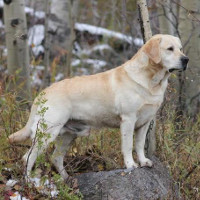
| Despite its name, the Labrador Retriever is not native to Labrador, but is actually thought to have originated in Newfoundland. Most agree that its ancestor is the St. John's Water Dog, an extinct breed originally from Newfoundland and anecdotally more at home in the water than on land. Historically, the Labrador Retriever was used to hunt on both dry and wet land, making it a favorite of local fishermen. Of course, many still use the Labrador Retriever for this purpose today, although the breed has developed into a multitude of other disciplines. Labrador Retrievers can be seen as therapy dogs, guide dogs for the blind and even drug detectors at airports and ferry terminals. In fact, the Labrador Retriever is such a successful breed that it now features in the top ten list of popular dogs in many countries around the world. | ||
 |
||
| Standard of the Labrador Retriever | ||
A little of the Weimaraner |
||
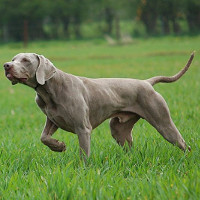
| The Weimar Pointer is a German dog breed that originated at the court of Weimar in the 19th century. The nobles wanted to go hunting with a powerful dog capable of bringing down a stag. Given the fickle nature of the stag, the ideal dog was one that would stand close to its master's heel until told to hunt. This is one of the reasons why the name Weimaraner is so appropriate, as in modern times, they still like to follow close to their owner. These early dogs were known as Weimar Shorthaired Pointers and were supposedly a mix of Bloodhounds, Great Blue Danes, German Shorthaired Pointers and English Pointers. Over time, stewardship of the breed was strictly controlled, and only those willing to breed responsibly and retain their distinctive appearance were allowed to keep these dogs. However, in the mid-twentieth century, a sudden rise in the breed's popularity led to a wave of unscrupulous breeding. This led to behavioral and health problems, resulting in a rapid decline in popularity. Fortunately, a few decades later, breeding was once again placed under responsible management and once again became a delight for dogs. | ||
 |
||
| Standard of the Weimaraner |
Appearance of the Labmaraner |
| A large dog, the Labmaraner is a short-haired breed that always has a color of its own. The most common coat colors are yellow, black, silver, gray or brown, with the leathery nose the same color as the coat. They have broad skulls and good-sized muzzles, with floppy ears reaching to the cheek and gray, amber or brown eyes. A well-proportioned breed, they have a deep ribcage, raised waist and sturdy yet athletic legs. Look closely at their paws and the dog often inherits the webbed toes of the Labrador's parent. And, the last word goes to the Labmaraner's tail. It should be straight and always happy, but can be long like that of the Weimaraner or broad at the base like that of the Labrador. |
Temperament of the Labmaraner |
| The Labmaraner is overflowing with enthusiasm and energy, making it prone to boisterousness and unruliness. But it's not a mean dog, it's just happy and likes to show it by rushing around and doing its own thing. As an intelligent dog, this inappropriate behavior can be channeled with puppy training using reward-based methods. Labradors love people and Weimaraners like to observe their owner, making them a dog devoted to its people. A Labmaraner is eager to please and will eagerly do its owner's bidding. Sometimes, however, the hunting instinct takes over, making life uncomfortable for cats and other small pets. For this reason, supervision is required at all times around other animals. |
Needs and activities of the Labmaraner |
| With both parent breeds very active and energetic, a Labmaraner will be identical and need plenty of exercise to keep fit and healthy. They'll enjoy long walks or a run to burn off energy, and love ball games and swimming. This breed is not suited to an apartment, but will benefit from a home with a large enclosed yard. They may adopt destructive behavior, such as digging, if not sufficiently driven, and will thrive on physically and mentally stimulating activities. They tolerate temperature variations, but most dogs should not be exercised if it's very hot or if they stay outside too long in cold weather. |
Maintenance of the Labmaraner |
| With their short, shiny coats, Labmaraners are low-maintenance when it comes to grooming. They shed very little, so a weekly brushing should be more than sufficient to remove loose hairs and stimulate the skin. They won't need to be washed often unless they're very dirty or have rolled around in a foul odor, which they love to do. Because they're so active, these breeds are unlikely to need their nails trimmed very often, as they'll be worn, but it's always a good idea to check. If possible, brush teeth daily for good dental hygiene and check ears as the breed is prone to ear infections. |



 English (United Kingdom)

Comments