
 |
Jug |
|
He is not recognized by the F.C.I. |
Origin |
England, Australia <> China -> U.S.A. | |
Translation |
Francis Vandersteen |
A brief presentation of the Jug |
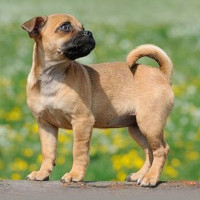
| No, not a vase to put your flowers in, the Jug is actually a cross between the feisty Jack Russell Terrier and the calm, confident Pug. As the parent breeds have extremely different personalities, appearances and exercise requirements, Jugs can be very different from each other, and it's not easy to predict the outcome of such a cross. A small dog with a robust body and short legs, the Jug tends to be more streamlined than the Pug, although less athletic than the Jack Russell. Their triangular ears droop gently to the side of their foreheads, and they have dark brown eyes that seem almost capable of conveying messages. |
History of the Jug |
| The Jug is actually one of the original specific crossbreed dogs and is said to have been created in the early 1970s, much more recently than most other breed hybrids. Although this cross-breed has been around for many decades, the appearance and personality of each Jug still varies greatly, because their parent breeds are so different in so many ways. To get a better idea of where the Jug comes from, it's a good idea to read about each of their parents. |
A little of the Jack Russell Terrier |
||
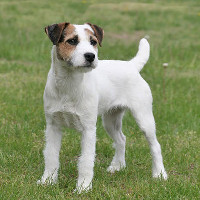
| The Jack Russell Terrier is sometimes affectionately called a terror by Jack Russell because it can have a big, fierce personality. Although these dogs originated as Fox Terriers in England in the 1800s, the Jack Russell was quickly exported to Australia, where the breed was developed. Traditionally bred to hunt foxes and rabbits, the Jack Russell was never a pocket dog and would have had to work for its supper. This has resulted in a tenacious breed with a strong character. As these dogs are extremely energetic and intelligent, they are frequently kept on farms and as working dogs. | ||
 |
||
| Standard of the Jack Russell Terrier | ||
A little of the Pug |
||
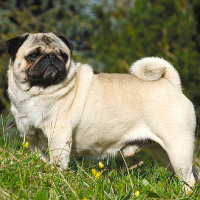
| The Pug originated in China and has probably been around for almost 2,000 years. Their big life personality and funny, cute appearance have secured their place on the most popular breed 10 lists in several countries, including the UK. Recently, however, they have been the subject of much criticism, with some feeling that their breeders put too much emphasis on their looks and didn't pay enough attention to their overall health. | ||
 |
||
| Standard of the Pug |
Appearance of the Jug |
| Although both the Jack Russell and the Pug are small dogs, the physical similarities almost end there. These two breeds are so different that it's not surprising that not all puppies are uniform in appearance. Their bodies are generally less muscular than those of the Jack Russell, but more defined than those of the Pug. They have a broad, flat forehead that is often wrinkled, and their ears come from the top of their skull, hanging wide apart. Their eyes are an expressive dark brown and can be very bulbous in some dogs. Most dogs will have a longer muzzle than the Pug and far fewer facial wrinkles. Their tails may curl gently over their backs or hang down like their Jack Russell relatives. An adult Jug measures between 28 and 33 cm and should weigh between 6 and 8 kg. Obesity, however, can be a real problem in the breed and many dogs will weigh much more than this. Jugs have a short, straight coat that can come in many colors, including black, fawn, white and brown. The typical Jug will have a fawn coat and dark black face mask, with or without black ears. |
Temperament of the Jug |
| The Jug may inherit more of its genes from its courageous, high-energy Terrier parent or from its entertaining, calm Carlin parent. Many will thrive on a good mix of both, with the possibility of crazy peaks of activity with plenty of quiet time in between. Most dogs are people-oriented and like to be close to their family, never wanting to miss out on any action. They tend to get on well with people of all ages, but should be supervised when around young children, as they are known to be boisterous when excited. Some Jugs have a heightened hunting sense of smell than others, and can find it hard to resist temptation when they're not in the lead. For this reason, many owners keep their Jug in the lead at all times. Having access to a fenced garden can provide a safe zone in which they can explore without threatening local wildlife. Despite the potential for a strong sense of smell, many dogs can learn to live in harmony with other pets, provided they are exposed to them from an early age. |
Needs and activities of the Jug |
| The Jack Russell Terrier tends to be an extremely active little dog, but the Pug tends to be a calmer, sometimes even lazy dog. While a hybrid animal can end up with activity needs on either side of the spectrum, the most common result is somewhere in between, resulting in an energetic, but not hyperactive, animal. Making sure your dog gets at least 45 minutes to an hour of vigorous exercise every day is usually enough to keep him healthy and fit, although dividing it into two or three shorter exercise sessions will be more beneficial than exercising full-time, just once a day. Dogs with shortened muzzles are also at greater risk of developing overheating problems and should not be over-exercised in hot weather. |
Maintenance of the Jug |
| Jugs are generally easy pets to groom. They require only an occasional bath, and the crisp, short coat most often seen can be maintained simply by brushing the dog once or twice a week with a smooth bristle brush. Although carpets are less likely to be worn with short coats, regular brushing helps to remove dead hairs and distribute the dog's natural oils properly, while keeping their coats shiny and supple. Dogs that inherit the dry or rough coat of the Jack Russell will generally need more brushing, both in duration and number of sessions. This particular crossbreed may also be more prone to dental disease than other dogs. Therefore, regular tooth brushing and visits to the dentist can both improve and prolong the life of this hybrid. |



 English (United Kingdom)

Comments