
 |
Golden Shepherd |
|
He is not recognized by the F.C.I. |
Origin |
Great Britain <> Germany -> U.S.A. | |
Translation |
Francis Vandersteen |
A brief presentation of the Golden Shepherd |
| The Golden Shepherd is a hybrid dog, the result of crossing a Golden Retriever with a German Shepherd. For many, the appeal of a hybrid dog lies in the borrowing characteristics from both sides of the family tree. If this works well, and the puppies inherit the parents' best traits, then the Golden Shepherd should be a prince among dogs. In an ideal world, the Golden Shepherd would inherit the gentle, loving nature of the Golden Retriever, spiced up with the speed and courage of the German Shepherd. Indeed, the Golden Shepherd could be summed up as loving yet protective. |
History of the Golden Shepherd |
| The trend towards hybrid dogs took off in the 1980s and 1990s. It's intriguing to realize that even with social media and the Internet, there isn't a single tangible dog that can truly claim to be the original Golden Shepherd. The parent breeds, however, are another matter. Both have venerable histories. |
A little of the Golden Retriever |
||
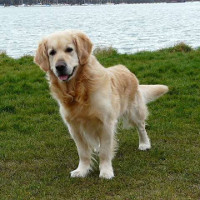
| The development of the Golden Retriever as a breed is attributed to Scottish Lord Tweedmouth. He worked diligently between around 1835 and 1890 to develop a golden dog gifted at retrieving waterfowl. He achieved this by selecting golden puppies from litters produced by matings between the now extinct Tweed Water Dogs, Flat-Coated Retrievers and Irish Setters. Officially recognized by the Kennel Club in 1911, they were then referred to as yellow or golden, and it was in the 1920s that the golden moniker was officially adopted. | ||
 |
||
| Standard of the Golden Retriever | ||
A little of the German Shepherd Dog |
||
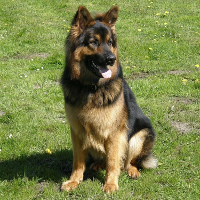
| As its name suggests, the German Shepherd has Germanic origins. The aim was to create a native dog breed from native dogs. Their job was to keep sheep together by guarding them quietly, rather than barking or biting heels, and to work with intelligence and stealth. The creation of the German Shepherd rests on a character named Max Emil Frederick von Stephanitz. He oversaw the selective breeding of dogs with desirable physical characteristics and temperament. Von Stephanitz exhibited the first German Shepherd Dog in the 1880s, and the breed society was founded in 1899. The breed's blend of intelligence, training and size made it an ideal service dog for the army, police and rescue organizations. | ||
 |
||
| Standard of the German Shepherd Dog |
Appearance of the Golden Shepherd |
| The Golden Shepherd is like an optical illusion, where some people see more Shepherd than Golden and others vice versa. The two parent breeds are roughly similar in size and body shape, their most distinctive feature being undoubtedly their color and pattern. The parent breeds have similar sizes and proportions, with minor differences between skull width and bone heaviness, the Golden Retriever being a more robust type than the German Shepherd. In fact, both breeds have the same double coat to protect them from the elements. The biggest contrast is in coat color. While the German Shepherd is most often black and beige, the Golden Retriever is golden. Of course, puppies can inherit characteristics from either parent, which can lead to stocky retrievers, such as puppies with black and beige coats, or leaner, golden-colored dogs. Then there are those ears. German Shepherds are naturally pricked, while Golden Retrievers are free-falling. Again, puppy ears will be anything but predictable. Fortunately, both breeds have long, feathered flag tails, just like the Golden Shepherd. |
Temperament of the Golden Shepherd |
| The Golden Shepherd loves company. That's great, but there are drawbacks too. They can become overly dependent on their owner's presence, which means they get stressed when left to their own devices. Like two sides of the same coin, you can argue that Golden's stable temperament has a calming effect on the more tense Shepherd. Alternatively, the Shepherd's protective nature can make the Golden's character slightly less predictable. This makes early socialization very important for puppies. By positively exposing the puppy to a wide range of sights, sounds and smells, you can build up their confidence. This is crucial to avoid an anxious dog, taking after the German Shepherd, who might become aggressive in order to keep things scary. Another interesting trait is the German Shepherd's protective nature, which can add a spark to the Golden's laid-back nature. It's always possible that a Golden Shepherd could lick an intruder to death, but the addition of the German Shepherd guard gene could make them formidable when threatened by a stranger. |
Needs and activities of the Golden Shepherd |
| The Golden Shepherd is a fairly active dog. It's recommended that they get enough exercise to maintain their weight and health. He may tend to put on weight if not exposed to regular physical activity. He'll do best in a home with a large yard in which he can be allowed to run and play. He'll also enjoy joining you for a walk or jog around the block. Head to the dog park, it's a great place for the Golden Shepherd to interact with other dogs, practicing his social skills. Obedience and field trials will be ideal activities for him to use his keen mind. What's more, this additional form of exercise will prevent him from chewing or barking excessively. |
Maintenance of the Golden Shepherd |
| The Golden Shepherd has a medium-length double coat designed to protect his skin from snow and rain, and enable him to swim in cold waters. It is also resistant to dirt. Some Golden Shepherds are long-haired, but in general they wear a medium-length coat. Sometimes, the outer coat will be stiff to the touch. They shed all year round, so he'll also have a stroke in which he undergoes heavy shedding twice a year, usually in spring and autumn. Brush him two or three times a week and only bathe him if necessary. Since Golden Shepherds like to chew, give them dental chews to keep their teeth clean, in addition to regular brushing, and promote overall dental health. Keep an eye on his nails - don't neglect them, as they can tear or break if not trimmed when necessary. |



 English (United Kingdom)

Comments