
 |
Doberdane |
|
He is not recognized by the F.C.I. |
Origin |
Germany -> U.S.A. | |
Translation |
Francis Vandersteen |
A brief presentation of the Doberdane |
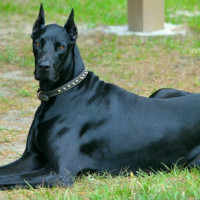
| The Doberdane is a formidable crossbreed that combines the impressive stature and noble appearance of the Great Dane with the muscular physique of the Dobermann. While many specific crossbred dogs are only kept as pets, the Doberdane is often used as a guard dog because of its intimidating appearance and the loyalty it shows to its master. With a confident gait and muscles to spare, a Doberdane walking or running towards you is a sight to behold. Although many Doberdanes in the USA have their ears cropped to make them more ferocious, this practice is frowned upon by most other countries. Although pure black is a popular coat color, there is potential for a variety of coat colors including brown, red and fawn. |
History of the Doberdane |
| The Doberdane is a relatively new addition to the specific crossbreed dog pack and was probably created only two or three decades ago. As with the vast majority of modern hybrids, their place of origin is difficult to determine, but many suspect they originated in America. |
A little of the Dobermann |
||
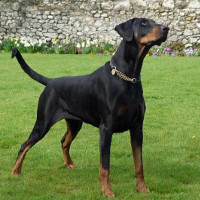
| The Dobermann is a German breed created in the late 19th century by a certain Karl Dobermann, who was in fact the local dog hunter. His work placed him in the unique position of being able to evaluate different breeds of dog and choose those he wished to breed together, in the hope of creating his ideal loyal, intelligent and strong dog. His ultimate goal was to produce a dog that would protect its master without question. To achieve his goal, he used a variety of breeds, including Beaucerons, Rottweilers and Weimaraners. Dobermanns enjoyed great popularity during the Second World War, when they were used by the army in a variety of ways. The modern-day Dobermann is thought to be much more docile and oriented than the former, as breeders selectively choose to breed these friendlier, less hostile dogs. | ||
 |
||
| Standard of the Dobermann | ||
A little of the Great Dane |
||
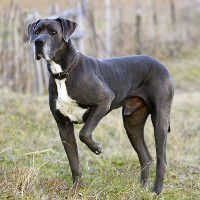
| The Great Dane is a dog that, over time, has undergone a complete turnaround. Dogs matching the description of the Great Dane's massive size can be found in 3000 BC in Egypt and 2000 BC in Babylon. These dogs accompanied Assyrian, Roman and Greek traders to settle throughout Europe. In the Middle Ages, these dogs were known as Sangliers, because they were used to hunt wild boar. Indeed, at that time, their ears were often cropped to prevent the auricles from being gorged by boar tusks. Of course, this task required the dogs to be extremely fierce and bold, and their temperament was a far cry from today's gentle dogs. The change in temperament was deliberately perfected from the 19th century onwards. The Great Dane was thought to be a beautiful but dangerous dog, and deliberate efforts were made to rehabilitate them into a peace-loving companion. Fortunately, these efforts succeeded and are evident in the placid dogs we know today. | ||
 |
||
| Standard of the Great Dane |
Appearance of the Doberdane |
| An undeniably attractive and impressive beast, the Doberdane is truly a sight to behold. Standing between 71 and 76 cm tall and weighing between 43 and 63 kg, it is one of the largest hybrid dogs in existence. Naturally, Doberdanes' ears are tilted close to the face, but many owners have had the ears cropped by the breeder, so they stand upright at all times. Their circular brown eyes are deeply set into their skulls. Their head is relatively small compared to their giant body, which has a broad, deep chest and a good abdominal tuck. They have robust bones and thick, strong limbs. The Doberdane's coat is short and straight, often with a beautiful sheen. Accepted colors include black, brown, red, fawn and blue. |
Temperament of the Doberdane |
| For the most part, Doberdanes' protective nature and dedication are what set them apart from other large dogs. They are unwavering in their loyalty and will form extremely close bonds with their owners. With their immediate family, they will be openly affectionate and exceptionally gentle. Unsurprisingly, when it comes to strangers, the Doberdane is rarely so welcoming and requires extensive socialization from an early age to avoid any unwanted hostility when guests come to the house. Although a good family pet, it is generally not recommended for people with young children to take on a Doberdane, as there is a risk of serious injury should they be bitten. Even the most well-behaved dogs can pose a danger to small children, purely because of their size and weight. Likewise, they must be housed with dogs of comparable size, and must be introduced to other dogs at an early age if they are to be accepted. |
Needs and activities of the Doberdane |
| Both parent breeds are active dogs, especially the Dobermann. A Doberdane is best suited to an experienced, active family with large or very large dogs. The Doberdane will require at least 3 long walks a day. They will also need plenty of space in the yard to run and expend energy. The Doberdane is a playful, energetic breed that can benefit from activities such as hiking, visiting dog parks and playing with toys. If you're willing to invest the time in a Doberdane, you'll have a fantastic companion. |
Maintenance of the Doberdane |
| As these hybrids generally have a short, elegant coat, they are considered low-maintenance breeds. They don't require regular visits to the groomer or regular bathing. An occasional brush over the coat should be given to distribute the natural oils produced by the sebaceous glands. You can wipe your Doberdane with a damp cloth when it's slightly dirty. These breeds can be droolers, so it's important to keep a towel handy. Cleaning the face will prevent skin irritation and bacteria build-up. Regular teeth cleaning and brushing, ear cleaning and nail trimming are other maintenance necessities. |



 English (United Kingdom)

Comments