
 |
Chug |
|
He is not recognized by the F.C.I. |
Origin |
China <> Mexico -> U.S.A. | |
Translation |
Francis Vandersteen | |
This breed is also known as |
Chihuahua-Pug
|
A brief presentation of the Chug |
| A Chug is a mix of Pug and Chihuahua, a charming and specific crossbreed that combines characteristic Pug and Chihuahua traits, such as playfulness, loyalty and affection. As interesting as this cross is, some less desirable traits may also prevail, including the respiratory problems of the Pug or the yappy nature of the Chihuahua. Chugs are ideal for families with older children, but not for any other pets. They are an adaptable crossbreed whose personality and even physical appearance are not set in stone, as they can vary depending on the contribution of the Pug or Chihuahua parents. Despite what some might claim, this is not a hypoallergenic breed. With proper training, they can excel in dog sports, such as obedience and herding, and they can make good therapy dogs. |
History of the Chug |
| Chugs were probably developed through cross-breeding in the 2000s. The breed's history is uncertain, and no breeder has been credited with developing the Chug as a cross. Unlike other breeds, Chugs have no Poodle ancestry in their lineage. Chugs are recognized by the American Canine Hybrid Club, the Designer Breed Registry, the Designer Dogs Kennel Club, the Dog Registry of America, Inc. and the International Designer Canine Registry. |
A little of the Pug |
||
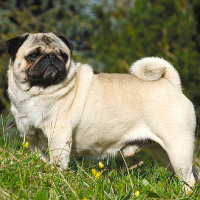
| The history of the Pug can be traced back to 206 BC in the Buddhist temples of Tibet. It is thought that the Carlins were then taken to China, where they were treated like kings and lived in the emperor's palace. They were then shipped to Europe by Dutch traders, and made their way to the Western world, where they became extremely popular. | ||
 |
||
| Standard of the Pug | ||
A little of the Chihuahua |
||
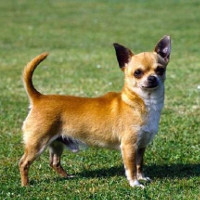
| Chihuahuas are dogs with ancient origins, probably around 300 BC in Mexico. Their history is linked to that of the Aztec civilization. Chihuahuas were kept in the home because they were supposed to have healing powers and guide the dead to the afterlife. | ||
 |
||
| Standard of the Chihuahua |
Appearance of the Chug |
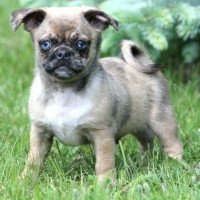
| Chugs are generally larger than Chihuahuas, but smaller than Pugs, although their size varies greatly from dog to dog. They have a smooth, short coat, which can otherwise be long if there are long-haired Chihuahuas in the dog line. Their colors can be: white or cream, golden or light brown, chocolate or dark brown, black brown, black. Chugs can also be speckled, brindle, merle or spotted. They have a very cute, expressive face that resembles that of a miniature boxer, with a short muzzle, almond-shaped eyes and wrinkles. Their ears can be floppy, like those of the Pug, or folded at the top, like those of the Chihuahua. Chugs are small dogs weighing up to 9 kg and generally measuring 15 to 30 cm. |
Temperament of the Chug |
| The character and temperament of Chugs are highly variable, depending of course on their parents (especially the mother), socialization and genetics. They are generally affectionate, intense and charming. They are playful and sometimes over-confident, with too much self-esteem. This trait can lead to aggression towards other dogs, even larger ones, so puppy socialization is imperative to prevent this from happening. This type of behavior is also known as small dog syndrome. Chugs can be wary and independent like the Chihuahua, or comical and fun-loving like the Pug. They like people, but don't much like other pets. They can get along with children, but it's probably not a good idea to mix Chugs with young children, as Chugs can easily get bored. As with any dog breed, however, it's important to ensure that children are mature enough to know and understand how to interact with their Chug pet. Always lively, Chugs are energetic, outgoing and friendly, loving attention and confident in their charm. A Chug can be a good watchdog, due to its barking and territorial tendencies, as well as its vigilance. They make excellent family dogs and enjoy human company as much as possible. Chugs are also known to make friends fairly easily and are eager to please. They can be bold and stubborn, which makes training difficult. So, alongside socialization, training needs to take place from an early age. |
Needs and activities of the Chug |
| Chugs can be laid-back dogs; they won't be demanding when it comes to exercise, but will also be very happy to go for a walk whenever you suggest. Their little legs won't need to go far to get a good stretch, so 30 to 45 minutes of short walks several times a day will satisfy your four-legged friend. Obedience training is always an appropriate outing, as it allows your dog to practice his social skills and show his enthusiasm for life. They can easily live in any environment. An apartment is fine, as is a house with a yard. Don't leave them outside, however, as they may find their way through the fence in search of adventure. Beware of extreme temperatures, as the Pug parent can transmit the respiratory difficulties associated with brachycephalic facial structure. |
Maintenance of the Chug |
| Generally speaking, the Chug is a low-maintenance dog. If the coat is short, a weekly brushing with the smooth brush will keep the coat shiny and clean. If the coat is longer, weekly brushing with a brush should work just fine. If your dog is shedding, you can brush more often to avoid tangles. Because your Chug is a small hybrid, it may be necessary to brush his teeth several times a week to prevent cavities and tooth loss. Your hybrid may have folds and wrinkles that need special attention, so check the folds every day to make sure moisture isn't building up. Keep folds dry by gently patting them with a soft towel as needed. Nails should be trimmed every two weeks or whenever they seem too long, depending on the rate of growth and their level of activity. |



 English (United Kingdom)

Comments