
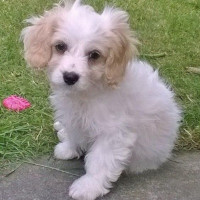
 |
Cav-A-Malt |
|
He is not recognized by the F.C.I. |
Origin |
Great Britain <> Central Mediterranean -> U.S.A. | |
Translation |
Francis Vandersteen | |
This breed is also known as |
Cavamalt
|
A brief presentation of the Cav-A-Malt |
| A cross between the courageous Maltese and the gentle Cavalier King Charles Spaniel, the Cav-A-Malt has a winning personality. Tolerant of children and devoted to his family, this specific crossbreed loves fun and cuddles. Beware of any clingy behavior, however, which should be stifled from the outset. Small and long with floppy ears and kind eyes, the Cav-A-Malt could easily be mistaken for a child's teddy bear. Their coat is generally long and soft, although many will prepare it to be shorter and easier to handle. |
History of the Cav-A-Malt |
| While it's true that any purebred dog can be used in the creation of a specific cross-breed dog, it's usually the small, fluffy dogs that are used most often. Specific crossbreed dogs are created when two different breeds are mixed, resulting in an F1 hybrid. These hybrids can be bred together, creating a new breed of dog. Although none of these new breeds are recognized by professional bodies such as the UKC or AKC, they are very popular with the general public and many make superb pets. While the Maltese and Cavalier King Charles Spaniel share many positive attributes, such as docile natures and cheerful attitudes, it's no surprise that they create a sweet-tempered and incredibly cute puppy known as the Cav-A -Malt, also known as Maltalier. Experts aren't sure where or when the Cav-A-Malt was created, although the first puppy was probably birthed 20 or 30 years ago. Over time, the breed has gained international popularity and is now frequently seen in America and Europe. With such a short history, we have to look to the Cav-A-Malt's parents to get an idea of their past. |
A little of the Cavalier King Charles Spaniel |
||
| The Cavalier King Charles Spaniel, or Cavie, originated in sport breeding and was used by the nobility for hunting. Over the years, however, these Spaniels have been crossed with less athletic breeds to give them a distinctive appearance, resulting in a less active, more skilful modern dog. Nevertheless, these dogs are very popular worldwide, and have even been owned by President Reagan and Frank Sinatra. | ||
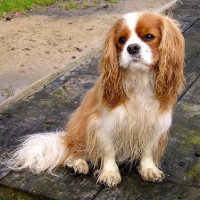 |
||
| Standard of the Cavalier King Charles Spaniel | ||
A little of the Maltese |
||
| The Maltese first settled somewhere to the east of the island of Malta, probably on the Croatian island of Meleda, now called Mljet. Throughout history, they have been loyal and valued companions, revered by their masters. In fact, it has even been proven that Maltese dogs are buried in ancient Greek tombs, illustrating their social status at the time. Although the original Maltese existed over 2,000 years ago, the breed almost disappeared in the 19th century, when misguided breeders tried to reduce them. | ||
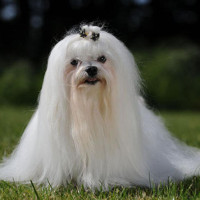 |
||
| Standard of the Maltese |
Appearance of the Cav-A-Malt |
| With a relatively domed head, circular brown eyes and silky, pendulous ears, the Cav-A-Malt is undeniably adorable. Their muzzle is quite short and they often have the loose upper lip of their Cavalier relative. Although quite small, their bone structure shouldn't be too delicate and their limbs have good muscle coverage. The Cav-A-Malt's tail is variable, some having the curved tail of the Maltese, while others have the curved, feathery tail of the Cavalier. The Cav-A-Malt's coat tends to be long and wavy, although many owners will opt for a shorter, curlier coat from a groomer. Black, bronze and white are the most common colors, but puppies can also have red fur, and it's not uncommon for a dog to be bicolor or tricolor. A small dog, most are between 25 and 35 cm when they reach maturity. Likewise, they rarely reach a weight of over 6.5 kg, with the smallest weighing around 4.5 kg. |
Temperament of the Cav-A-Malt |
| The Cav-A-Malt is a lively, playful, fun-loving dog that often gets along very well with all kinds of people. These little hybrid dogs have moderate to low energy levels and are fairly easy to train, especially for novice owners. Consistency is essential, however, and repetition is sometimes necessary. They are friendly and curious when meeting strangers and children. However, this characteristic depends on the Cav-A-Malt's degree of socialization. Poor Cav-A-Malt training can lead to your dog displaying dominant behavior, such as lunging and protecting food and toys. When adopting a small dog, it's important to teach it how to behave - encouragement and positive reinforcement are very helpful. However, as with all dogs, it's just as important to teach children how to handle and approach them. Cav-A-Malt owners say they are a wonderful addition to the family, but they need a lot of attention and don't like to be left alone at home as they are prone to separation anxiety. |
Needs and activities of the Cav-A-Malt |
| The Cav-A-Malt's size and activity level make it a good candidate for apartment accommodation. They don't require a lot of space and are content with a few short walks a day. They like to meet and greet in the neighborhood. It's a good activity for practicing the social skills acquired in obedience training. The Cav-A-Malt is also known for his talent in the agility circle, so give him a chance to show off his intelligence and eager personality. He'll also appreciate a home with a backyard. Be sure to accompany him outdoors, as he doesn't like to be left alone. |
Maintenance of the Cav-A-Malt |
| The Cav-A-Malt is a small breed dog with long, silky, wavy hair. They have low to moderate shedding and are not hypoallergenic. Owners are often advised to groom their hybrids regularly to reduce dullness and other potential problems. Brushing and dry shampooing, if necessary, can be used to maintain a healthy coat and avoid tangles. The fur around the ears, eyes and pads may also need to be trimmed for comfort and mobility. Your Cav-A-Malt's eyes should be gently wiped daily if tears are abundant, and his ears should be cleaned regularly, as the parent breed, the Cavalier King Charles Spaniel, is prone to ear infections. With such hairy ears, moisture and dirt can sometimes accumulate, causing yeast and bacteria to form. As with all dogs, dental hygiene must be maintained. Nail trimming should not be neglected. Twice a month is often the norm. |



 English (United Kingdom)

Comments