
 |
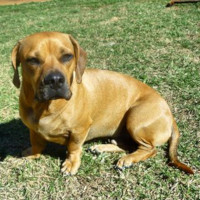
Miniature English Bulldach |
|
He is not recognized by the F.C.I. |
Origin |
Great Britain <> Germany -> U.S.A. | |
Translation |
Francis Vandersteen |
A brief presentation of the Miniature English Bulldach |
| There are probably no two breeds of dog as recognizable as the English Bulldog and the Dachshund. The Miniature English Bulldach is a hybrid breed, a cross between a pure-bred Bulldog and a pure-bred Dachshund. The result is a dog with a wrinkled face, a longer nose than a Bulldog, and a tendency to be longer than his waist. Both parent breeds have distant origins as hunting or baiting dogs, which has consequences for their character. While the Bulldog softens the edges of the Dachshund's tendency to hang on, the Miniature English Bulldach requires respectful treatment. They should not be left unsupervised with children, as any teasing or teasing could result in a pinch of retaliation. |
History of the Miniature English Bulldach |
| The trend for hybrid dogs has grown in popularity over the past two decades. Dogs that would only have bred through misadventure are now deliberately united to create new and interesting variations. Such is the case with the Miniature English Bulldach. The story of this new hybrid is the story of their famous ancestors: the English Bulldog and the Dachshund. |
A little of the English Bulldog |
||
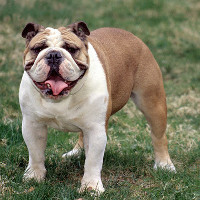
| The English Bulldog traces its roots back to the ancient Romans. They had ferocious Molosser dogs that were essentially dogs of war. Their ferocity was legendary as they went into battle alongside Roman soldiers. The Bulldog is descended from these beige dogs with their powerful jaws. The Bulldog's physique has changed considerably over the years. Their heyday was in the 17th century, when bull-baiting was a popular sport. These Bulldogs were bred to have powerful jaws, low to the ground and heavy in front. This was the ideal physique to get under a bull to attack their throats. These Tudor Bulldogs were agile and athletic, and it wasn't until the following centuries that they took on the form we know today, including that flat face and ponderous gait. | ||
 |
||
| Standard of the English Bulldog | ||
A little of the Dachshund |
||
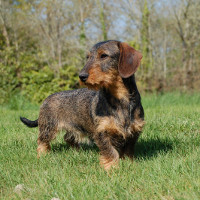
| Another dog with a distinctive appearance is the Dachshund. These long, low-set dogs with their straight tails were bred in Germany in the 15th century. They were a working dog, used to flush out badgers or chase them into their dens. Consequently, a dog with short legs but a courageous temperament was needed. Even the long tail served a purpose in that a farmer could retrieve his dog from a badger by pulling it by the tail. | ||
 |
||
| Standard of the Dachshund |
Appearance of the Miniature English Bulldach |
| The parent breeds have very different appearances, as do the resulting offspring. While a good percentage of puppies will be a mix of characteristics from both parents, some puppies will err more on one side of the family tree or the other. So there's no guarantee when you buy a Miniature English Bulldach what they'll look like. However, the majority of Miniature English Bulldachs are sturdy, blocky dogs with strong, if slightly curved, legs. They also lean towards Dachshund proportions, being a little longer than they are tall. One of the most striking aspects of the Miniature English Bulldach is that they lean towards Bulldog wrinkles, but are elongated on a longer nose. They also have floppy ears and some may have straight tails, while others inherit the Bulldog's naturally ingrained tendency. The Miniature English Bulldach has a short coat, which is most often bronze, sometimes with white patches. However, the color of the parent dog has an influence on the brindle or fawn. |
Temperament of the Miniature English Bulldach |
| The Bulldog has undergone something of a character change since their biting antecedents. They now have a reputation for being gentle, loving companions slow to anger. This can serve as a lucky foil to soften the sharp contours of the Dachshund's character. While utterly adorable, loyal and loving, the Dachshund can be a strong character. They know their own mind and aren't quick to change it unless it suits them. When challenged, that bold courage that prepared them to hunt badgers can surface. This may mean growling and biting when forced to do something they don't want to do. As a result, the Miniature English Bulldach can be described as bold and courageous with a tendency to protect people or property they love. This can lead to liveliness if a child has perhaps tried to take away a favorite toy or made the Miniature English Bulldach feel threatened. |
Needs and activities of the Miniature English Bulldach |
| Although the inclusion of the Dachshund in this cross gives the Miniature English Bulldach a little more liveliness than the average English Bulldog, it's still a relatively attractive animal. These dogs certainly don't nag you for more exercise, but it's important that they get at least 30 minutes of vigorous activity a day to help prevent them from developing obesity, a disease to which English Bulldogs are prone. Dogs with elongated backs, as seen in miniature English Bulldogs, should avoid back-straining exercises such as jumping and gesticulating, especially on hard surfaces, and dogs that inherit a shortened muzzle should be carefully monitored for weather conditions. This dog barks a little, but not as much as the average Dachshund, and can be an excellent companion in larger homes or smaller spaces, such as an apartment. |
Maintenance of the Miniature English Bulldach |
| The Miniature English Bulldach should have a fairly simple grooming routine. Bathing is an infrequent requirement, usually every few months or if the dog finds itself in a messy situation. In most cases, short weekly brushing sessions with a smooth brush, bristle brush or washcloth are satisfactory to remove dead and loose hairs and to properly distribute the animals' natural oils on the coat. If the hybrid has inherited the less common coat of the long-haired or wire-haired Dachshund, it may require more brushing. It's important to regularly remove wrinkles from the face, especially after eating, to prevent mold growth in these areas. |



 English (United Kingdom)

Comments