
 |
Boston Iggy |
|
He is not recognized by the F.C.I. |
Origin |
U.S.A. <> Italy -> U.S.A. | |
Translation |
Francis Vandersteen |
A brief presentation of the Boston Iggy |
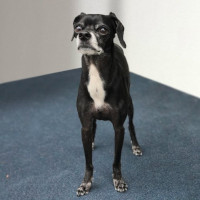
| The Boston Iggy is a hybrid of a Boston Terrier and an Italian Sighthound. Little is known about the birth date of this hybrid breed, and it's a rare breed without much data to draw on. The Boston Terrier and the Italian Sighthound are both small dogs, so it's fair to say that the Boston Iggy stays within that size range. The body is a combination of the two parent dogs, giving an athletic appearance to the body and slightly longer legs than the Boston Terrier. Its short, fine, glossy coat comes in a wide range of colors: gray, slate gray, red, fawn, blue, black and white. The Boston Iggy can be white with colored markings or colored with white markings. As both the Boston Terrier and the Italian Sighthound are sensitive to tone of voice, it's safe to say that the Boston Iggy will be sensitive by nature, happy to please and slightly submissive. This dog responds well to a gentle but firm pack leader, who allows it to develop its personality while maintaining control. An excellent companion dog, devoted and loyal. |
History of the Boston Iggy |
| Information on the Boston Iggy is scarce, but it's a perfect balance between the Boston Terrier and the Italian Sighthound. Although it's a rare breed, it's set to become popular with owners who live in apartments or smaller dwellings. Although their history is vague, we can look to the parent dogs to get an idea of what the Boston Iggy inherited. |
A little of the Boston Terrier |
||
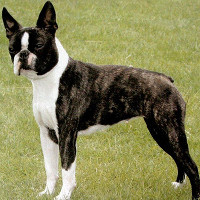
| Boston Terriers were bred from Bull and Terrier-type dogs that fought in arenas. They were born in Boston, Massachusetts, from a cross between the English Bulldog and the now extinct English White Terrier, which began around 1865. After several crosses of the offspring, the breed became popular in Boston in 1889. It was recognized by the American Kennel Club in 1893. A terrier in name only, the Boston Terrier is a far cry from the fighting dogs of the past. | ||
 |
||
| Standard of the Boston Terrier |
A little of the Italian Sighthound |
| The Italian Sighthound is a fairly ancient breed, with 6000-year-old Egyptian tombs depicting dogs like the Italian Sighthound. They also feature prominently in Mediterranean decorative art dating back 2,000 years. These dogs, with their noble, refined appearance, became popular with the nobility during the Renaissance. A small Greyhound was found in Pompeii after horrific lava flows ruined and partially buried the Roman city near present-day Naples. During the 16th century, the Italian Sighthound's ancestors were brought to Europe by Phoenician civilization, where it became popular with European nobility. Catherine the Great of Russia and Queen Victoria both owned Italian Sighthounds. Frederick the Great of Prussia took one of these little dogs to war with him, and buried it himself when he died at Sans Souci. Frederick's family fulfilled his wish to be buried with his Italian Sighthound. Even in the 19th century, this little dog continued to win hearts, as evidenced by the fact that an African chief loved dogs so much that he offered 200 cattle in exchange for a single Italian Sighthound. The breed was recognized by the AKC in 1886. |
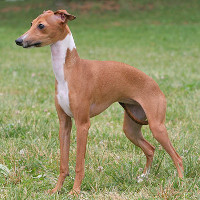 |
| Standard of the Italian Sighthound |
Appearance of the Boston Iggy |
| The Boston Iggy is a small dog combining the muscular build of the Boston Terrier with the elegance and athleticism of the Italian Sighthound. The head is more refined, with a narrow, pointed muzzle, unless the parents have a high proportion favoring the Boston Terrier, in which case it can be much shorter. The Boston Iggy has a body well proportioned to its head, and a well-developed deep chest. The Boston Iggy's eyes are large, round and very expressive. The nose is black and the teeth meet in a regular or scissor bite, depending on the genes inherited. The ears are erect on the head, with the tips slightly folded back. The front legs are straight and longer than those of the Boston Terrier. By combining the coats of both parents, the Boston Iggy has a silky, short, fine-textured coat that comes in a wide variety of colors. |
Temperament of the Boston Iggy |
| The Boston Iggy comes from a line of dogs that are sensitive to their master's tone of voice. It responds best to gentle but firm direction. The Boston Iggy is playful, lively, affectionate, intelligent and well-mannered. Slightly submissive due to his Italian Sighthound nature, he is eager to please his master. However, he does not respond well to harsh discipline and can become difficult to control. Although your Boston Iggy may be slightly nervous, he's not as fragile as he seems. Don't overprotect these dogs, as they could become snarling if frightened. Remain consistent in your requests and during training and you'll have a dog that will follow you everywhere and be a devoted friend. Well socialized when young and given adequate exercise, this little dog can excel in social settings. In general, the Boston Iggy is a peaceful dog. They get on well with children and other animals, as long as they have a strong master and are not stressed. |
Needs and activities of the Boston Iggy |
| The Boston Iggy is always active, even indoors. He likes to be part of everything and loves to play. Be careful when he's a puppy, as he can injure himself playing because of his fine bones, which come from his Italian Sighthound parent. They are sensitive to climatic temperature changes, and extremes can affect them. The Boston Iggy is a good apartment dog, provided it has the opportunity to go for a daily walk or play in a dog park. He's eager to please and will snuggle up to you if nothing's going on, and be just as happy. |
Maintenance of the Boston Iggy |
| The Boston Iggy is an easy dog to groom. His fine, silky coat just needs regular brushing and wiping with a piece of chamois or terry cloth. If you give him a bath, do so only if necessary, making sure to use a special shampoo for sensitive dogs. Then dry your Boston Iggy and check that his ears are in good health. If you get your dog used to having his teeth brushed when he's young, it'll be easy to make sure his teeth are healthy when he's an adult. Trim toenails if necessary. The fact that your dog clicks on the floor is a sure sign that his nails are long. If you don't feel comfortable doing it yourself, or if you've never done it before, ask a professional groomer to show you how to do it safely. |



 English (United Kingdom)

Comments