
 |
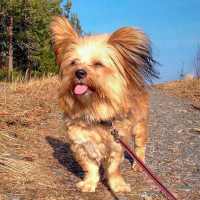
Tibepillon Terrier |
|
He is not recognized by the F.C.I. |
Origin |
Tibet <> France and Belgium -> U.S.A. | |
Translation |
Francis Vandersteen |
A brief presentation of the Tibepillon Terrier |
| The Tibepillon Terrier is an adorable mixed breed that combines the traits of the Continental Toy Spaniel and the Tibetan Terrier. It's a small dog that tends to carry the small body and large ears of the Papillon with the coat and coloring of the Tibetan Terrier. Although the appearance and personality of these dogs can vary considerably, even within the same litter, the typical Tibepillon Terrier will be very active, very noisy and very affectionate. Everything about this dog, except its size, is big. From its ears to its heart, the Tibepillon makes an excellent family dog, as it loves children of all ages and gets along relatively well with other pets. |
History of the Tibepillon Terrier |
| With more recent hybrid breeds like the Tibepillon Terrier, the best way to find out about their origins is to consult their parent breeds. |
A little of the Tibetan Terrier |
||
| The Tibetan Terrier is surprisingly not really a Terrier at all. Its name derives mainly from its size and geological location at the time of its creation: Tibet. It was originally created by Tibetan monks, who used the breed as a guardian and herdsman. As these dogs were considered sacred due to their association with the monks, they were never sold, and it took a long time for dogs of this breed to be marketed to the rest of the world. Eventually, a very lucky British doctor named Agnes R.H. Greig, who was studying in India at the time, received a beautiful female puppy as a thank-you gift from a grateful patient. From there, Agnes managed to acquire a male Tibetan Terrier and proceeded to breed both. As the breed had no name at the time, they were given the name Tibetan Terriers. The American Kennel Club officially recognized the breed in 1973, and since then they have been considered companion and show dogs. | ||
 |
||
| Standard of the Tibetan Terrier |
A little of the Continental Toy Spaniel |
| The Papillon Continental Toy Spaniel is a magnificent toy breed that has been a favorite of royal courts and palaces for generations. If we look at works of art from the 17th or 18th century, we'll see small Spaniels used as focal points. These Spaniels are the ancestors of the Papillon. With long, silky fur and big, alert ears, the Papillon was a favorite of the French for its delicate yet lively nature. In the USA and Canada, the Papillon became a champion in the show ring, while mastering activities such as obedience training and tracking. Despite this, the Papillon is still very popular as an energetic family pet that brings smiles and joy to all who see it. |
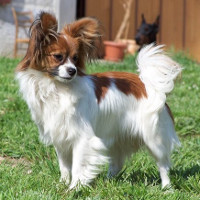 |
| Standard of the Continental Toy Spaniel |
Appearance of the Tibepillon Terrier |
| Resembling a teddy bear with big ears, the Tibepillon is a rather fluffy little breed. Its coat most often resembles that of the Tibetan Terrier, being longer and slightly wavy, but it can also have the straighter, silkier look of the Papillon. Measuring around 35.5 centimeters and weighing 8 kilos as an adult, the Tibépillon is a small dog with a big personality. His eyes reveal his lively nature in dark brown pools of intelligence, and are perfectly matched by his large triangular ears. His friendly face is complemented by a delicate muzzle, a small black nose and the classic Papillon feathers found along his cheeks and ears. Its tail is long and, although not as curled as that of the Tibetan Terrier, it is feathered and can curl slightly at the base. |
Temperament of the Tibepillon Terrier |
| Although the Tibepillon Terrier is small in stature, in mind and heart it's a big dog. The Tibetan Terrier brings a middle-of-the-road attitude that helps balance the Papillon's exuberant energy. When these two dogs are combined, we get a playful, vocal, alert and very happy dog who gets on well with everyone he meets. While older children may be a good option due to the Tibepillon's small size, this breed honestly adapts very well in homes where ages vary. As long as it's socialized at a young age and given plenty of opportunity to come into contact with other people, the Tibepillon will be well-behaved and easy to control. The only drawback is that it can be a little difficult to house-train, due to its excitable nature. All in all, the Tibepillon Terrier is an excellent choice for those looking for a hardy, affectionate little dog that's always ready for the next adventure. |
Needs and activities of the Tibepillon Terrier |
| Although this dog is lively and playful, it generally doesn't need much exercise to stay healthy and fit, and is usually content with around 30 minutes of vigorous activity a day. Exercise sessions are most effective if they are split into two or three shorter sessions throughout the day, and can include agility training, advanced obedience and sleight-of-hand training, puzzles and mental games designed for dogs, and perhaps even herding exercises in addition to more traditional walks and search games. If their tendency to bark is kept under control, these small, family-oriented dogs make excellent companions, whether in large or small spaces. |
Maintenance of the Tibepillon Terrier |
| If you're looking for a small dog who likes to spend all day cuddled up on your lap, the Tibepillon Terrier may not be the right choice for you. This little dog has a huge personality, and a lot of energy to match. To keep this little whirlwind out of trouble, a good hour of play and training a day will be necessary, otherwise Tibepillon will find a way to entertain himself. To keep your dog tired and satisfied, you can offer him agility training, obedience training, a long walk, a short jog or a good hour's play with other dogs his size. Don't forget that the Tibépillon is like the Papillon in many ways, not least by forgetting its actual size. When playing with children or other dogs, it's always best to ensure that supervision is present to prevent little Tibépillon from injuring himself in any way. |



 English (United Kingdom)

Comments