
 |
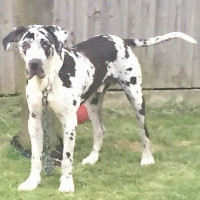
Taylor's Bulldane |
|
He is not recognized by the F.C.I. |
Origin |
Great Britain <> Germany -> U.S.A. | |
Translation |
Francis Vandersteen |
A brief presentation of the Taylor's Bulldane |
| The Taylor's Bulldane is both a Dorset Old Tyme Bulldogge and a Great Dane. The Old Tyme Bulldog is a rare breed, which makes the Taylor's Bulldane very unique. They are giant dogs weighing between 68 and 91 kilos and measuring between 63.5 and 76 centimetres. Their short, fine coats make them easy to care for. They are generally in good health and can live into their teens. While they make an excellent addition to any family, they are best suited to homes with plenty of space and a fenced-in yard so they have room to play. This breed is easy to train and gets along well with other dogs and older children. |
History of the Taylor's Bulldane |
| The history of the Taylor's Bulldane is spotty at best, as the history of the Dorset Old Tyme Bulldogge is not well known, as the breed has only existed since the 1980s. |
A little of the Dorset Old Tyme Bulldogge |
||
| A Bulldog lover named Steve Barnett decided to remake the Bulldog in a more original style, so he used some old-style Victorian Bulldogs from a breeder named Ken Mollett for their strength and athleticism. After a few generations of breeding, the Dorset Old Tyme Bulldogge has become a loyal, affectionate dog with a great personality that can fit into any family. The Dorset Old Tyme Bulldogge is a Bulldog with a more elongated body and a streamlined appearance. However, they are still Bulldogs with a history dating back to the 1200s in England, where they were bred from Asian Mastiffs and other dogs roaming the area at the time. Originally, they were bred to bait bulls. As a result, they are very brave, have a high pain tolerance, tons of energy and endless endurance. The Dorset Old Tyme Bulldogge is not recognized by the American Kennel Club, but has been a member since 1886 and is the 4th most popular breed in America. | ||
 |
||
| Presentation of the Dorset Old Tyme Bulldogge |
A little of the Great Dane |
| The Great Dane is thought to have appeared around 3000 BC, as proven by sculptures found in Egyptian tombs. Back then, these giant dogs were used to fight bulls and bears, but today they are more companions than fighters. These gentle giants originated in Germany from the Greyhound, the English Mastiff and the Wolfhound. The breed may have existed earlier in Tibet, according to Chinese writings dating back to 1121 BC, but experts are unsure. It was first called a "boar dog", because it hunted wild boar, but its name was changed to "English dog" in the 16th century, then to "chamber dog" in the 1600s. In the 18th century, a dog similar to the Kammerhunde was discovered in Denmark and named Great Dane, a name later changed to Danish Mastiff. In the late 1880s, the breed was finally given the name Great Dane by German breeders and judges. However, these dogs were different from today's modern Great Danes in that they were more aggressive and violent as a result of their breeding. German breeders succeeded in making the breed more gentle, and they were accepted by the AKC in 1887. Today, this breed is the 14th most widespread dog breed in America. |
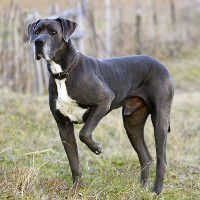 |
| Standard of the Great Dane |
Appearance of the Taylor's Bulldane |
| The Taylor's Bulldane is a large dog that can weigh between 68 and 91 kilos and measure between 63.5 and 76 centimeters in height. Its coat is short, straight, fine and flat, and comes in many different colors and patterns. These include blue, gray, piebald, brindle, sable, red, black, chocolate, liver, merle, spotted, orange, white and lemon. It has a stocky, muscular body with well-toned legs, a broad chest, small ears and a massive head with a black nose and almond-shaped brown eyes. Like the Bulldog, the Taylor's Bulldane has plenty of extra skin that can be wrinkled and requires extra care to reduce the risk of irritation and rashes. |
Temperament of the Taylor's Bulldane |
| Although the Taylor's Bulldane enjoys other dogs and older children, it doesn't get on very well with other types of pets, such as cats, and shouldn't be left alone with young children. They are too big to be safe with younger children unsupervised. They also need to be socialized when young, so they can get on better with other dogs. This breed is certainly friendly, affectionate and calm for the most part, and particularly easy to train. In fact, even novice dog owners should be able to train this type of dog easily. It needs a lot of attention and is sensitive to separation anxiety. |
Needs and activities of the Taylor's Bulldane |
| The Taylor's Bulldane doesn't need a lot of exercise, but it does need a lot of space to run around, so it's not suited to small apartments without a garden. He needs at least half an hour to 45 minutes of vigorous physical activity every day, as well as an hour or more of mental stimulation from you. A large fenced yard is ideal for this breed, so you can let them run around a little every day. Their favorite activities include agility training, obedience training, tracking, fly-ball, playing with other dogs at the dog park and walking around the neighborhood. |
Maintenance of the Taylor's Bulldane |
| The Taylor's Bulldane doesn't need much maintenance, as it has a fine, smooth coat. You should brush your dog's coat three or four times a week with a rubber curry glove or long-haired brush to stimulate circulation and prevent excessive shedding. You can also give your Taylor's Bulldane a bath once a month or when necessary. Use a mild, conditioning shampoo and be sure to dry your dog's skin thoroughly to avoid pyoderma or other skin problems caused by excess skin folds. Trim your dog's toenails if necessary, and clean his teeth once a week to prevent dental disease. |



 English (United Kingdom)

Comments