 |
Swiss Bernese Mt. Dog |
|
He is not recognized by the F.C.I. |
Origin |
Switzerland -> Switzerland | |
Translation |
Francis Vandersteen |
A brief presentation of the Swiss Bernese Mt. Dog |
| The Swiss Bernese Mt. Dog is a hybrid between the Bernese Mountain Dog and the Great Swiss Mountain Dog. The Swiss Bernese Mt. Dog is a delightful blend of its two parent breeds. It is extremely calm, loyal and affectionate. The Swiss Bernese Mt. Dog hybrid is thought to have far fewer health problems and a longer lifespan than its parents. If you're looking for a large, gentle, easy-going dog, you won't be disappointed by the Swiss Bernese Mt. Dog. He focuses his whole life on his human family. His entire existence is devoted to pleasing his beloved masters. Although his size may seem intimidating, he's a lover who enjoys making friends with strangers and other animals. They generally weigh between 54.5 and 63.5 kilos and measure 71 to 73.5 centimeters at the shoulders. |
History of the Swiss Bernese Mt. Dog |
| The Swiss Bernese Mt. Dog shares all the positive characteristics of its parents. The Bernese Mountain Dog and the Great Swiss Mountain Dog are large, loyal, intelligent and affectionate dogs. Both breeds are thought to have originated 2,000 years ago, when Rome invaded what is now Switzerland. Mastiff war dogs bred by the Romans and used in their battles crossed with local Alpine sheepdogs. The result was a robust dog that could easily withstand the adverse climatic conditions of the Swiss mountains. Sadly, both breeds almost became extinct. However, in the 1900s, a number of dog enthusiasts began working to restore the dogs of Switzerland. As the breeds were restored, their popularity spread throughout Europe, and even Americans came to recognize the dogs. They were used as draught dogs, drovers and watchdogs on farms. Both breeds excel at pulling small carts. They also make exceptional family dogs that have always been historically adored by their families. The two breeds are almost identical, but the Bernese Mountain Dog has longer hair and the Great Swiss Mountain Dog tends to be a little more hyperactive. For many years, people thought the dogs were identical, but recent scientific tests have revealed that they are two distinct breeds. The Bernese Mountain Dog was officially recognized by the American Kennel Club in 1937 and classified in the working dog group. In 1985, the Great Swiss Mountain Dog was recognized by the American Kennel Club and placed in the miscellaneous group. |
A little of the Bernese Mountain Dog |
||
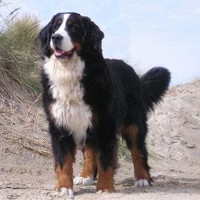
| The Bernese Mountain Dog is a dog of ancestral origin which, in the pre-Alps and in the central countryside of the canton of Berne, was used as a guard, draft and herding dog. It was originally called "Dürrbächler" after the hamlet and inn of Dürrbach near Riggisberg, where this tricolored longhaired cattle dog was especially widespread. As early as 1902, 1904 and 1907, the breed was shown at dog shows. In 1907, a number of breeders in the Burgdorf region decided to promote the pure-bred breeding of this native cattle dog, founding the "Swiss Dürrbächler Club" and laying down the breed's characteristic traits in a first standard. In 1910, at a dog show in Burgdorf, local farmers were able to present 107 animals. From that day on, the Bernese Mountain Dog, renamed "Bouvier Bernois" after other Swiss cattle dog breeds, spread rapidly throughout Switzerland and southern Germany. Today, the Bernese Mountain Dog is known and appreciated the world over for its tricolored coat with well distributed markings and spots, its adaptability and its qualities as a family dog. | ||
 |
||
| Standard of the Bernese Mountain Dog |
A little of the Great Swiss Mountain Dog |
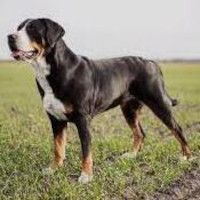
| In 1908, at a dog show in Langenthal commemorating the 25th anniversary of the Swiss Cynological Society (SCS), Prof. A. Heim, a great promoter of Swiss Mountain Dog breeds, was presented with two Bernese Shorthaired Cattle Dogs. He recognized them as survivors of the endangered large butcher's mastiffs or grand bouviers, whose ancestors were once widespread throughout Europe and were used as guard dogs, draught dogs or herdsmen. In 1909, they were recognized as a distinct breed by the Swiss Kennel Club and entered in volume 12 (1909) of the Swiss stud book (LOS). In 1912, the "Club suisse du Great Swiss Mountain Dog" was founded to promote purebred breeding of this dog. It wasn't until February 5, 1939 that the standard was published for the first time by the FCI. Today, this dog is also bred in other European countries, and is especially appreciated as a family dog thanks to its calm, reliable character. |
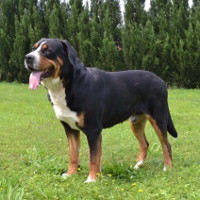 |
| Standard of the Great Swiss Mountain Dog |
Appearance of the Swiss Bernese Mt. Dog |
| The Swiss Bernese Mt. Dog can share the physical characteristics of either of its parents. Some dogs are long-haired, like the Bernese Mountain Dog, while others are short-haired, like the Great Swiss Mountain Dog. Their coats are always soft and silky. They have big, soulful eyes and soft, floppy ears. They can be bicolored or tricolored. As a hybrid, the Swiss Bernese Mt. Dog doesn't have the shedding problem often found in its parents. These dogs can grow quite large, weighing between 54.5 and 63.5 kilos. He measures 71 to 73.5 centimeters at the shoulders. Their whole body is robust, muscular and vigorous. |
Temperament of the Swiss Bernese Mt. Dog |
| The Swiss Bernese Mt. Dog is a loyal companion who loves nothing more than spending time with his family. It is a gentle dog that generally gets along well with other pets. This intelligent dog excels at obedience because he wants to please his master. He loves to go for walks, play ball or simply lie close to his beloved master. He's highly intelligent and a great problem-solver. If you're looking for a large, gentle dog that will make a wonderful member of the family, the Swiss Bernese Mt. Dog is an ideal choice. |
Needs and activities of the Swiss Bernese Mt. Dog |
| The Swiss Bernese Mt. Dog needs daily walks of about 30 minutes or more. It's generally not overly hyperactive and doesn't need much exercise. This dog's gentle nature makes him an ideal choice to take to a dog park, as he generally gets on well with other dogs and pets. He loves to play ball, go swimming or share any other activity with his beloved family. Not suited to apartment living, he'll thrive in a home with a large fenced-in yard where he can roam and explore, enjoying the fresh air and scenery all around. He'll need your company, though, so be sure to take him out for some healthy interaction. |
Maintenance of the Swiss Bernese Mt. Dog |
| Whatever the length of its coat, your Swiss Bernese Mt. Dog will need daily brushing to keep its coat in good condition and remove dead hairs. Twice a year, his undercoat will be removed, at which time he will usually need to be brushed thoroughly. Its long, floppy ears should be cleaned of debris once a week. Many owners choose to brush their dog's teeth to keep them white, prevent bad breath and remove harmful plaque that can lead to gum disease. His nails should generally be trimmed once a month, but if he gets a lot of exercise, he'll often wear out his nails on his own. |



 English (United Kingdom)

Comments