 |
Standard Wire Hair Snauzer |
|
He is not recognized by the F.C.I. |
Origin |
Great Britain <> Germany -> U.S.A. | |
Translation |
Francis Vandersteen |
A brief presentation of the Standard Wire Hair Snauzer |
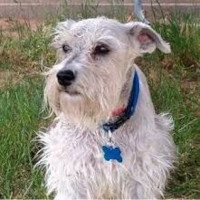
| The Standard Wire Hair Snauzer is a dog by design, the intentional blend of Germany's bearded farm dog, known as the Schnauzer, and an English dog developed to chase foxes from their dens and burrows, the Wire Fox Terrier. The result is a medium-sized, square-shaped dog with a classic silhouette and a prominent double-coated coat with a wiry outer layer. Dark eyes usually reveal the extremely intelligent and inquisitive nature of this hybrid. While these dogs are likely to be pleasant companions if kept busy enough, they can become destructive, manipulative and hyper-vigilant if their energy doesn't find a suitable physical and mental outlet. |
History of the Standard Wire Hair Snauzer |
| The Standard Wire Hair Snauzer is a deliberate cross between the Schnauzer, a German farm dog, and the Wire Fox Terrier, an English hunting dog specialized in fox hunting. |
A little of the Wire Fox Terrier |
||
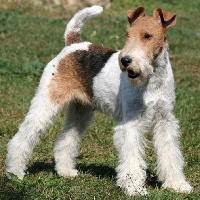
| Although the Wire Fox Terrier has been registered and exhibited alongside the Smooth Fox Terrier for over a century in the USA, most experts now believe that the two have very different origins. While the Smooth Fox Terrier was a mix of several dogs, including the Beagle, Greyhound, Bull Terrier and Smooth Black and Tan Terrier, the Wire Fox Terrier was more directly descended from the now extinct Rough Coated Black and Tan Terriers of Derbyshire, Durham and Wales. In 1866, a dog named Old Tip became the first officially registered Wire Fox Terrier, and most modern Wire Fox Terriers can trace their heritage back to him in one way or another. The Fox Terrier Smooth has often been incorporated into the Wire Fox Terrier heritage, giving it a lighter coat, a more classic silhouette and a cleaner head. | ||
 |
||
| Standard of the Wire Fox Terrier |
A little of the Schnauzer |
| Dogs very similar to the modern Schnauzer have been working on German farms since the Middle Ages, ably providing protection and pest control services at home and on the road. In the mid-1800s, dog lovers began to take notice of these medium-sized, rough-coated dogs and started crossing them with black Poodles and gray Wolfspitzes, improving their rough coat and giving them the characteristic black or salt-and-pepper color we know today. Although they were originally known as Wirehaired Pinschers, they were eventually given the name Schnauzers, from the German word schnauz, meaning nose, in reference to their characteristic large, bearded muzzle. |
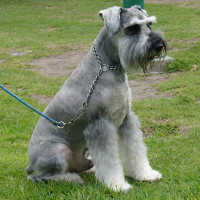 |
| Standard of the Schnauzer |
Appearance of the Standard Wire Hair Snauzer |
| This crossbreed is a medium-sized dog with a square build, robust but not stocky, although those most like the Wire Fox Terrier are a little slimmer than those inspired by the Schnauzer. The Standard Wire Hair Snauzer has a long, rectangular head with a flat top and a long, broad muzzle that is usually adorned with some kind of beard, either the short, distinguished beard of the Wire Fox Terrier or the abundant, stately beard of the Schnauzer, with round or slightly oval dark-brown eyes and V-shaped or triangular ears that break and fold forward either halfway to the ear or level with the skull. Some dogs may hold their ears erect or partially erect when standing at attention. This dog will have a thick, strong tail that is held straight in relation to the body or slightly curled over the back, although many Wire Fox Terrier and Schnauzer breeders still choose to have their dogs' tails docked at an early age in countries where this practice has not yet been banned. |
Temperament of the Standard Wire Hair Snauzer |
| Both parent breeds are lively and can be rather quarrelsome with other dogs, especially those of the same sex. The Wire Fox Terrier has a rather peppery personality, but the Schnauzer, although sometimes aloof, also has a typically reliable and discriminating behavior that can moderate the impulsive behavior of the Standard Wire Hair Snauzer, especially if the dog is properly socialized. Both breeds are highly intelligent and mentally agile, with impressive problem-solving abilities, but the Standard Wire Hair Snauzer's trainability can vary somewhat from dog to dog. Many Schnauzers are extremely eager to please their owners and exceptionally easy to train, but some can be a little stubborn and most have a tendency to be mischievous. Wire Fox Terriers bring to this hybrid the tenacity of the Terrier as well as an intense hunger for prey. It's important to keep the Standard Wire Hair Snauzer's mind occupied with toys and activities, as it will find its own toys and activities, which you may not like. The urge to chase cats and other animals can be unbearable for this crossbreed, but it will be more likely to get along with them if it is raised in the same home. |
Needs and activities of the Standard Wire Hair Snauzer |
| The Standard Wire Hair Snauzer is likely to have lots of energy and curiosity. Fortunately, he needs only a moderate amount of vigorous exercise to stay happy and healthy, and is generally content with an hour of vigorous activity a day, preferably divided into several short sessions throughout the day. He'll certainly appreciate long walks, short jogs and endless games of dodgeball, but he may also enjoy more mentally demanding exercises, such as agility training, free dance routines, tracking exercises and rally competitions. Although this dog can make an excellent housemate, even in small spaces like apartments, it's best to give it extra exercise, both mental and physical. |
Maintenance of the Standard Wire Hair Snauzer |
| The Standard Wire Hair Snauzer has a distinctive two-layer coat, with a short, soft undercoat protected by a rough or coarse outer layer that needs to be stripped at least twice a year. Hair removal can be carried out by hand or with a depilatory knife, and many groomers offer this service to owners who don't have the time, knowledge or ability to perform the operation themselves. Standard Wire Hair Snauzers with more Schnauzer-like coats generally require more grooming time and effort than those with Wire Fox Terrier coats, and may require professional grooming and clipping every five to eight weeks. Brushing for this thick coat is necessary several times a week, and daily grooming around the face and feet will help prevent tangles, remove food particles and remove road debris. Those whose coats are more representative of Wire Fox Terriers have less intensive grooming needs; their shorter, softer coats still need brushing to prevent tangles and matting, but weekly or twice-weekly sessions are usually sufficient, and shearing this type of coat can change not only the texture of the new growth, but also its color. |



 English (United Kingdom)

Comments