
 |
Silkese |
|
He is not recognized by the F.C.I. |
Origin |
Australia <> Central Mediterranean Basin -> U.S.A. | |
Translation |
Francis Vandersteen |
A brief presentation of the Silkese |
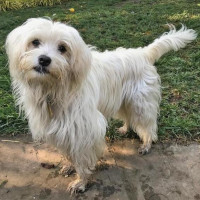
| The Silkese is a toy-sized hybrid of an Australian Silky Terrier and a Maltese. The Silkese has a long, silky coat that comes in a variety of colors such as black, brown, white, gold and a combination of these. It generally measures 20.5 to 25.5 centimeters and weighs up to 6.5 kilos. They are excellent family dogs that get on well with children, as they are playful, affectionate and active. As a small dog, he doesn't need much physical activity; daily play will keep him happy. |
History of the Silkese |
| The Silkese is a designer dog resulting from the breeding of an Australian Silky Terrier with a Maltese. Little is known about the origins of this designer dog. |
A little of the Australian Silky Terrier |
||
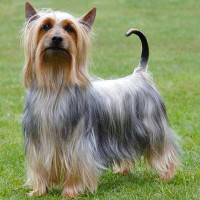
| The origins of the Australian Silky Terrier date back to 1890 in Australia. The breed is the result of crossing Australian Terriers with imported Yorkshire Terriers. In 1906, in Sydney, New South Wales, a breed standard was established. And in 1909, another standard was drawn up in Victoria. These standards had many differences, until in 1926, a newly negotiated breed standard was established. These dogs were initially called Sydney Silky Terriers, then in 1955 Australian Silky Terriers, which remains the official name in Australia. In the United States, the breed name was changed to Silky Terrier. The breed was recognized by the American Kennel Club in 1959. | ||
 |
||
| Standard of the Australian Silky Terrier |
A little of the Maltese |
| The Maltese is one of the oldest toy breeds. Its history goes back more than two millennia. Although their history is ancient, little is known about the breed's origins. There are several theories on the origin of this dog. Some think they come from Malta, others from Italy, and another theory is that they originated in Asia. In the early Egyptian, Roman and Greek cultures, these dogs were represented by artists, writers and poets. Even Aristotle mentioned these dogs. We know that the Greeks built tombs for their Maltese and that the Egyptians depicted similar dogs on artifacts, indicating an appreciation of dogs. Among the Egyptians, and later Europeans, the Maltese was believed to be able to heal people, so a Maltese was placed on the pillow of sick people. These dogs were then called "the comforter". In the 15th century, this breed was the favorite of French aristocrats. The breed arrived in Great Britain during the reign of Henry VIII and, by the end of the 16th century, had become the preferred dog of royal and noble ladies. The breed was a favorite of Queen Elizabeth, Mary, Queen of Scots and Queen Victoria. These dogs were often depicted in paintings of beautiful ladies by artists such as Goya and Sir Joshua Reynolds. Later, in the 17th and 18th centuries, breeders almost put an end to the Maltese breed by trying to breed them as small as a squirrel. To recover the breed, they had to mix them with Miniature Spaniels, Poodles and East Asian Miniature Dogs. As a result, several new breeds were created. The Maltese we see today was developed by English breeders. In the United States, the Maltese became well known in the late 1800s. The Maltese was recognized by the American Kennel Club in 1888. |
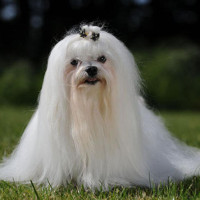 |
| Standard of the Maltese |
Appearance of the Silkese |
| The Silkese is a teddy-bear-like toy dog with long, silky, straight fur. It comes in a variety of colors, including brown, gold, cream, black, gray and a mix of all of these. It generally measures 20.5 to 25.5 centimeters and weighs up to 6.5 kilos. It has small, dark-rimmed eyes; its ears are furry and may be floppy or sometimes pointed. Its head is slightly rounded, with a flat muzzle ending in a rounded black nose. Despite its small size, it has a robust complexion, square shoulders and a beautiful curly tail. Their gait is full of drive and determination. |
Temperament of the Silkese |
| These little dogs are cheerful and affectionate. Silkese love to learn new things and are obedient, making them easy to train. It's important to train them well, as they can become bossy and wary of other people and animals. They are excellent family dogs and get on very well with children and the elderly, provided there is regular interaction. They love to spend time with their family and have fun playing. These dogs are very curious, love to dig and tend to bark at other animals and strangers. It's highly likely that they inherit the prey-hunting instincts of the Australian Silky Terrier. |
Needs and activities of the Silkese |
| The Silkese is a toy hybrid and, because of its small size, doesn't need long walks or vigorous physical activity. They do well indoors and in small apartments. Nevertheless, these small dogs are active and playful, so playtime and short walks a few times a day will keep them healthy and at their best. A short walk, not too fast, will do just fine; 45 minutes of daily exercise will suffice. These dogs also enjoy being outdoors and digging, so taking them to a park or yard will keep them entertained and happy. It's important not to expose these dogs to extremely cold or hot temperatures, as they are sensitive to temperature extremes. |
Maintenance of the Silkese |
| The Silkese requires a significant amount of grooming due to its long, delicate coat. These dogs tangle and tangle easily, and it's very important to remove them as soon as they occur to avoid skin irritation and traction problems. Daily grooming helps to avoid these knots and tangles, and to remove dead and loose hair. Occasional trimming is necessary to keep the coat healthy and beautiful. They tend to get dirty easily, sometimes requiring frequent or even weekly baths. It's important to try to remove knots and tangles with your fingers, and to brush your hybrid before bathing. If you don't, knots can become even more difficult to remove. It's a good idea to check the ears every week - wipe them clean with a cloth, making sure all moisture is removed. If the ears smell bad, they should be examined by a vet. Nails should be trimmed once or twice a month and teeth brushed daily. |



 English (United Kingdom)

Comments