
 |
Nova Scotia Duck Tolling Retriever |
|
FCI standard Nº 312 |
||
Origin |
Canada | |
Group |
Group 8 Retrievers-Flushing Dogs- Water Dogs | |
Section |
Section 1 Retrievers | |
Working |
With working trial | |
Acceptance on a definitive basis by the FCI |
Monday 30 November 1981 | |
Publication of the official valid standard |
Wednesday 24 June 1987 | |
Last update |
Friday 05 February 1999 | |
En français, cette race se dit |
 |
Retriever de la Nouvelle-Ecosse |
Diese Norm ist in deutscher Sprache sichtbar |
 |
Nova Scotia Retriever |
En español, esta raza se dice |
 |
Perro cobrador de Nueva Escocia |
In het Nederlands, wordt dit ras gezegd |
 |
Nova Scotia Duck Tolling Retriever |
Usage |
| The Tolling dog runs, jumps and plays along the shoreline in full view of a flock of ducks, occasionally disappearing from sight and then quickly reappearing, aided by the hidden hunter, who throws small sticks or a ball for the dog. The dog’s playful actions arouse the curiosity of the ducks swimming offshore and they are lured within gunshot range. The Toller is subsequently sent out to retrieve the dead or wounded birds. |
Brief historical summary |
| The Nova Scotia Duck Tolling Retriever was developed in Nova Scotia in the early 19th century to toll (or lure) and retrieve waterfowl. |
General appearance |
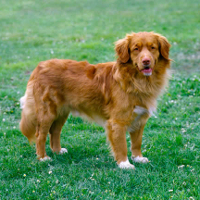
| The Toller is a medium-sized, powerful, compact, balanced, well-muscled dog; medium to heavy in bone, with a high degree of agility, alertness and determination. Many Tollers have a slightly sad expression until they go to work, when their aspect changes to intense concentration and excitement. At work, the dog has a speedy, rushing action, with the head carried out almost level with the back and heavily-feathered tail in constant motion. |
Behaviour / temperament |
| The Toller is highly intelligent, easy to train and has great endurance. A strong and able swimmer, he is a natural and tenacious retriever on land and from water setting himself for springy action the moment the slightest indication is given that retrieving is required. His strong retrieving desire and playfulness are qualities essential to his tolling ability. |
Head |
||
Cranial region |
||
Head |
Clean-cut and slightly wedge-shaped. | |
Skull |
The broad skull is ontly slightly rounded, the occiput not prominent and the cheeks flat. A good measurement for an average male would be 5½ ins. (14 cm) between the ears, tapering to 1½ ins. (3.8 cm) at the bridge of the nose. Length of head is approximately 9 ins. (23 cm) from nose to occiput, but the head must be in proportion to body size. | |
Stop |
Moderate. | |
Facial region |
||
Nose |
Tapers from bridge to tip, with nostrils well open. Colour should blend with that of the coat or be black. | |
Muzzle |
Tapers in a clean line from stop to nose, with the lower jaw strong but not prominent. The underline of the muzzle runs almost in a straight line from the corner of the lip to the corner of the jaw-bone, with depth at the stop being greater than at the nose. Hair on the muzzle is short and fine. | |
Lips |
Fit fairly tightly, forming a gentle curve in profile, with no heaviness in flews. | |
Jaws and teeth |
Strong enough to carry a sizeable bird, and softness in mouth is essential. The correct bite is tight scissors; full dentition is required. | |
Eyes |
Set well apart, almond-shaped, medium sized. Colour amber to brown. Expression is friendly, alert and intelligent. Flesh around the eyes should be the same colour as the lips. | |
Ears |
Triangular, of medium size, set high and well back on the skull, with the base held very slightly erect, well feathered at the back of the fold, hair short at the rounded tips. | |
Neck |
| Strongly muscled and well set on, of medium length, with no indication of throatiness. |
Body |
||
Topline |
Level. | |
Back |
Short and straight. | |
Loin |
Strong and muscular. | |
Chest |
Deep, brisket reaching to the elbows. Ribs well sprung, neither barrel-shaped nor flat. | |
Underline and belly |
Tuck-up moderate. | |
Tail |
| Following the natural very slight slope of the croup, broad at the base, luxuriant and heavily feathered, with the last vertebra reaching at least to the hock. The tail may be carried below the level of the back except when the dog is alert when it curves high over, though never touching the body. |
Limbs |
Forequarters |
||
Generality |
Should appear as parallel columns; straight and strong in bone. | |
Shoulders |
Shoulders should be muscular, with the blade well laid back and well laid, on giving good withers sloping into the short back. The blade and upper arm are roughly equal in length. | |
Elbows |
Should be close to the body, turning neither in nor out, working cleanly and evenly. | |
Pastern |
Strong and slightly sloping. | |
Hindquarters |
||
Generality |
Muscular, broad and square in appearance. Rear and front angulation should be in balance. Upper and lower sections being approximately equal in length. | |
Upper thigh |
Very muscular. | |
Stifle |
Well bent. | |
Hock |
Well let down, turning neither in nor out. Dewclaws must not be present. | |
Feet |
| Strongly webbed of medium size, tight and round, with well arched toes and thick pads. Dewclaws may be removed. |
Gait and movement |
| The Toller combines an impression of power with a springy, jaunty gait, showing good reach in front and a strong driving rear. Feet should turn neither in nor out and the legs travel in a straight line. As speed increases, the dog should single-track, with the topline remaining level. |
Coat |
||
Hair |
The Toller was bred to retrieve from icy waters and must have a water-repellent double coat of medium length and softness with a softer, dense undercoat. The coat may have a slight wave on the back, but is otherwise straight. Some winter coats may form a long, loose curl at the throat. Featherings are soft at the throat, behind the ears and at the back of the thighs, and forelegs are moderately feathered. | |
Colour |
Colour is various shades of red or orange with lighter featherings and underside of tail, and usually at least one of the following white markings : tip of tail, feet (not extending beyond the pasterns), chest and blaze. A dog of otherwise high quality is not to be penalized for lack of white. The pigment of the nose, lips, and eye rims to be flesh-coloured, blending with coat, or black. | |
Size and weight |
||
Height at withers |
Ideal height for males over 18 months is 19-20 ins. (48-51 cm); females over 18 months 18-19 ins. (45-48 cm). One inch (2,5 cm) over or under ideal height is allowed. | |
Weight |
Should be in proportion to the height and bone of the dog - Guidelines : 45-51 lbs. (20-23 kg) for adult males; bitches 37-43 lbs. (17-20 kg). | |
Faults |
| • Any departure from the foregoing points should be considered a fault and the seriousness with which the fault should be regarded should be in exact proportion to its degree and its effect upon the health and welfare of the dog and its ability to perform its traditional work. • Faults listed should be in degree of seriousness. |
General faults |
 Dish- or down-faced. Abrupt stop. Bright pink nose. Nose, eye rims and eyes not of prescribed colour. Overshot bite. Large, round eyes. Roached, sway back. Slack loins. Tail carried below level of back when dog gaiting. Tail too short, kinked or curled touching the back. Down on pastern. Splayed or paper feet. Open coat (not tight enough, loose). Lack of substance in adult dog. Dogs more than 1 inch (2,5 cm) over or under the ideal height. Dish- or down-faced. Abrupt stop. Bright pink nose. Nose, eye rims and eyes not of prescribed colour. Overshot bite. Large, round eyes. Roached, sway back. Slack loins. Tail carried below level of back when dog gaiting. Tail too short, kinked or curled touching the back. Down on pastern. Splayed or paper feet. Open coat (not tight enough, loose). Lack of substance in adult dog. Dogs more than 1 inch (2,5 cm) over or under the ideal height. |
Disqualifying faults |
| Aggressive or overly shy dogs. Butterfly nose. Overshot of more than 1/8 inch (3 mm). Undershot bite, wry mouth. Lack of webbing. White on shoulders, around ears, on back of neck, across back or flanks. Silvery coat, grey in coat, black areas in coat. Any colour other than red or orange shades. |
NB : |
| • Any dog clearly showing physical or behavioural abnormalities shall be disqualified. • The above mentioned faults when occurring to a highly marked degree or frequently are disqualifying. • Male animals should have two apparently normal testicles fully descended into the scrotum. • Only functionally and clinically healthy dogs, with breed typical conformation should be used for breeding. |
Bibliography |
| https://www.fci.be/ |



 English (United Kingdom)

Comments